India EU FTA 2026: Status, Tariffs and What Changes for EU Companies
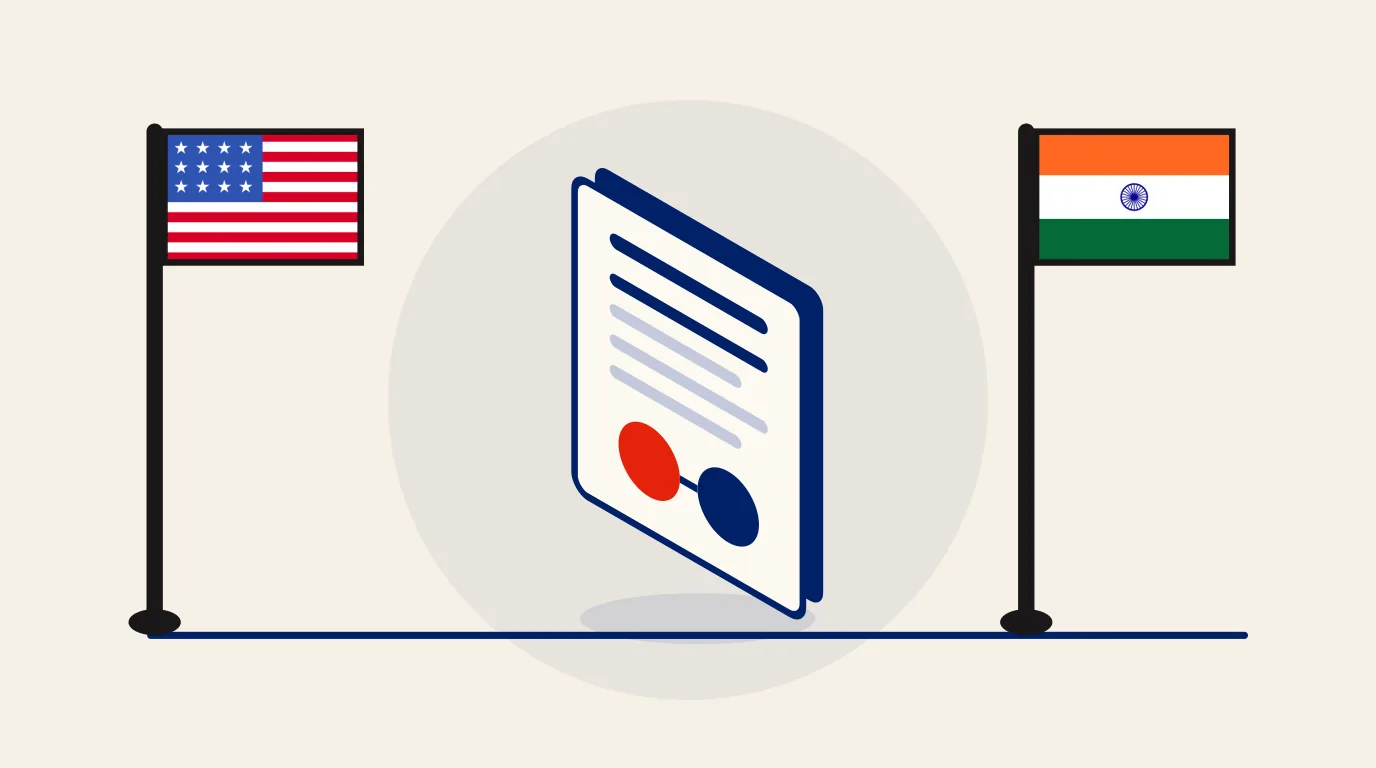
The India EU FTA was concluded on 27 Jan 2026 but is not yet signed or in force. Tariff cuts by sector, the origin rules, services and what it does not change for an EU parent.
Krystal7 Consultants · India entry, tax and compliance
Written by CA Nandini Hasija, Krystal7 Consultants. Last updated 23 October 2026.
India and the European Union concluded their Free Trade Agreement on 27 Jan 2026 at the 16th EU India Summit in New Delhi. On 23 Oct 2026 it is not yet signed or in force. Once in force, India removes or cuts duty on 96.6 percent of EU goods exports, often over 5 to 10 years. Importers claim the lower rate with a Statement on Origin under Chapter 3 and CAROTAR 2020. FDI rules and tax treaties do not change.
This page is for EU groups that own an Indian subsidiary, and for the Indian finance teams that run them. It covers the status, the tariff schedules by sector, the origin rules, services and investment, and what stays the same.
What is the India EU FTA and is it in force?
The India EU FTA is a goods, services and rules agreement between India and the 27 EU member states. Leaders announced its conclusion on 27 Jan 2026. On 23 Oct 2026 it is concluded but not signed, not ratified and not in force. Indian customs still charges standard (MFN) duty on EU goods.
The European Commission and the Government of India announced the deal together. See Commission press release IP/26/227 and PIB release 2219065. Negotiations restarted in 2022 after a break, according to the PIB release.
"Concluded" means the negotiators agreed the text. It does not bind anyone yet. The published chapters say the texts are for information only and may change during legal revision (Commission texts page). The text becomes final on signature. It binds the parties only after each completes its internal procedures.
Several reports in January 2026 called the deal "signed". In law the deal was only concluded on that date.
The agreement has 20 chapters. The trade chapters cover goods, rules of origin, customs, SPS and TBT measures, trade remedies, services and digital trade. The rules chapters cover intellectual property, competition and subsidies, SMEs, transparency and good regulatory practice. The rest deal with food systems, sustainable development, disputes, institutions, exceptions and final provisions. There is no investment protection chapter and no government procurement chapter.
Trade at stake is large. EU exports to India were EUR 75 billion in 2024, according to the Commission factsheet on main benefits. Goods made up EUR 48.8 billion and services EUR 26 billion. In 2024-25 Indian goods exports to the EU were USD 75.85 billion. Imports from the EU were USD 60.68 billion (PIB FAQ, 29 Jan 2026).
When will the India EU FTA enter into force?
The FTA enters into force on the first day of the second month after both sides confirm their internal legal procedures are complete. The parties may agree another date (PIB FAQ Q58). The Commission expects entry into force in the first half of 2027.
Legal revision of the text and translation into all EU languages.
A Council decision authorising signature, then signature.
Consent of the European Parliament.
A Council decision concluding the agreement.
The Commission treats the whole FTA as falling within exclusive EU competence under Opinion 2/15 of the Court of Justice. The legal bases are Articles 207, 91 and 100(2) TFEU. See COM(2026) 483, Council document 13066/26. The memorandum does not say in terms that national parliaments will not ratify. Our reading is that an EU only agreement does not need 27 national ratifications.
India runs its own approval process in parallel. On the Indian side, the date that matters for an importer is the date CBIC notifies the tariff concession and the origin rules. Until then, a bill of entry cannot claim the rate.
The same pattern played out for the UK deal. India signed the UK CETA on 24 Jul 2025. It entered into force on 15 Jul 2026 (PIB release 2285085). That gap was about one year. Plan your 2027 budgets on today's duty and treat the FTA as upside.
Which EU goods get lower Indian tariffs?
India removes or cuts duty on 96.6 percent of EU goods exports, according to the Commission. Many cuts phase in over 5, 7 or 10 years rather than on day one. Cars get a quota, not open access. Wine, spirits and beer fall to a floor, not to zero.
India's average duty on EU industrial goods is above 16 percent (Commission chapter summary). The table shows the Commission's sector figures. Check the line in India's tariff schedule (Appendix 2-A2) before you price a product.
Sector (EU exports to India in 2024, EUR)
Current Indian duty, up to (%)
Duty after the FTA (%)
Staging (years)
Machinery and electrical equipment (EUR 16.3 bn)
44%
0% for almost all products
Up to 10 years, mostly 5 to 7
Aircraft and spacecraft (EUR 6.4 bn)
11%
0% for almost all products
Up to 10 years, mostly 5
Optical, medical and surgical equipment (EUR 3.4 bn)
27.5%
0% for 90% of products
Up to 10 years, mostly at entry, 5 or 7
Chemicals (EUR 3.2 bn)
22%
0% for almost all products
Mostly at entry into force
Plastics (EUR 2.2 bn)
16.5%
0% for almost all products
Mostly 7 years
Iron and steel (EUR 1.5 bn)
22%
0% for almost all products
Mostly at entry, 5 or 7 years
Pharmaceuticals (EUR 1.1 bn)
11%
0% for almost all products
Mostly 5 or 7 years
Motor vehicles (EUR 1.6 bn)
110%
10% within a quota of 250,000 vehicles a year
Gradual
Car parts
Not stated
Most duties removed
5 to 10 years
Wine
150%
20% premium, 30% medium range
Gradual
Spirits
150%
40%
Gradual
Beer
110%
50%
Gradual
Olive oil
45%
0%
At entry or after 5 years
Processed food (bread, pasta, chocolate, pet food)
33% to 50%
0%
At entry or staged
Sources: Commission factsheet on main benefits, chapter by chapter memo and Q&A of 27 Jan 2026. The Commission's documents quote different current rates for some farm goods. Processed food is 33 percent in the chapter summary and up to 50 percent in the Q&A. Olive oil is up to 45 percent in the chapter summary and 40 percent in the factsheet.
The Commission says EU exporters save up to EUR 4 billion a year in duty once cuts are complete. For cars, the Commission gives only the end point. Duty falls gradually from 110 percent to 10 percent, within a quota of 250,000 vehicles a year. The Commission does not say whether the full quota applies from the first year. India's tariff schedule, Appendix 2-A2, sets the yearly quota volumes and in quota rates. It is on the Commission texts page. Read that schedule before you price an imported car.
India counts its own offer differently. The PIB FAQ (Q3) says 49.6 percent of lines (30.6 percent of trade value) become duty free at entry into force. Another 39.5 percent of lines (63.1 percent of value) phase out over 5, 7 or 10 years. Overall, India covers 92.1 percent of lines and 97.5 percent of EU trade value. The Commission says tariffs on 96.6 percent of EU goods exports will be eliminated or reduced. The two sides use different bases and publish no reconciliation, so always quote the source with the number.
India keeps sensitive products out. These include beef, poultry, dairy, fish and seafood, cereals (especially rice and wheat), fruit and vegetables, nuts, edible oils, tea, coffee, spices and tobacco (PIB FAQ Q4).
What does the EU offer on goods made in India?
The EU removes duty on about 70.4 percent of tariff lines at entry into force, covering about 90.7 percent of India's export value. It phases out another 20.3 percent of lines. Overall, the EU covers about 97 percent of lines and over 99 percent of trade value (PIB FAQ Q2).
This matters if your Indian subsidiary exports to the EU parent or to EU customers. Labour intensive sectors gain most. Textiles, apparel, leather, footwear, marine products, gems and jewellery, handicrafts and engineering goods see duties of up to 10 percent go to zero at entry into force. PIB puts these exports at almost USD 33 billion.
The EU keeps its own sensitive lines. It gives no concession on meat and offal, dairy, honey, rice, sugar and tobacco (PIB FAQ Q5). The Commission also lists ethanol, soft wheat, poultry, milk powders and bananas. Steel moves through tariff rate quotas in Annex 2-B.
The FTA has a bilateral safeguard. India may raise duty back to the MFN rate if a surge of EU imports causes serious injury. A measure lasts two years, extendable to four (PIB FAQ Q27 to Q29).
How do the rules of origin work under the India EU FTA?
Only products wholly obtained or sufficiently processed in India or the EU get the lower duty. The exporter or producer proves this with a Statement on Origin, valid for 12 months. The Indian importer must hold it when claiming the rate and must enter its details in the bill of entry (Articles 3.17 and 3.19).
The rules sit in Chapter 3 and its annexes (Chapter 3 text on commerce.gov.in). Product specific rules are in Annex 3-B. They use change in tariff classification, a cap on non originating materials, and specific processes. Steel follows a melt and pour rule. Automotive products need high value addition (PIB FAQ Q20).
Point
Rule in Chapter 3
Article
Originating product
Wholly obtained, or meets the product specific rule in the annex
3.2
Tolerance
5% or 10% by weight for Chapters 1 to 24; 10% of ex works price or FOB value for other goods outside the textile chapters
3.4
Cumulation
Bilateral: EU inputs count as originating in India, and the reverse
3.6
Proof
Statement on Origin by exporter or producer, with an invoice or other commercial document
3.17, 3.19
Validity
12 months from completion
3.19(4)
Importer's knowledge
Allowed for claims into the EU; not for claims into India
3.17, 3.23
Late claim and refund
Within one year of importation, or longer if domestic law allows
3.18(2)
Records
Importer at least 3 years; exporter or producer at least 5 years
3.24
Verification
Importer replies in 10 working days, with possible extra time; exporting authority replies within 7 months
3.26(2), 3.27(6)
Transport
Goods must meet the transport rule; failure is a ground for denial
3.15, 3.28
Goods in transit at entry into force
Claim within 12 months of entry into force
3.35
Customs may deny the preference where the exporter has no valid unique identification number under the exporting party's rules (Article 3.28(1)(b)). Each side must have an authentication system before entry into force. If it does not, a certificate of origin signed by a competent authority applies instead (Article 3.17(6); PIB FAQ Q26).
Indian exporters will register and self certify through DGFT's Common Digital Platform for certificates of origin (PIB FAQ Q25). If your Indian subsidiary exports to the EU, it will make out the statement there.
How does an Indian importer claim the EU preference at customs?
The importer claims at the time of import in the bill of entry. It declares that the goods originate in the EU, quotes the tariff notification serial, and enters the Statement on Origin details. Section 28DA of the Customs Act, 1962 and CAROTAR 2020 then apply, as they do to every Indian FTA.
CAROTAR adds duties on top of the FTA text. The importer must hold the origin information in Form I and keep supporting documents for at least five years from the bill of entry (rule 4). Customs may ask for information and the importer has 10 working days to reply (rule 5). These rules are summarised in a CBIC training deck on CAROTAR.
Where the FTA and CAROTAR differ, the FTA rule prevails (CAROTAR rule 8(3)). The five year record rule still works alongside the FTA's three year minimum, because three years is a floor. We advise EU groups to keep origin files for five years in India.
A Statement on Origin alone does not end the importer's duty. Section 28DA(2) says producing an origin document does not absolve the importer of reasonable care. Ask the EU parent for a cost sheet and bill of materials before the first claim. Our guide to rules of origin and CAROTAR walks through Form I and each verification step.
What does the services chapter cover?
The EU commits in about 144 services subsectors for India and India commits in about 102 for the EU (PIB FAQ Q7). India's offer includes maritime transport, financial, telecom and environmental services. The EU offer includes IT and ITeS, professional services, other business services and education.
The mobility rules matter most for groups that move staff. The EU durations below come from PIB FAQ Q9.
Category (EU commitment)
Maximum stay
Notes
Business visitors
90 days in any 6 months
No local employment
Short term business visitors
90 days in any 6 months
No local employment
Intra corporate transferee, manager or specialist
3 years, extendable by 2
Subject to domestic law
Intra corporate transferee, trainee
1 year, extendable by 2
Subject to domestic law
Contractual service supplier
12 months cumulative
37 sectors
Independent professional
12 months cumulative
17 sectors
Family of intra corporate transferees
Entry and work rights
Dependants and family members
India's financial services offer binds 100 percent FDI in insurance and 74 percent in banking. EU banks get 15 branch licences over four years (PIB FAQ Q10). The Commission adds that India took clear commitments on senior management and boards of directors.
The services MFN clause runs for five years from entry into force. Its continuation depends on a review of Indian students' entry and work rights and of social security arrangements (PIB FAQ Q13). There is also a five year framework for talks on social security agreements, according to PIB release 2219065.
The digital trade chapter includes rules on the protection of software source code (Commission chapter summary).
Does the India EU FTA include investment protection?
No. The FTA has no investment protection chapter and no investor state dispute settlement. A separate Investment Protection Agreement and a Geographical Indications Agreement have been under negotiation since 17 Jun 2022. Neither had concluded on 23 Oct 2026 (Commission EU India agreements page).
The FTA also gives no rights to private persons. PIB FAQ Q65 says it "does not confer direct rights or impose obligations on private persons". A company cannot sue India or the EU under the FTA. Only the two parties can use the dispute settlement chapter.
What the FTA does cover is capital movement linked to liberalised trade and services. The Commission's memorandum describes this, and keeps each side's laws on matters such as bankruptcy and securities (COM(2026) 483).
For an EU parent, the protection of an Indian investment still rests on Indian law and the courts. Structure your shareholding, board and intercompany contracts on that basis.
What changes for an EU parent with an Indian subsidiary?
Three things change once the FTA is in force. Imports from the EU parent pay less basic customs duty if the origin proof is in order. Exports from India to the EU become duty free for most lines. Staff moves between the group's EU and Indian entities get clearer rules.
Area
Change once in force
What to do
Imports from the EU parent
Lower basic customs duty on qualifying goods, phased by line
Map each HSN code to Appendix 2-A2 and its staging year
Origin evidence
Statement on Origin from the EU exporter, valid 12 months
Agree a template and a cost data pack with the parent
Exports to the EU
Duty free entry on most lines
Register on DGFT's platform and build the origin file
Landed cost and pricing
Duty saving shifts margins between parent and subsidiary
Revisit transfer prices and distributor margins
Staff mobility
Intra corporate transfer up to 3 years, plus 2
Plan secondments around the EU commitments and Indian PE risk
Financial services
Bound FDI levels and 15 bank branches
Relevant only to banks and insurers
Car imports
10% duty only within the 250,000 quota
Check quota use before pricing
The duty saving affects transfer pricing. A distributor that pays less customs duty earns a higher margin unless the transfer price moves. Review the benchmark and the intercompany agreement in the year the cut takes effect. Our page on transfer pricing documentation covers the file.
Staff secondments create a separate risk. An EU employee working in India for the parent can create a permanent establishment in India. The FTA does not change that test. See our note on permanent establishment risk.
The FTA leaves Indian FDI rules, the tax treaties with EU member states, GST, transfer pricing law and the Companies Act as they are. Where the FTA and a tax treaty conflict, the tax treaty prevails (PIB FAQ Q66). Most day to day compliance for an EU owned subsidiary stays the same.
Area
Position after the FTA
Instrument that still governs
FDI entry route and sector caps
Unchanged
FEMA (Non Debt Instruments) Rules, 2019 and the consolidated FDI policy
Land border beneficial ownership
Unchanged
Press Note 3 (2020) and the Cabinet decision of 10 Mar 2026
Share issue reporting
Unchanged
Form FC-GPR within 30 days of allotment (FEMA 395/2019-RB)
Dividend and royalty withholding
Unchanged
Income Tax Act, 2025 and the DTAA with the parent's state
GST on imports
IGST still payable on the full value
IGST under the Customs Tariff Act, 1975
Customs valuation of related party imports
Unchanged
Customs Valuation Rules, 2007
Transfer pricing
Unchanged
Sections 161 to 173 of the Income Tax Act, 2025
Resident director
Unchanged
Section 149(3) of the Companies Act, 2013
FDI rules stay where they are. Most sectors remain on the automatic route, and caps still apply sector by sector. See our page on FDI automatic route sectors. An EU company with a Chinese or Hong Kong beneficial owner still meets the land border rules. The Cabinet release of 10 Mar 2026 keeps non controlling beneficial ownership up to 10 percent on the automatic route.
Tax treaties stay where they are. A German parent still applies the India Germany DTAA to dividends and royalties. The Netherlands and France MFN positions still follow the Supreme Court in Nestle SA (19 Oct 2023). The India France protocol, signed in New Delhi on 18 Feb 2026 and announced by PIB on 23 Feb 2026, is not yet in force. See our MFN clause note.
GST stays where it is. The FTA cuts basic customs duty only. IGST on imports still applies, and the Social Welfare Surcharge follows basic duty because it is calculated on it.
Our reading on directors is that the services commitments on boards do not remove the resident director rule. One director must still stay in India for at least 182 days in a financial year.
How does the FTA deal with CBAM and sustainability?
The FTA does not exempt Indian exporters from the EU Carbon Border Adjustment Mechanism. It gives India a forward looking MFN assurance: if the EU grants CBAM flexibilities to another country, India gets them too. It also provides for technical cooperation on carbon prices and verifiers (PIB release 2219065).
The carbon border measures annex is Annex 14-A, attached to the good regulatory practice chapter. If your Indian subsidiary exports steel, aluminium or fertilisers to the EU, CBAM reporting still applies to the EU importer.
The trade and sustainable development chapter commits both sides to the ILO core principles and to environmental agreements they have ratified, including the Paris Agreement. PIB says this chapter is cooperative and not subject to dispute settlement (PIB FAQ Q42 to Q49). The Commission describes the commitments as legally binding and enforceable through a dedicated consultation mechanism (Commission chapter summary).
How does the India EU FTA compare with India's UK and EFTA deals?
The EU deal is the largest, but it is the only one of the three not yet in force. The EFTA agreement has applied since 1 Oct 2025 and the UK agreement since 15 Jul 2026. EU groups with Swiss or UK entities may already have a working preference route.
Agreement
Signed
In force
Investment feature
Origin proof
India EU FTA
Not yet (concluded 27 Jan 2026)
Not yet
No investment chapter; separate talks since 2022
Statement on Origin by exporter
India EFTA TEPA
10 Mar 2024
1 Oct 2025
USD 100 billion FDI objective over 15 years
Approved exporter declaration, EUR.1 or Indian certificate
India UK CETA
24 Jul 2025
15 Jul 2026
No investment target
Origin declaration by the UK exporter or producer, valid 12 months; the exporter must first register with HMRC
Sources: Commission texts page; PIB releases 2236134, 2274280 and 2285085; Ministry of Commerce FTA highlights (March 2026). The UK row follows rule 16 of the CETA origin rules in Notification 62/2026-Customs (N.T.) of 3 Jul 2026. The HMRC registration point is from the UK Business Growth Service page on India.
Do you have a Swiss production site? Test whether Swiss origin goods already qualify under the India EFTA TEPA. Groups with UK operations should read our UK India FTA guide. EU origin and EFTA origin do not cumulate under these agreements. Each set of origin rules counts only its own parties.
What changed in 2026
Date
Before
After
Instrument or source
27 Jan 2026
Negotiations under way since the 2022 relaunch
Negotiations concluded at the 16th EU India Summit
Commission IP/26/227; PIB 2219065
29 Jan 2026
No official Indian explainer
Government of India FAQ sets out tariff, origin and services terms
PIB 2220413
Feb 2026
Texts confidential
20 chapters and annexes published for information
Commission texts page; commerce.gov.in
15 Jul 2026
UK CETA signed but not applied
UK CETA in force, a benchmark for the EU timeline
PIB 2274280 and 2285085
11 Sep 2026
No formal EU signature step
Commission proposes Council decisions on signature and conclusion
COM(2026) 483 (Council document 13066/26) and a parallel proposal on conclusion; IP/26/1842
What has happened since
This page first went up on 29 Jan 2026, two days after the conclusion. These events came after that date.
In February 2026 the Commission and the Ministry of Commerce published the negotiated chapters and annexes for information. The Commission lists 20 chapters, the tariff schedules and the steel quotas.
On 11 Sep 2026 the Commission sent the Council its proposals for signature and conclusion. See Commission press release IP/26/1842. The signature proposal is COM(2026) 483, procedure 2026/0278/NLE. A separate proposal covers conclusion. After signature, the European Parliament must consent before conclusion and entry into force.
The financial statement in COM(2026) 483 expects entry into force in the first half of 2027. Its revenue estimate uses May 2027 as a working assumption.
On 23 Oct 2026 the Commission's EU India page still showed the 11 Sep 2026 proposals as the latest step. It reported no Council decision on signature and no signature. Check the Council's press releases and the EU procedure file 2026/0278/NLE for the decision when it issues.
Worked example
A German parent sells a CNC machine to its Indian subsidiary. The assessable value is EUR 200,000. Assume INR 100 per EUR and a standard basic customs duty of 7.5 percent. Assume a Social Welfare Surcharge of 10 percent of basic duty and IGST of 18 percent. These rates are assumptions for the arithmetic. Check the actual HSN line.
Assessable value in rupees: EUR 200,000 x 100 = INR 2,00,00,000.
IGST: 18 percent of INR 2,16,50,000 = INR 38,97,000.
Total paid at customs: INR 55,47,000. Of this, INR 16,50,000 is a cost. The INR 38,97,000 IGST is creditable if the subsidiary uses the machine for taxable supplies.
After the FTA, once machinery duty on this line reaches zero:
Basic customs duty: INR 0.
Social Welfare Surcharge: INR 0.
IGST: 18 percent of INR 2,00,00,000 = INR 36,00,000.
Total paid at customs: INR 36,00,000. The cost element falls from INR 16,50,000 to nil.
The cash outflow at import falls by INR 19,47,000 (55,47,000 less 36,00,000). The real saving is INR 16,50,000, because IGST is creditable either way. If the line is on a 7 year staging, the saving builds over those years rather than on day one.
Now the origin file. The Statement on Origin was completed on 1 Jun 2027. It is valid for 12 months, so the subsidiary can rely on it for imports up to 31 May 2028. If customs asks for information under CAROTAR rule 5, the subsidiary has 10 working days to answer. It needs the parent's cost data ready before the claim, not after the query.
Common mistakes
Treating the FTA as in force. Fix: keep quoting standard duty in 2026 budgets and add the FTA rate only after CBIC notifies it.
Assuming the rate cut is immediate. Fix: read the staging category for each line in Appendix 2-A2; many cuts take 5, 7 or 10 years.
Claiming the rate on an invoice alone. Fix: hold a valid Statement on Origin at the time of the claim and enter its details in the bill of entry.
Using a statement older than 12 months. Fix: diarise the completion date of each statement and ask for a fresh one before it lapses.
Keeping only three years of records. Fix: keep the origin file for five years in India, because CAROTAR rule 4 asks for five.
Expecting investment protection. Fix: rely on Indian law, a sound shareholders' structure and contracts; the FTA has no investor state route.
Changing withholding rates because of the FTA. Fix: keep applying the DTAA and the Income Tax Act, 2025; the tax treaty prevails over the FTA.
Forgetting transfer pricing. Fix: reprice intercompany sales or reset the distributor's margin when duty falls.
Pricing cars on 10 percent duty without checking the quota. Fix: confirm quota availability for the year before committing to a price.
Checklist
List every product the Indian subsidiary imports from the EU, with its eight digit HSN code and annual value.
Map each code to India's tariff schedule in Appendix 2-A2 and note its staging category.
Identify the product specific rule for each code in Annex 3-B.
Ask the EU exporter for a bill of materials and cost sheet that shows the rule is met.
Agree who makes out the Statement on Origin and how it travels with the invoice.
Build a Form I file for each product line under CAROTAR rule 4.
Set a five year retention period for origin documents in India.
Train the customs broker to declare origin and enter the statement details in the bill of entry.
Review transfer prices and distributor margins for the first year of each duty cut.
Register the Indian subsidiary on DGFT's Common Digital Platform if it exports to the EU.
Track the Council decision, signature and CBIC notifications, and update this file when they issue.
No. India and the EU concluded the FTA on 27 Jan 2026, but on 23 Oct 2026 it is not signed or in force. The Commission sent proposals for signature and conclusion to the Council on 11 Sep 2026. It expects entry into force in the first half of 2027. Until CBIC notifies the tariff concession, Indian customs charges standard duty on EU goods.
When was the India EU FTA concluded?+
Leaders announced the conclusion of negotiations on 27 Jan 2026 at the 16th EU India Summit in New Delhi. The Commission press release IP/26/227 and PIB release 2219065 record the date. Talks had restarted in 2022. Conclusion means the negotiators agreed the text, which still goes through legal revision before signature.
Has the India EU FTA been signed?+
Not on 23 Oct 2026. The EU signs only after the Council adopts a decision authorising signature. The Commission proposed that decision as COM(2026) 483 on 11 Sep 2026. Some reports in January 2026 called the deal signed, but the published texts say they become final only on signature.
Will the FTA reduce customs duty on imports from our EU parent?+
Yes, for goods that meet the rules of origin, once the FTA is in force. India removes or cuts duty on 96.6 percent of EU goods exports, according to the Commission, often over 5, 7 or 10 years. The importer must hold a Statement on Origin and claim the rate in the bill of entry under section 28DA of the Customs Act, 1962.
What is a Statement on Origin under the India EU FTA?+
It is a declaration by the exporter or producer, in the template in Annex 3-C, that a product meets the origin rules in Chapter 3. It accompanies an invoice or other commercial document. Customs may deny the claim if the exporter has no valid unique identification number. For claims into India, the importer enters the statement's details in the bill of entry.
How long is a Statement on Origin valid?+
A Statement on Origin is valid for 12 months from the date the exporter completes it, under Article 3.19(4). The importer must hold a valid statement when it claims the preferential rate. Goods imported after the statement lapses need a new one. Track the completion date for each statement in the origin file.
Does CAROTAR 2020 apply to imports under the India EU FTA?+
Yes. CAROTAR 2020 applies to every preferential claim under any Indian trade agreement, under section 28DA of the Customs Act, 1962. The importer must hold Form I information, keep records for five years and answer customs queries within 10 working days. Where CAROTAR conflicts with the FTA, the FTA rule prevails under rule 8(3).
Does the India EU FTA change FDI rules for EU investors?+
No. Entry routes, sector caps and reporting such as Form FC-GPR stay under the FEMA (Non Debt Instruments) Rules, 2019 and the FDI policy. The FTA binds some services levels, such as 100 percent FDI in insurance and 74 percent in banking. Investors still follow the domestic rules for each investment.
Does the FTA override our DTAA, for example with Germany?+
No. PIB FAQ Q66 says the FTA preserves both sides' tax rights and obligations. Where the FTA and a tax treaty are inconsistent, the tax treaty prevails to that extent. Dividend, interest and royalty withholding for an EU parent still follows the Income Tax Act, 2025 and the DTAA with the parent's state.
Does the India EU FTA include investment protection or ISDS?+
No. The FTA has no investment protection chapter and no investor state dispute settlement. It gives no direct rights to private persons. A separate Investment Protection Agreement has been under negotiation since 17 Jun 2022. It had not concluded on 23 Oct 2026, according to the Commission's EU India agreements page.
What happens to goods in transit when the FTA enters into force?+
Article 3.35 covers originating goods that are in transit, or not yet cleared for home consumption, on the date of entry into force. The importer can still claim the preferential rate. It must make the claim within 12 months of entry into force and hold a valid Statement on Origin for those goods.
Can our Indian staff move to the EU parent more easily?+
The EU commits to intra corporate transfers of managers and specialists for up to 3 years, extendable by 2, subject to domestic law. Trainees get 1 year, extendable by 2. Business visitors get 90 days in any 6 months. Dependants of transferees get entry and work rights, according to PIB FAQ Q8 and Q9.
Do EU member states need to ratify the India EU FTA?+
The Commission's memorandum to COM(2026) 483 says all areas of the FTA fall within exclusive EU competence under Opinion 2/15. That points to an EU only agreement, concluded by the Council with European Parliament consent. The memorandum does not discuss national ratification in terms, so treat this as our reading.
What happens to import duty on European cars?+
India cuts duty on EU cars from 110 percent to 10 percent within an annual quota of 250,000 vehicles. The Commission Q&A of 27 Jan 2026 gives these figures and says the cut is gradual. It does not say whether the full quota applies from the first year. Imports above the quota pay the standard rate. Check the year by year quota in India's tariff schedule before pricing.
Sources
European Commission, EU India agreements page (status, Investment Protection and GI Agreement talks), accessed 23 Oct 2026, https://policy.trade.ec.europa.eu/eu-trade-relationships-country-and-region/countries-and-regions/india/eu-india-agreements_en
European Commission, Texts of the EU India Free Trade Agreement (20 chapters and annexes), 2026, https://policy.trade.ec.europa.eu/eu-trade-relationships-country-and-region/countries-and-regions/india/eu-india-agreements/text-agreements_en
European Commission, EU India FTA chapter by chapter summary, 2026, https://policy.trade.ec.europa.eu/eu-trade-relationships-country-and-region/countries-and-regions/india/eu-india-agreements/memo-eu-india-free-trade-agreement-chapter-chapter-summary_en
European Commission, Factsheet: EU India FTA main benefits, 2026, https://policy.trade.ec.europa.eu/eu-trade-relationships-country-and-region/countries-and-regions/india/eu-india-agreements/factsheet-eu-india-free-trade-agreement-main-benefits_en
European Commission, Questions and answers on the EU India FTA (QANDA/26/185), 27 Jan 2026, https://ec.europa.eu/commission/presscorner/api/files/document/print/en/qanda_26_185/QANDA_26_185_EN.pdf
European Commission, 16th EU India Summit press release (IP/26/227), 27 Jan 2026, https://ec.europa.eu/commission/presscorner/api/files/document/print/en/ip_26_227/IP_26_227_EN.pdf
European Commission, Commission presents India trade deal to Council for signature (IP/26/1842), 11 Sep 2026, https://ec.europa.eu/commission/presscorner/api/files/document/print/en/ip_26_1842/IP_26_1842_EN.pdf
Council of the European Union, Proposal for a Council Decision on the signing of the EU India FTA, COM(2026) 483, document 13066/26, 11 Sep 2026, https://data.consilium.europa.eu/doc/document/ST-13066-2026-INIT/en/pdf
Publications Office of the European Union, procedure file 2026/0278/NLE on COM(2026) 483, accessed 23 Oct 2026, https://eur-lex.europa.eu/procedure/EN/2026_278
Press Information Bureau, India EU Free Trade Agreement Concluded (release 2219065), 27 Jan 2026, https://www.pib.gov.in/PressReleasePage.aspx?PRID=2219065®=3&lang=1
Press Information Bureau, Frequently Asked Questions: India and EU FTA (release 2220413), 29 Jan 2026, https://www.pib.gov.in/PressReleasePage.aspx?PRID=2220413&lang=2®=3
Press Information Bureau, India's achievements in FTAs for 2025-26 (release 2236134), 6 Mar 2026, https://www.pib.gov.in/PressReleasePage.aspx?PRID=2236134®=3&lang=1
Ministry of Commerce and Industry, India's Free Trade Agreements (2025-26) key highlights, March 2026, https://www.commerce.gov.in/files/2026-03/FTAs%20achievement%20v6%205%20pm.pdf
Ministry of Commerce and Industry, EU India FTA Chapter 3 Rules of Origin (text for information), February 2026, https://www.commerce.gov.in/wp-content/uploads/2026/02/3.-Chapter-3-Rules-of-Origin.pdf
Press Information Bureau, India UK CETA and Social Security Agreement to enter into force on 15 Jul 2026 (release 2274280), 17 Jun 2026, https://www.pib.gov.in/PressReleasePage.aspx?PRID=2274280®=48&lang=2
Press Information Bureau, India UK CETA and Agreement on Social Security enter into force (release 2285085), 15 Jul 2026, https://www.pib.gov.in/PressReleasePage.aspx?PRID=2285085&lang=1®=3
CBIC, Notification 62/2026-Customs (N.T.), Customs Tariff (Determination of Origin of Goods under Comprehensive Economic and Trade Agreement between India and the United Kingdom of Great Britain and Northern Ireland) Rules, 2026, 3 Jul 2026, in force 15 Jul 2026, Gazette of India (search at https://egazette.gov.in)
UK Department for Business and Trade, Business Growth Service, Tariffs and customs for imports from and exports to India, accessed 23 Oct 2026, https://www.business.gov.uk/export-from-uk/markets/india/trade-agreement/tariffs-and-customs-for-imports-from-and-exports-to-india/
CBIC, Training presentation on section 28DA and CAROTAR 2020 (hosted by Bengaluru Customs), https://bangalorecustoms.gov.in/wp-content/uploads/2024/02/CAROTAR-221023-1.pdf
TALK TO AN ADVISOR
Facing this in your own entity?
Guides explain the rules. A conversation solves your specific case. Talk to a Krystal7 Consultants advisor about your India entry, FEMA or compliance position.
Nandini Hasija is a co-founder of Krystal7. She leads brand, business development and marketing, and works with founders to define their engagement. She is a Chartered Accountant and achieved All India Rank 49 in the CA examinations.
Six things you can check before you sign, and hold us to after.
A Chartered Accountant signs off
Filings go out through our Chartered Accountant practice, led by CA Nandini Hasija, All India Rank 49, ICAI.
A reply within 4 business hours
The team is online from 9:30 AM to 11:59 PM IST, which covers the working day in the UK and the UAE, the afternoon in Singapore and the morning in the US.
The fee is fixed before work starts
You see the professional fee in writing first. Government fees are passed on at cost.
Both sides of the border, one team
Company law, FEMA and RBI reporting, tax and transfer pricing sit with the same advisers.
Your due dates, tracked by us
We keep the compliance calendar for your entity and tell you what is due before it is due.
500+ clients across 5 continents
More than 50 advisers on the bench when a matter needs a specialist.
Working with the Kristal7 team has been an absolute pleasure. Their professionalism, attention to detail, pace they work at and commitment to delivering top-quality results stand out. They took the time to understand our needs and executed seamlessly. Highly recommend Kristal7 to anyone looking for a reliable partner to establish business in India.
We can't be happier after dealing with true professionals who really do things in India. Absolutely recommended, high-class professionals, Nihal knows his stuff better than anybody in India, trust me. Highly recommended if you ever need any type of business needs to be done properly and ON TIME in India! Thank you guys!!!
Krystal7 Consultants has an exemplary and professional attitude in their approach to services rendered by them. The team and it's leaders are thoroughly aggressive all throughout setting the processes timely and getting procedures done in a time bound and disciplined manner. Highly recommended Consultants to go-to.We wish them all the very best in all their future endeavours and growth story.
I had a great experience with this firm while filing my ITR! The team handled my ITR filing end-to-end, answered all my queries patiently, and made the entire process smooth and hassle-free. Nandini is highly professional, responsive, and took complete ownership throughout. Highly recommended for anyone looking for reliable tax filing assistance.
Very energetic and young professionals with best consultation and commitment of work completion on time in regionable fees. Mr. Nihal is very punctual & committed .
Very happy with my experience with them. They have thoroughly guided me through the processes and executed them as planned, for all my registrations. Definitely would recommend using their services.
Recap
Crystal Seven Consultants, especially Nandini Hassija and Nihal Srivastava, have redefined my experience with compliance management. From professionalism to problem-solving, they delivered trust, accuracy, and peace of mind—qualities rare in this industry.
Detailed Review
When Nandini first called me from Crystal Seven Consultants, I’ll admit I was hesitant. In the compliance and consultancy space, it’s common to see aggressive sales tactics with little to no delivery. But Nandini immediately broke that stereotype with her professionalism, clear communication, and genuine approach. She personally assisted me with something as important as a resignation process, ensuring it was handled responsibly and without stress.
Later, Nihal stepped in and impressed me with his technical expertise and eye for detail. He uncovered a serious compliance error (a mug-up) created by my previous consultant—something that could have been risky and damaging for my company. The way Nihal managed this issue with care, accuracy, and professionalism gave me full confidence that my compliance matters were finally in safe hands.
Today, I rest assured knowing that Daxy’s compliances are being managed with integrity, precision, and accountability. Both Nandini and Nihal have shown me that this industry can, in fact, be built on trust, transparency, and delivery.
I genuinely recommend Crystal Seven Consultants to any business owner who wants their legal, financial, and compliance matters handled not just properly—but with care, reliability, and genuine expertise.
We use Google Analytics to see how the site is used and Google Ads cookies to measure enquiries that come from our ads. You choose what we use, and you can change it at any time. Cookie policy