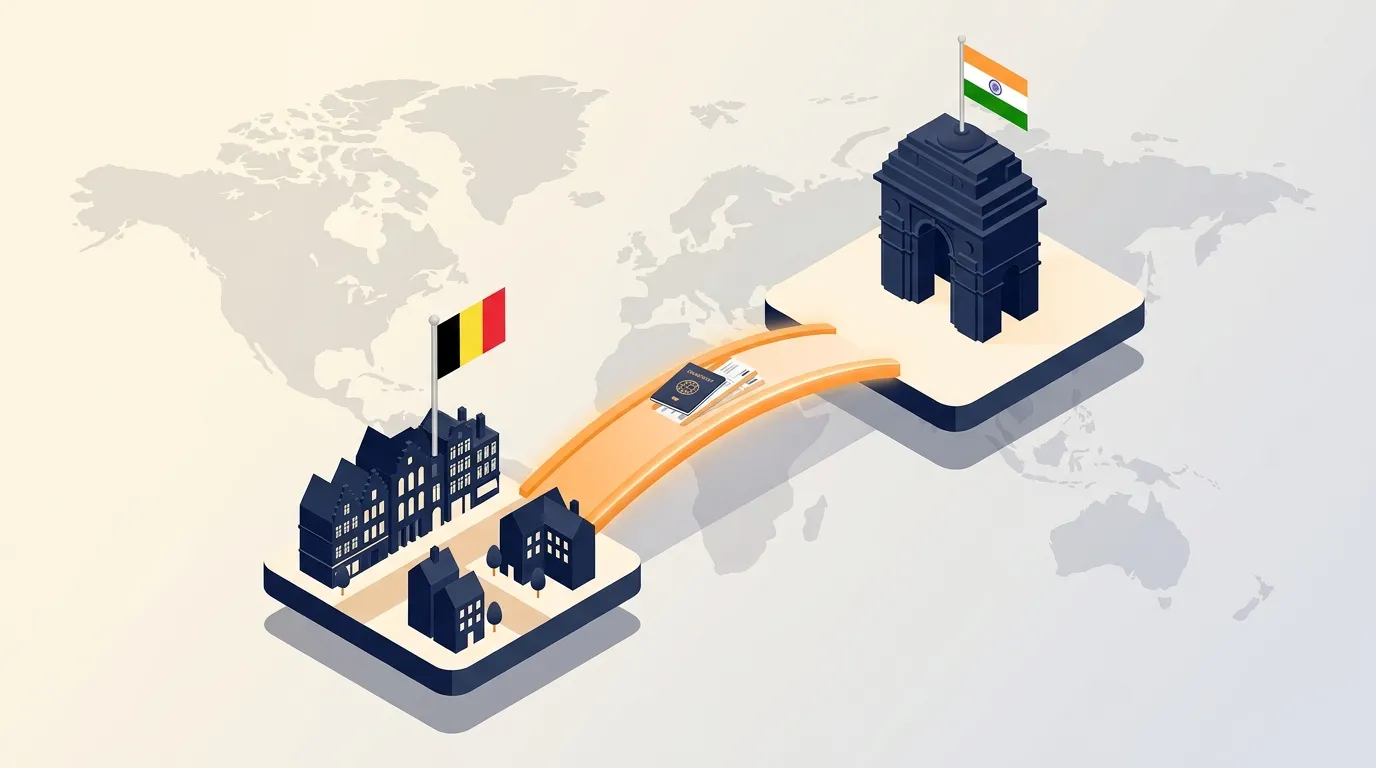
Company registration in India runs on the same statutory rail whoever the parent is, but the Belgium corridor carries its own FEMA reporting, treaty and banking wrinkles. Here is the process, cost and timeline that actually holds in 2026.
## The Belgium to India Corridor in 2026
Antwerp's diamond trade has run on Indian family businesses for a century. Chemicals and logistics firms followed, and now a broader wave of Belgian mid-sized companies, from Flanders industrial suppliers to Wallonia engineering firms, are setting up their own operations in India rather than routing everything through trading partners or agents.
The reasons are practical. India's domestic market has scaled up fast, and Belgian companies selling into pharma, chemicals, ports and logistics, or specialty manufacturing want a local legal entity that can invoice in rupees, hire directly, sign contracts with Indian counterparties, and hold its own GST registration. A branch or liaison office rarely does the job well. A properly incorporated Indian subsidiary does.
This guide walks through what it actually takes in 2026 for a Belgian parent company to register a company in India from Belgium: which entity to pick, the incorporation steps, the apostille chain you will need to run through Belgium's Legaweb portal, banking and remittance mechanics, the tax treaty position, and the ongoing compliance calendar once the entity is live. If you are the finance director in Antwerp or Brussels weighing this up, treat this as the reference document you hand to your board before the decision meeting.
## Entity Choice: BV or NV Parent, Indian Private Limited Subsidiary
Most Belgian groups operate as a BV or an NV. Either structure can hold shares in a foreign company without restriction under Belgian law, so the parent entity choice at home rarely changes the India side decision.
On the Indian side, the almost universal answer for a Belgian parent is a private limited company, incorporated as a wholly owned subsidiary. It gives you limited liability, a separate legal personality recognised by Indian courts and regulators, straightforward compliance under the Companies Act, and a structure that Indian banks, GST authorities and customers already understand. Other options exist: a Limited Liability Partnership, a branch office, or a liaison office. But for a Belgian BV or NV that wants to trade, invoice, hire staff and eventually repatriate profit, the private limited subsidiary route is the one that works cleanly, and it is what our [foreign subsidiary setup service](/services/foreign-subsidiary.html) is built around.
The Belgian parent holds 100 percent of the shares in the Indian company from day one. There is no requirement to bring in a local Indian shareholder, and no cap on foreign ownership in the sectors most Belgian companies operate in, subject to the usual sectoral checks under India's FDI policy.
## Step by Step Incorporation: DSC, Name Reservation, SPICe+, MoA
The incorporation process runs through the Ministry of Corporate Affairs and follows a fixed sequence, whether the parent is in Brussels, Antwerp or anywhere else.
- Digital Signature Certificate for the proposed directors, including the Belgian parent's authorised signatory and the Indian resident director. This is issued by a licensed certifying authority in India and requires identity verification.
- Name reservation through the RUN or Part A of the SPICe+ form, checking availability against existing company names and trademarks.
- SPICe+ filing itself, which is the integrated form covering incorporation, PAN, TAN, EPFO, ESIC and GST registration in a single submission. This is where most of the document set from Belgium gets uploaded.
- Memorandum of Association and Articles of Association, drafted to reflect the shareholding, objects clause and governance terms agreed with the Belgian parent.
- Certificate of Incorporation issued by the Registrar of Companies, along with the company's CIN, PAN and TAN.
Once the certificate is in hand, the company opens its bank account, issues share certificates to the Belgian parent, and can begin operating. In practice, from the point all Belgian side documents are signed and apostilled, incorporation itself takes roughly two to three weeks, with the full setup, including bank account opening and initial GST registration, usually landing within the 30 to 45 day window most Belgian boards plan around.
## Documents and the Apostille Chain in Belgium
This is the step Belgian finance teams underestimate most often. Indian authorities require certain Belgian corporate documents, such as the board resolution authorising the subsidiary, the parent company's certificate of incorporation, and identity documents of directors, to be notarised and then apostilled before they can be relied on in India.
Belgium is a party to the Hague Apostille Convention, and since 2021 it operates a fully digital e-apostille system through the Legaweb portal, run by the Belgian Federal Public Service Foreign Affairs. In practice this means: a Belgian notary certifies the document first, then the apostille is applied through Legaweb rather than through a physical stamp at a counter. Because both Belgium and India are Hague Convention members, no consular legalisation at the Indian embassy is needed. This shaves real time off the process compared to jurisdictions still requiring embassy attestation.
The practical sequence is: notarise the document with a Belgian notary, obtain the e-apostille via Legaweb, then have the apostilled document translated into English if it was originally in Dutch or French, since Indian authorities require English filings. Get this sequence wrong, or miss a document in the set, and the SPICe+ filing stalls. We manage this end to end for Belgian clients as part of the [foreign subsidiary setup service](/services/foreign-subsidiary.html), because a document rejected at the ROC stage costs far more time than getting the apostille chain right the first time.
## Resident Director, Banking and Capital Remittance
Indian company law requires at least one director on the board who has been resident in India for a minimum period in the preceding financial year. Belgian founders rarely have this on their own board, so the standard solution is a nominee resident director, provided as a service, who holds no operational control but satisfies the statutory requirement while the Belgian parent retains full ownership and management authority through its own appointed directors.
On the banking side, the Indian subsidiary opens a current account once incorporated, and the Belgian parent remits share capital via SWIFT transfer from Belgium to India. The Indian bank issues a Foreign Inward Remittance Certificate, confirming receipt of funds. This FIRC then supports the filing of Form FC-GPR with the Reserve Bank of India, which must be submitted within 30 days of allotment of shares to the Belgian parent. Missing this deadline creates a compounding issue with the RBI that is avoidable with basic calendar discipline.
This whole reporting chain sits under FEMA, and getting it wrong early creates cleanup work later. Our [FEMA compliance](/services/fema-compliances.html) team handles the FC-GPR filing, FIRC reconciliation and ongoing FEMA reporting as a standard part of subsidiary setup for Belgian clients.
## Corridor Taxes: Corporate Tax, GST and the India Belgium DTAA
An Indian private limited subsidiary is taxed as a domestic Indian company, not as a foreign entity, once incorporated. Standard corporate tax is 25 percent for companies below the applicable turnover threshold, while newly incorporated manufacturing companies and companies opting into the new regime can access a 22 percent rate, subject to giving up certain exemptions and incentives.
GST applies at 18 percent on most goods and services the subsidiary supplies or procures, with registration typically bundled into the SPICe+ filing at incorporation.
On repatriation, the India Belgium Double Taxation Avoidance Agreement caps dividend withholding tax at 15 percent, and royalty payments at 10 percent, both lower than the domestic withholding rates that would otherwise apply, provided the Belgian parent holds a valid Tax Residency Certificate and meets the treaty's beneficial ownership tests. Structuring the flow of dividends, royalties for any IP licensed to the Indian subsidiary, and management fees needs to be planned from the start rather than retrofitted, and our [transfer pricing advisory](/services/transfer-pricing-advisory.html) team works alongside the FEMA team on this. For a full walkthrough of how to plan cash extraction efficiently, see our [repatriation of profits from India](/insights/repatriation-of-profits-from-india-to-a-foreign-parent-the-2026-strategic-guide) guide.
## Ongoing Compliance Calendar
Incorporation is the easy part. What determines whether a Belgian owned Indian subsidiary stays in good standing is the recurring compliance calendar, and it is heavier than what most Belgian finance teams are used to running for a domestic BV or NV.
- Annual Foreign Liabilities and Assets return to the RBI, due by 15 July each year, covering the subsidiary's outstanding foreign investment position.
- Annual ROC filings, including financial statements and the annual return, filed with the Registrar of Companies within the statutory deadlines after the financial year close.
- Monthly GST returns, covering outward and inward supplies, plus periodic reconciliation.
- Monthly TDS compliance, covering tax deducted at source on salaries, vendor payments and other specified transactions, with associated returns filed quarterly.
Miss any of these and penalties accrue, sometimes automatically, and in the RBI's case a missed FLA filing can flag the entity for closer scrutiny on future remittances. A Belgian board that treats this calendar the same way it treats VAT and social security deadlines at home will avoid most of the friction. Our [virtual CFO service](/services/ecfo.html) exists specifically to run this calendar for Belgian parents who do not want to build an in house Indian finance function from scratch.
## Local Reporting: Belgian Parent Books and IFRS Consolidation
The Indian subsidiary maintains its statutory books under Indian Accounting Standards and Indian GAAP requirements, which do not map one to one onto Belgian statutory accounting under the Belgian GAAP framework. For consolidation purposes, most Belgian parents preparing group accounts under IFRS, or under Belgian GAAP with IFRS equivalent disclosures for larger groups, need a bridge between the Indian subsidiary's local books and the reporting format the Belgian finance team consolidates.
In practice this means monthly or quarterly management accounts from the Indian entity, mapped to the Belgian group's chart of accounts, with adjustments for the differences in depreciation treatment, revenue recognition timing and provisioning that commonly arise between Indian books and IFRS. Getting this reporting rhythm right from month one avoids a scramble at year end when the Belgian auditors ask for consolidation packs that do not exist yet in the right format.
## Timeline and Fees
For a Belgian parent with documents in order, incorporation typically takes 30 to 45 days from the point the apostille chain is complete through to certificate of incorporation, PAN, TAN and initial GST registration. Add bank account opening and the FC-GPR filing after capital remittance, and most subsidiaries are revenue ready, meaning able to invoice, hire and operate, within 45 days of the engagement starting.
Fees should be fixed and quoted before signing, covering incorporation, the resident director service, FEMA filings and the first year of compliance handoff. Belgian finance teams are used to fixed fee engagements for statutory work at home, and there is no reason the India side should be different. Anyone quoting a wide range without seeing your documents first is pricing in unknowns you should not be paying for.
## Why Belgian Companies Pick Krystal7
Belgian companies working through this corridor for the first time want a firm that has actually done it before, not one learning on their file. We bring over 10 years of cross border practice, more than 10,000 startups and founders advised across India and five continents. Our work is led by Chartered Accountants, we respond to first inquiries within 4 business hours, and we quote fixed fees before the engagement begins. That combination matters when you are coordinating a Legaweb apostille in Belgium, a resident director appointment in India, and an RBI filing deadline, all inside the same working week.
For the structure most foreign parents choose, read the [wholly owned subsidiary in India guide](/insights/wholly-owned-subsidiary-in-india), or go straight to the [foreign subsidiary registration service](/services/foreign-subsidiary.html) for the fixed fee scope.
## Frequently Asked Questions
### Can a Belgian company own 100 percent of an Indian subsidiary
Yes. A Belgian BV or NV can hold 100 percent of the shares in an Indian private limited company as a wholly owned subsidiary, with no local Indian shareholder required, subject to the sectoral limits under India's FDI policy that apply to a small number of restricted sectors.
### How long does it take to register an Indian company from Belgium
Most incorporations complete in 30 to 45 days from the point Belgian documents are notarised and apostilled through Legaweb, with the entity typically revenue ready within 45 days once banking and initial registrations are in place.
### Which documents need apostille in Belgium
The parent company's certificate of incorporation, board resolutions authorising the Indian subsidiary and its directors, and director identity documents typically need to be notarised by a Belgian notary and then apostilled through the Legaweb e-apostille portal before they can be used in the SPICe+ filing.
### What is the dividend withholding rate under the India Belgium treaty
Under the India Belgium Double Taxation Avoidance Agreement, dividend withholding tax is capped at 15 percent, and royalty payments are capped at 10 percent, provided the Belgian recipient holds a valid Tax Residency Certificate and meets the treaty's conditions.
### Do I need to travel to India to incorporate
No. The entire incorporation process, including DSC issuance, SPICe+ filing and bank account opening, can be completed remotely from Belgium, provided the notarised and apostilled documents are couriered or submitted digitally and the Indian resident director requirement is satisfied through a nominee director service.
### What does it cost to set up an Indian subsidiary from Belgium
Costs vary based on structure and scope, but a fixed fee should be quoted before signing, covering incorporation, resident director provision, initial FEMA filings and the first year of compliance handoff, so there are no surprises once the engagement starts.
Frequently Asked Questions
Can a Belgian company own 100 percent of an Indian subsidiary
How long does it take to register an Indian company from Belgium
Which documents need apostille in Belgium
What is the dividend withholding rate under the India Belgium treaty
Do I need to travel to India to incorporate
What does it cost to set up an Indian subsidiary from Belgium
Facing this in your own entity?
Guides explain the rules. A conversation solves your specific case. Talk to a Krystal7 advisor about your India entry, FEMA, or compliance position.
Book a Discovery Call