NETHERLANDS TO INDIA
Company Registration in India from the Netherlands: Process, Cost and Timeline (2026)
This guide covers registering a company in India from the Netherlands. It is for a Dutch business expanding into India or a founder planning to invest personally.
Country Guides

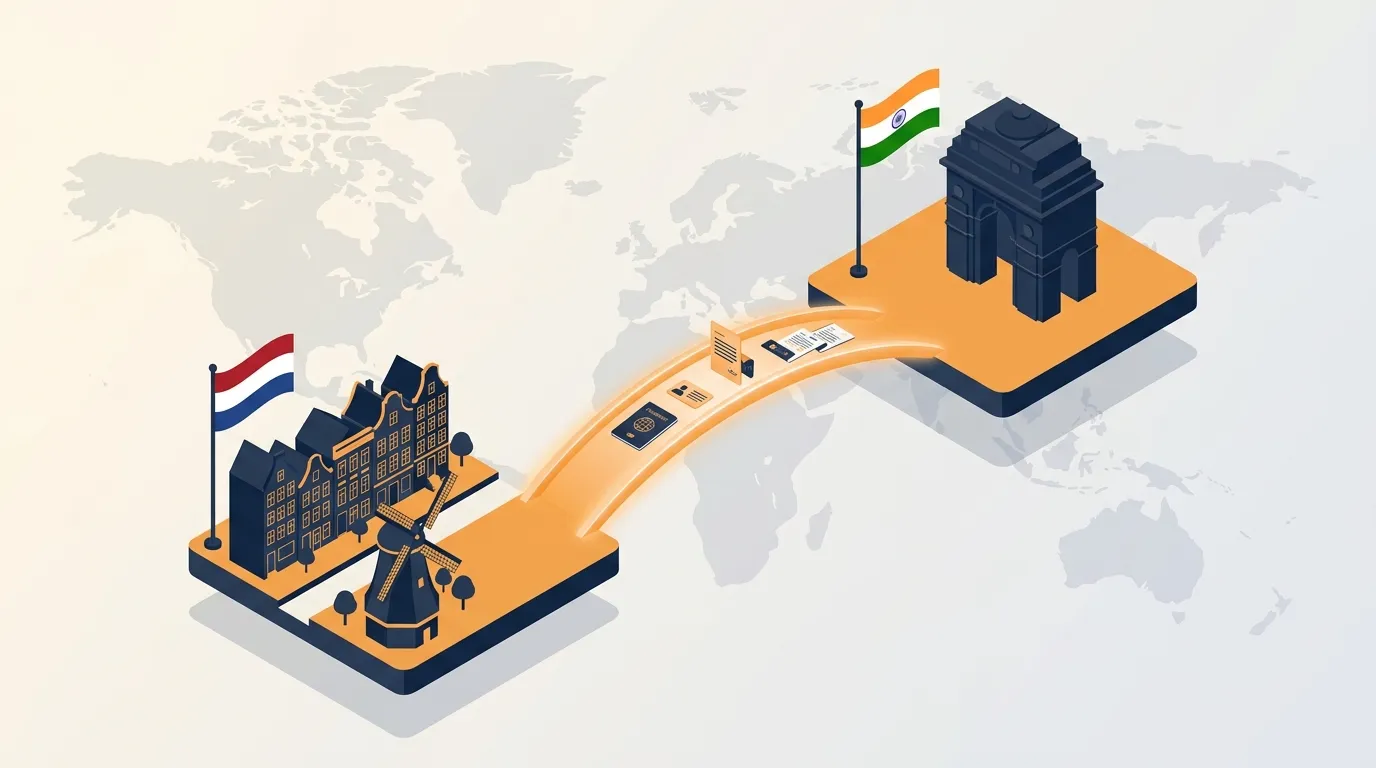
This guide covers registering a company in India from the Netherlands. It is for a Dutch business expanding into India or a founder planning to invest personally.
Identify the investor before preparing documents. A Dutch corporate parent needs its own records and investment authority; an individual shareholder needs a personal investor review. Follow the country process below, then discuss the Indian subsidiary registration scope.
Why Netherlands Companies Are Building in India
What usually triggers the move
In practice, the decision to incorporate rarely comes from a single event. It tends to follow one of a few patterns: an Indian customer or partner asking for a local contracting entity, a need to hire engineers or analysts directly rather than through a staffing vendor, a manufacturing or sourcing relationship that has outgrown a liaison arrangement, or a group restructuring where the Dutch BV becomes the intermediate holding company for the Asia business. Understanding which of these applies to you changes how the entity should be structured from day one.
Choosing the Structure from Netherlands
Wholly owned subsidiary as the default
For most Dutch groups, a wholly owned Indian subsidiary structured as a Private Limited Company is the sensible default. It gives limited liability, a recognised legal form for Indian customers and banks, and a clean route for the Dutch BV to hold 100 percent of the shares. It is also the structure Indian tax and FEMA rules are built around, which makes ongoing compliance more predictable than the alternatives.
Branch and liaison office compared
A branch office or a liaison office can look appealing because they avoid setting up a fresh company, but both come with meaningful restrictions and need approval under the FEMA branch and liaison office rules. An authorised dealer (AD Category-I) bank approves most applications. RBI approval is needed only in specified cases under RBI Master Direction No. 10/2015-16: an applicant from Pakistan; an applicant from Bangladesh, Sri Lanka, Afghanistan, Iran, China, Hong Kong or Macau opening an office in Jammu and Kashmir, the North East or the Andaman and Nicobar Islands; or an applicant in defence, telecom, private security or information and broadcasting. A wholly owned subsidiary under the automatic route needs no such approval.
| Structure | Ownership | Can it trade and invoice in India | Typical approval needed | Best fit |
|---|---|---|---|---|
| Wholly owned subsidiary (Private Limited) | Up to 100 percent by the Dutch BV | Yes | Generally none, automatic route in most sectors | Ongoing operations, hiring, contracting |
| Branch office | Extension of the Dutch parent, no separate shares | Limited to approved activities | AD bank approval; RBI only in specified cases | Established groups with a narrow, defined India activity |
| Liaison office | Extension of the Dutch parent, no separate shares | No, cannot invoice or trade | AD bank approval; RBI only in specified cases | Market research and representation only |
Personal shareholding versus corporate parent
Personal investment and investment through a corporate parent produce different ownership records and document requirements. Choose the investor based on the operating plan, governance and future funding. An individual does not automatically lose all treaty relief because the investment is held personally. Eligibility depends on the treaty, residence, payment and applicable conditions.
How Do You Register a Company in India from the Netherlands?
You register a company in India from the Netherlands by incorporating a Private Limited subsidiary through the SPICe Plus filing, with the Dutch BV as shareholder. Much of the work can run remotely, but bank KYC or document execution may need personal attendance. It typically takes about four to five weeks from engagement to a bank account and GST registration, plus the time to apostille the Dutch documents.
SPICe Plus with a foreign parent
SPICe Plus (Simplified Proforma for Incorporating Company Electronically) is the single integrated form the Ministry of Corporate Affairs uses for name reservation, incorporation, PAN, TAN, and several other registrations in one filing. When the shareholder is a foreign company like a Dutch BV, the form additionally requires the BV's certificate of incorporation, its registered address, and board authorisation confirming the investment and the signatories.
Documents and legalisation
The Dutch BV's documents need an apostille before the Indian filing. The section on apostille in the Netherlands below names the competent authorities and the working set.
DIN for foreign directors
Every director of the Indian company, including Dutch nationals who never plan to visit India, needs a Director Identification Number (DIN). This is obtained alongside the SPICe Plus filing using the director's passport and address proof, apostilled in the Netherlands where the director is not physically present in India for the process.
Resident director and registered office
At least one director must have stayed in India for at least 182 days during the financial year. For a newly incorporated company, the requirement applies proportionately at the end of its first financial year. Nationality does not replace this residence test. A resident director has statutory duties even when the overseas parent retains ownership. See section 149 of the Companies Act.
Prepare the Indian registered office address, authority to use it and supporting evidence. Ownership of the office is not the same question as company ownership.
Netherlands Specifics That Change the Playbook
The BV as an India Holding Layer
Many Dutch groups already use a BV as an intermediate holding company for other international subsidiaries, and the same logic often extends naturally to a Dutch BV Indian subsidiary arrangement. The BV can consolidate dividends, manage intercompany funding, and act as the single point of contact for Indian banks and auditors. This still makes sense where the group already has BV level substance, meaning real staff, decision making, and books at the BV, rather than a shell layer inserted purely for tax positioning, since thin substance can undermine the treaty and domestic tax benefits the structure is meant to preserve.
Apostille in the Netherlands
For the European Netherlands, designated district courts, Rechtbanken, issue apostilles. Separate authorities serve the Caribbean parts of the Kingdom. Confirm the origin of the registry record or notarial act and the correct authority before certification. Use the official Netherlands authority directory to identify the competent office.
The working set can include the investor’s registration and governing documents, investment approval, signatory authority and director identity evidence. Agree the required forms and any translations before paying for certification.
Treaty Eligibility for the Proposed Payment
Check the treaty provisions and current domestic law for the proposed payment before remitting funds. Dividend, interest, royalty and service payments can have different treatment. Residence evidence alone does not establish every treaty condition. Review beneficial ownership, substance and any relevant limitation or anti abuse rule. Obtain a calculation for the actual recipient and payment rather than assuming a single corridor rate.
Money In, Money Out
Capital remittance and FC GPR
Agree the investment route, valuation and bank evidence before sending capital. Record the receipt and issue dates separately. A remittance certificate evidences funds received; it does not itself classify the money as equity or a loan. For a reportable FDI equity issue, FC-GPR is due within 30 days of issue under the RBI reporting direction. Assign the reporting work before funding and retain the filed acknowledgement.
Substance requirements the RBI and Dutch tax office both care about
Both the Indian regulator and the Dutch tax authority tend to look past the paperwork to the substance behind it. On the Indian side, FEMA rules and transfer pricing scrutiny generally expect that the subsidiary's dealings with the Dutch parent, whether cost sharing, royalty payments, or intercompany services, reflect arm's length pricing, which is where transfer pricing advisory becomes relevant once the Indian entity starts transacting with the Dutch group. On the Dutch side, the tax office generally wants to see that the BV, if it is claiming treaty or participation exemption benefits, has genuine decision making capacity and is not merely a conduit. Building both of these into the operating model early avoids awkward questions on either side later.
The Compliance Calendar After Day One
FC GPR, FLA and the FEMA rhythm
Track each investment report from its own triggering event. Check whether the annual Foreign Liabilities and Assets return applies and verify the deadline for that year, including notified extensions. Keep the bank acknowledgements, share records and filed reports together.
ROC, GST and payroll basics
The Indian company will also need to run its Registrar of Companies (ROC) annual filings, statutory audit, and income tax return under the usual company law and tax calendar. If the business sells goods or services above the applicable threshold, or trades across Indian states, GST registration generally becomes necessary fairly early. Payroll for Indian employees brings its own withholding and social security obligations, typically run monthly rather than annually.
What a monthly retainer should cover
For a Dutch parent managing this from a distance, a sensible monthly retainer with an Indian compliance provider generally covers bookkeeping, GST returns, payroll processing, and a running check on FEMA filing deadlines, with the ROC annual filing and statutory audit billed separately as year end items. A good compliance company partner should be able to lay this out as a fixed annual fee rather than an hourly estimate, so the Dutch finance team can budget it the same way they would any other overhead line.
What Does It Cost to Register a Company in India from the Netherlands?
Setting up an Indian subsidiary from the Netherlands generally costs a moderate professional fee for incorporation, plus government and stamp duty charges that vary by state and authorised capital. Ongoing annual compliance, covering audit, ROC filings, tax returns, and FEMA reporting, typically runs as a separate fixed yearly budget once the company is operational.
A realistic all in budget
Exact professional fees vary by provider and by the complexity of the shareholding structure, but Dutch groups should budget for three broad cost buckets: incorporation and document legalisation, first year statutory compliance, and ongoing monthly bookkeeping and payroll if the company starts hiring immediately.
| Cost head | What it covers | Typical timing |
|---|---|---|
| Incorporation professional fee | SPICe Plus filing, DIN, PAN, TAN, name reservation | One time, at setup |
| Government and stamp duty fees | State stamp duty, ROC fees tied to authorised capital | One time, at setup |
| Apostille and legalisation | BV documents and director proofs legalised in the Netherlands | One time, before filing |
| Annual ROC and audit compliance | Statutory audit, annual return, board and shareholder filings | Recurring, yearly |
| FEMA and transfer pricing filings | FC GPR, annual FLA return, transfer pricing documentation if applicable | Recurring, yearly |
| Monthly bookkeeping, GST, payroll | Ongoing accounting, GST returns, payroll if staff are hired | Recurring, monthly |
A CA firm working exclusively with foreign parents can generally quote most of this as fixed fees rather than hourly billing, which is worth confirming against a firm's published pricing before signing on.
Planning the Completion Date
Ask for a schedule that separates overseas document preparation, any investment approval, incorporation and bank onboarding. Filing queries and bank checks can change the completion date. Do not treat incorporation as confirmation that the company is ready for every transaction.
Frequently Asked Questions
Can a Netherlands company own 100 percent of an Indian subsidiary?
Under current FEMA rules, most sectors allow up to 100 percent foreign ownership through the automatic route, meaning a Dutch BV can generally hold the entire shareholding without prior government approval. Certain sectors carry caps or conditions, so it is worth confirming the specific activity against the current sector list before finalising the shareholding.
How long does it take to register an Indian company from Netherlands?
A realistic timeline is about 8 to 10 working days from engagement to incorporation. Bank account opening and GST registration bring the total to about four to five weeks, plus the time to apostille the Dutch documents. Marketing claims of one or two week incorporation usually exclude the Netherlands side legalisation and bank account opening, which are typically the slowest steps in practice.
Do I need to travel to India to incorporate?
Much of the incorporation work can be coordinated remotely. Confirm the document execution, digital signature verification and bank KYC requirements for the actual people and documents. Some steps may need original documents or personal attendance. Agree those requirements before deciding whether travel is necessary.
What does it cost to set up and run an Indian subsidiary?
Setup involves a one time professional fee plus government and stamp duty charges, and legalisation costs in the Netherlands. Annual running costs cover statutory audit, ROC filings, tax returns, and FEMA reporting, generally billed as a fixed yearly package, with monthly bookkeeping and payroll added once the company starts operating and hiring.
Can foreigners register a company in India?
Yes. Foreign individuals and foreign companies, including a Dutch BV, can generally hold shares in an Indian Private Limited Company and act as directors, subject to at least one director meeting the resident director condition and to sector specific investment caps that apply under current FEMA rules.
How much will it cost to register a company in India?
Costs depend on the state of incorporation, the authorised share capital, and whether documents need extensive legalisation, but Dutch founders should budget for a moderate professional fee for incorporation itself, plus separate government fees and a distinct annual compliance budget once the company is running.
How can European companies register business in India?
Most European companies, including those from the Netherlands, follow the same path: incorporate a wholly owned Private Limited subsidiary through SPICe Plus, legalise home country documents through apostille where the country is a Hague Convention member, obtain DIN for foreign directors, and report the investment to the Reserve Bank of India through FC GPR after allotment.
How to legally register a company in India?
Legal registration runs through the Ministry of Corporate Affairs using the SPICe Plus integrated form, which combines name reservation, incorporation, PAN, and TAN in one filing, followed by FEMA reporting for any foreign shareholding. Working with an Indian company secretary or chartered accountant familiar with foreign parent filings generally keeps the process compliant from the first step.
NEXT STEP
Plan your India registration from Netherlands
Review our incorporation scope and discuss the ownership structure, documents and support your Indian entity needs.
WRITTEN BY
CA Nandini
Co-founder · All India Rank 49, ICAINandini Hasija is a co-founder of Krystal7. She leads brand, business development and marketing, and works with founders to define their engagement. She is a Chartered Accountant and achieved All India Rank 49 in the CA examinations.
Filed under Country Guides · All corridors