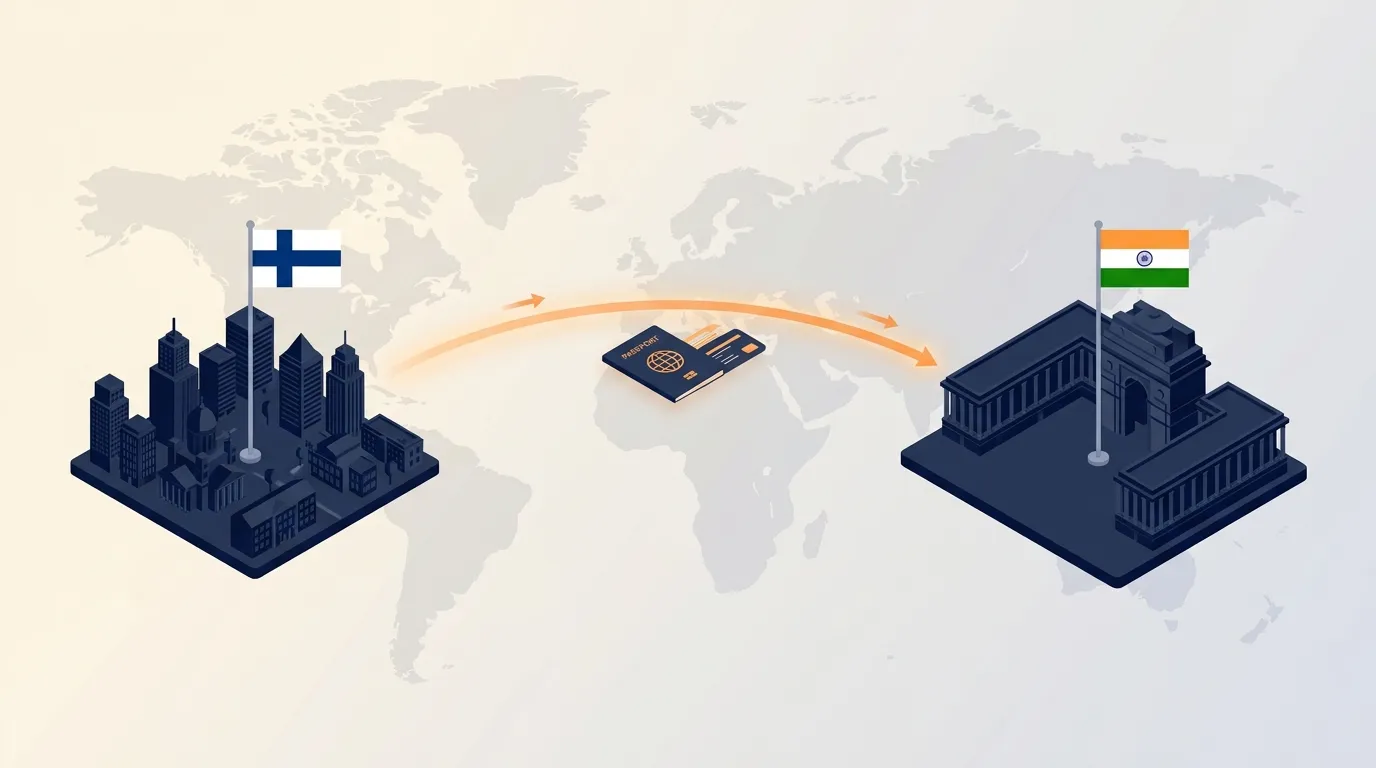
Company registration in India runs on the same statutory rail whoever the parent is, but the Finland corridor carries its own FEMA reporting, treaty and banking wrinkles. Here is the process, cost and timeline that actually holds in 2026.
## The Finland to India Corridor in 2026
Finnish companies have been building in India for years, but in 2026 the conversation is more direct. It is no longer about whether India matters. It is about how a Finnish parent should enter India in a way that is legally clean, operationally usable and tax aware from day one. For many Finnish promoters, especially in telecoms, cleantech, industrial systems and software, the practical question is now simple: how do we register a company in India from Finland without losing time to avoidable filing errors.
The corridor is already familiar. Nokia built one of the largest Finnish operations in India, and newer cleantech and telecom businesses tend to follow the same logic: serve Indian customers locally, hire in India, contract in rupees where needed, and create a structure that can scale rather than a short term representative arrangement. The mechanics are well known, but the order matters. Entity choice, apostilled documents, resident director support, banking, FEMA reporting and the ongoing compliance calendar all have to line up cleanly.
We write this from the Indian side of the table, where the job is not to theorise about market entry but to actually get the Finnish parent to a live Indian subsidiary. This guide sets out the sequence the Finnish promoter, CFO or group controller will actually need in 2026.
## Entity Choice: Oy Parent, Indian Private Limited Wholly Owned Subsidiary
For most Finnish groups, the starting point is straightforward. The parent company remains a Finnish Oy, and it incorporates an Indian private limited company as a wholly owned subsidiary. That structure fits Indian company law, banking practice and foreign investment rules well, and it lets the Finnish parent retain full ownership and control.
This is normally the cleanest route for a group that intends to invoice locally, employ people in India, sign vendor contracts and build a real operating base. Branch offices and liaison offices exist in India, but they do not suit most commercial entry plans. A wholly owned subsidiary is easier to fund, easier to govern and easier to align with Indian tax and FEMA compliance over time.
The legal shape is also familiar to Indian regulators. A Finnish Oy can subscribe to 100 percent of the shares of the Indian company, appoint its directors and control the subsidiary through standard board resolutions and shareholder authority. This is exactly the pattern we use in our [foreign subsidiary setup service](/services/foreign-subsidiary.html), because it is the structure that works in practice, not just in theory.
## Step by Step Incorporation: DSC, Name Reservation, SPICe+, MoA
Once the structure is clear, the incorporation itself follows a sequence under Indian company law.
- Digital Signature Certificate, DSC: each proposed director needs an Indian DSC before the filings can be made. For Finnish directors, this is usually handled remotely through identity verification and document processing.
- Name reservation: the proposed company name is checked and reserved, usually through the SPICe+ flow. Two name options are normally prepared so that the filing does not stall if the first choice is rejected.
- SPICe+ filing: this is the integrated company incorporation form that covers incorporation, PAN, TAN and connected registrations. The constitutional documents, director details and subscriber details are filed here.
- Memorandum of Association and Articles of Association: these are prepared to reflect the business objects, shareholding and internal governance of the Indian subsidiary.
- Certificate of Incorporation: once approved by the Registrar of Companies, the Indian company comes into legal existence with its own corporate identity.
For a Finnish parent with properly prepared documents, the process is routine, but only if the document chain is correct from the start. Most delays are not caused by Indian law itself. They come from avoidable errors in signatures, apostille sequence, mismatch of names across documents or missing supporting proofs.
## Documents and the Apostille Chain in Finland
Finland is a Hague Apostille member, which simplifies the document legalisation path. The normal sequence is to notarise where required, then obtain the apostille from the Digital and Population Data Services Agency. No Indian consular legalisation is needed once the apostille has been properly affixed.
The typical document set includes the Finnish parent company registration documents, constitutional documents, a board resolution approving the Indian subsidiary and appointing the authorised signatory, plus identity and address proof for directors and beneficial owners. Each item has to be prepared in the right form and in the right order.
This is a mechanical area, but it matters a lot. If a document is apostilled incorrectly, or if the board resolution is inconsistent with the signatory details used later in the Indian filing, the Registrar of Companies can raise a query and the clock starts slipping. The practical fix is a document checklist reviewed before anything is signed, notarised or apostilled.
## The Resident Director Rule
Indian company law requires every private limited company to have at least one resident director. A Finnish parent usually does not have an India based director ready on day one, so this requirement needs to be solved as part of the setup plan, not after incorporation.
The standard answer is a nominee resident director arrangement. The resident director satisfies the statutory requirement, while the Finnish parent retains economic ownership and management control through the board and shareholder rights. This is a standard structure for foreign subsidiaries and not an unusual exception.
The important point is governance clarity. The nominee resident director is not the commercial owner of the Indian business. The role is defined contractually and sits within a controlled legal framework. We build this into the setup process so the Finnish parent has compliance coverage without losing control of the subsidiary.
## Banking and Capital Remittance
Once the Indian company is incorporated, it needs an operational bank account and inbound capital from Finland. This is the point where company law and banking practice meet FEMA reporting.
The normal route is a SWIFT remittance from the Finnish parent into the Indian subsidiary's account. The Indian bank issues the Foreign Inward Remittance Certificate, or FIRC, which is the key proof of capital coming into India. Shares are then allotted to the Finnish parent against the capital received.
After allotment, Form FC-GPR must be filed within 30 days. This filing records the share issue to the non resident parent and sits at the centre of early stage [FEMA compliance](/services/fema-compliances.html). If the filing is delayed, the company moves from routine compliance into a remediation exercise, which is exactly what a new foreign subsidiary should avoid.
A clean remittance trail, correct board approvals, correct allotment records and timely FC-GPR filing matter more than most first time promoters expect. This is why banking and FEMA reporting are handled together rather than as separate workstreams.
## Corridor Taxes: What a Finnish Parent Actually Needs to Know
Tax planning in the India Finland corridor should be clear and conservative from the start. The Indian subsidiary generally pays Indian corporate tax at 25 percent under the standard domestic regime, or 22 percent if it validly opts into the newer concessional regime and gives up specified incentives. GST at 18 percent commonly applies on services, with goods following their own rate classification.
On repatriation, the India Finland tax treaty provides for dividend withholding of 10 percent and royalty withholding of 10 percent in the relevant treaty framework used for group planning. That said, treaty analysis should always be checked against the exact payment type and facts of the transaction before money moves.
This becomes especially important when the Finnish parent is charging for services, software, technology support or brand related usage. If intercompany charging is not designed carefully, the problem is not just withholding tax. It can also create transfer pricing issues and disputes over characterisation. That is why the tax section sits naturally beside our [transfer pricing advisory](/services/transfer-pricing-advisory.html) work.
Finnish, Swiss and other European groups sometimes come to India with assumptions about automatic lower treaty benefits under MFN logic. That logic has become much weaker after the Supreme Court's 2023 Nestle ruling in India. Any repatriation planning should therefore be reviewed on current law, not on legacy assumptions. For practical planning on dividends and upstream cash movement, our guide on [repatriation of profits from India](/insights/repatriation-of-profits-from-india-to-a-foreign-parent-the-2026-strategic-guide) is the right starting point.
## Ongoing Compliance Calendar
The real work starts after incorporation. A Finnish parent that wants a stable Indian subsidiary needs a functioning compliance calendar from the first month onward.
- The annual FLA return is due by 15 July each year for companies with foreign investment or overseas assets or liabilities.
- Registrar of Companies annual filings must be completed each year, including financial statements and annual return filings.
- Monthly GST returns apply where the company is registered under GST and making taxable supplies.
- Monthly TDS compliance applies where the company is deducting tax on salaries, vendors or other taxable payments.
These are not optional housekeeping items. Missed filings create penalties, director exposure and a messy control environment for the Finnish parent. The better answer is to build a working finance and compliance rhythm early, usually through a structured [virtual CFO service](/services/ecfo.html) that sits on top of the statutory calendar and produces usable reporting for the parent.
## Finnish GAAP to Indian Books and IFRS Consolidation
A Finnish parent will usually maintain its group reporting under Finnish standards or IFRS at the consolidated level, while the Indian subsidiary keeps statutory books under Indian accounting rules. That means the first year is not just an incorporation exercise. It is a reporting design exercise as well.
Revenue recognition, depreciation logic, expense mapping, employee cost treatment and intercompany balances all need a clean bridge between Indian books and parent level reporting. If that bridge is ignored until year end, the clean up can be expensive and slow.
The practical answer is to build the Indian chart of accounts with group reporting in mind from the beginning. Done properly, this reduces reconciliation pain, supports audit readiness and makes the parent consolidation process much smoother.
## Timeline and Fees
For a Finnish parent with clean documents, a realistic incorporation timeline is 30 to 45 days. That covers company setup through to Certificate of Incorporation. If the bank account opening, SWIFT remittance, FIRC issuance and FC-GPR filing move without avoidable delay, the company is typically revenue ready within about 45 days from the start of the process.
For Finnish management teams, the time zone is usually workable. In summer, IST is 2.5 hours ahead of Finland, which makes document review and approval cycles relatively manageable between Helsinki and India.
Fees should be quoted as a fixed number before signing. That fixed scope should make clear whether nominee resident director support, banking coordination, first stage FEMA filings and post incorporation registrations are included. The right mandate is the one where the Finnish parent knows the full path and the full fee before work starts.
## Why Finnish Companies Pick Krystal7
Finnish companies usually want a team that is direct, technically precise and fast on cross border execution. That is exactly how we work. We bring over 10 years of cross border practice, more than 10,000 startups and founders advised across India and five continents, and a structure built for promoter led as well as group CFO led engagements.
Our work is handled by Chartered Accountants. That matters because the same team thinking about incorporation is also thinking ahead to FEMA, tax, reporting and the compliance cadence that follows. We aim to respond to first queries within 4 business hours, and we quote on a fixed fee basis so the promoter does not discover key costs halfway through the mandate.
The [wholly owned subsidiary in India guide](/insights/wholly-owned-subsidiary-in-india) covers the structure most parents pick, and the [registration service page](/services/foreign-subsidiary.html) shows the fixed fee.
## Frequently Asked Questions
### Can a Finnish company own 100 percent of an Indian subsidiary
Yes. A Finnish Oy can generally own 100 percent of an Indian private limited subsidiary in sectors where foreign direct investment is permitted under the automatic route. Sector specific restrictions should still be checked before incorporation.
### How long does it take to register an Indian company from Finland
With clean, properly apostilled documents, incorporation usually takes 30 to 45 days. If banking and FEMA reporting are managed promptly, the company is often revenue ready within around 45 days from the start.
### Which documents need apostille in Finland
The parent company's registration and constitutional documents, the board resolution approving the Indian subsidiary, and the identity and address proofs required for the filing typically need to go through the apostille chain in Finland.
### What is the dividend withholding rate under the India Finland treaty
The treaty position generally used for India Finland planning places dividend withholding at 10 percent. The exact treatment should still be checked on the facts before repatriation.
### Do I need to travel to India to incorporate
No. Most of the incorporation process can be handled remotely through digital signatures, apostilled documents and authorised filings in India.
### What does it cost to set up an Indian subsidiary from Finland
The cost depends on scope, especially whether resident director support, banking coordination and early FEMA filings are included. A fixed fee should be quoted before signing so the Finnish parent knows the full cost upfront.
Frequently Asked Questions
Can a Finnish company own 100 percent of an Indian subsidiary
How long does it take to register an Indian company from Finland
Which documents need apostille in Finland
What is the dividend withholding rate under the India Finland treaty
Do I need to travel to India to incorporate
What does it cost to set up an Indian subsidiary from Finland
Facing this in your own entity?
Guides explain the rules. A conversation solves your specific case. Talk to a Krystal7 advisor about your India entry, FEMA, or compliance position.
Book a Discovery Call