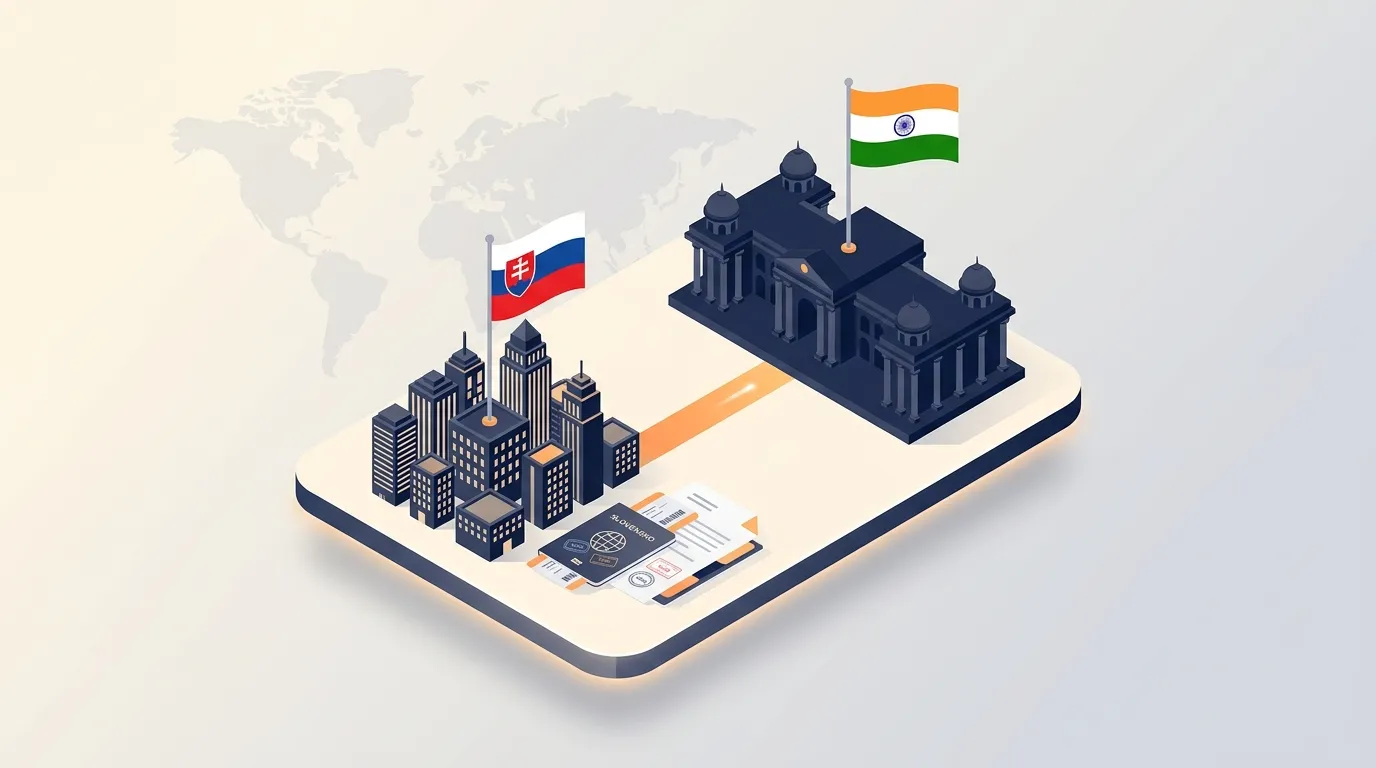
Company registration in India runs on the same statutory rail whoever the parent is, but the Slovakia corridor carries its own FEMA reporting, treaty and banking wrinkles. Here is the process, cost and timeline that actually holds in 2026.
## The Slovakia to India Corridor in 2026
Slovak automotive suppliers follow their German customers into India. For a Slovak parent, the mechanics of registering a company in India follow a fixed sequence: entity choice, documents, incorporation filing, banking, and the FEMA reporting that makes the investment legal. None of it requires travel, and all of it rewards getting the order right the first time.
We write this from the Indian side of the table. It is the internal checklist we use on live mandates, published because the corridor deserves a straight answer rather than a sales page.
## Entity Choice for a Slovak Parent
For nearly every Slovak parent the right structure is the simplest one: keep the s.r.o. at home exactly as it is, and set up a wholly owned Indian private limited company underneath it. Indian company law is built around this pattern, banks and regulators recognise it instantly, and the parent can hold 100 percent of the shares in most sectors under the automatic route.
A branch office can invoice but sits inside the parent's legal personality, and a liaison office cannot earn revenue at all. The wholly owned subsidiary ring fences liability, keeps funding and repatriation clean, and is the structure our [foreign subsidiary setup service](/services/foreign-subsidiary.html) is built around.
## Step by Step Incorporation
Incorporation itself runs on a fixed rail under Indian company law:
- Digital Signature Certificates for every proposed director, including the nominee resident director. For directors in Slovakia this happens through remote video verification.
- Name reservation through SPICe+ Part A, with two options submitted against the trademark and company registers.
- The SPICe+ filing itself: one integrated form covering incorporation, PAN, TAN, EPFO, ESIC and in most states GST, with the Memorandum and Articles attached and the Slovak parent shown as subscriber.
- Certificate of Incorporation from the Registrar of Companies, at which point the company exists with its own PAN, TAN and CIN.
From a clean document set, filing to certificate typically runs 30 to 45 days, and most of the elapsed time sits in document preparation on the Slovakia side rather than Indian processing queues.
## Documents and the Legalisation Chain in Slovakia
Slovakia is a member of the Hague Apostille Convention, which keeps the document chain short: notarise the parent's corporate documents locally, then obtain the apostille from the competent authority. No Indian consular legalisation is needed once the apostille is affixed. The set usually covers the parent's certificate of incorporation, constitutional documents, the board resolution authorising the Indian subsidiary, and identity and address proof for directors and beneficial owners. Order matters: notarise first, apostille second, and date the resolution before anything that relies on it. One missing apostille page is enough for the Registrar to raise a query and stall the filing.
## The Resident Director Rule
Every Indian private limited company needs at least one director who meets the residency test, which a team based entirely in Slovakia cannot satisfy on day one. The standard answer is a nominee resident director: provided as a service, bound by a nominee agreement that keeps their role narrow, holding no shares and taking no part in strategy. The Slovak parent keeps full control through its own directors and its 100 percent shareholding. This is not a grey area; it is how Indian law expects a foreign owned subsidiary to operate in its first years, and it is included in our standard corridor engagement.
## Banking, Capital and FC-GPR
Once incorporated, the subsidiary opens its Indian current account and the parent funds it by SWIFT from Slovakia. The receiving bank issues a Foreign Inward Remittance Certificate, the FIRC, which is the evidence that the money is share capital rather than a loan. Against it the company files Form FC-GPR on the RBI's FIRMS portal within 30 days of allotting shares, not 30 days of the wire, a distinction that catches out more subsidiaries than any other single rule. Working hours overlap is workable: Slovakia runs IST minus 3.5 to 4.5 hours, which leaves a clean daily window for bank calls and verification. Our [FEMA compliance](/services/fema-compliances.html) desk handles the FIRC, valuation and FC-GPR sequence end to end, because a missed window here becomes a compounding case later.
## Taxes on the Slovakia Corridor
The subsidiary pays Indian corporate tax at 25 percent, or 22 percent under the concessional regime for companies that give up specified incentives. GST applies at 18 percent on most services from the first invoice. Under the India Slovakia tax treaty, dividends to the parent are withheld at 15% at 25%+ holding, else 25% (former Czechoslovakia treaty), against a domestic rate of 20 percent plus surcharge, so the treaty paperwork, tax residency certificate, Form 10F and beneficial ownership, pays for itself on the first distribution. Intercompany charges, management fees, royalties or shared services, sit under transfer pricing rules with Form 3CEB disclosure, which is where our [transfer pricing advisory](/services/transfer-pricing-advisory.html) work starts. The full menu of routes home, dividends, royalties, buyback and capital reduction, is covered in our guide to [repatriation of profits from India](/insights/repatriation-of-profits-from-india-to-a-foreign-parent-the-2026-strategic-guide).
## The Compliance Calendar After Day One
After incorporation the calendar never stops: the FEMA annual return on Foreign Liabilities and Assets by 15 July, Registrar of Companies annual filings, monthly or quarterly GST, monthly TDS deposits, and statutory audit regardless of size. Miss a date and penalties compound quietly. This recurring layer is what our [virtual CFO service](/services/ecfo.html) exists to own, with a monthly close and a reporting pack the Slovakia head office can actually read.
## The First 90 Days After Incorporation
Treat the first 90 days as three sprints. Days 1 to 30: entity live, bank account open, capital received and evidenced. Days 31 to 60: FC-GPR filed inside its window, registrations completed, accounting stack and payroll running, intercompany agreements in draft. Days 61 to 90: first full compliance cycle closed, first management pack shipped to Slovakia, and the intercompany file signed and priced at arm's length. Subsidiaries that follow this sequence never meet the compounding process; subsidiaries that improvise usually do.
## Where Slovak Parents Lose Time
Four patterns cause nearly all the delay we see on this corridor:
- Documents notarised and apostilled in the wrong order, or a resolution dated after the documents that depend on it. The chain is cheap to redo early and expensive to redo from a Registrar query.
- Treating the FC-GPR window casually. Thirty days from allotment, and the clock does not pause for internal approvals in Slovakia.
- Signing intercompany agreements after the money has already moved, which turns clean planning into retrospective justification under transfer pricing review.
- Assuming the compliance calendar can wait for revenue. It starts at incorporation, revenue or not, and late fees accrue per day, not per reminder.
## Timeline and Fees
From clean documents, incorporation runs 30 to 45 days, and the subsidiary is typically revenue ready, able to invoice, hire and bank, within 45 days of starting. We quote a fixed fee before engagement covering incorporation, the nominee director, banking support and the initial FEMA filings. No hourly billing, no surprise invoice for a form that was always going to be needed.
## Why Slovak Companies Pick Krystal7
Slovak companies working with us get the same desk that runs every corridor we serve: over 10 years of cross border practice, more than 10,000 startups and founders advised across India and five continents, Chartered Accountants, first response within 4 business hours, and fixed fees quoted before signing. The team that incorporates the company is the team that files its FEMA reports and closes its books, so nothing is lost in a handover.
For the structure most foreign parents choose, read the [wholly owned subsidiary in India guide](/insights/wholly-owned-subsidiary-in-india), or go straight to the [foreign subsidiary registration service](/services/foreign-subsidiary.html) for the fixed fee scope.
## Frequently Asked Questions
### Can a Slovak company own 100 percent of an Indian subsidiary
Yes. A s.r.o. in Slovakia can hold 100 percent of an Indian private limited company in most sectors under the automatic route, with no local shareholder required.
### How long does it take to register an Indian company from Slovakia
With documents prepared correctly, 30 to 45 days from filing to Certificate of Incorporation, and revenue ready within about 45 days including banking and the first FEMA filings.
### Which documents need legalisation in Slovakia
The parent's certificate of incorporation, constitutional documents, authorising resolution and the directors identity and address proofs: notarised first, then apostilled in Slovakia. No Indian consular step is needed after the apostille.
### What is the dividend withholding rate on this corridor
Dividends from the Indian subsidiary to the Slovakia parent are withheld at 15% at 25%+ holding, else 25% (former Czechoslovakia treaty) under the treaty, provided the tax residency certificate, Form 10F and beneficial ownership are in place before the remittance.
### Do I need to travel to India to incorporate
No. Digital signatures are issued through video verification, documents move by courier after legalisation, and every filing is electronic. The entire process runs remotely from Slovakia.
### What does it cost to set up an Indian subsidiary from Slovakia
It depends on scope, incorporation, nominee director, banking support and FEMA filings, but the fee is fixed and quoted before signing, with no hourly billing and nothing added later for filings that were always required.
Frequently Asked Questions
Can a Slovak company own 100 percent of an Indian subsidiary
How long does it take to register an Indian company from Slovakia
Which documents need legalisation in Slovakia
What is the dividend withholding rate on this corridor
Do I need to travel to India to incorporate
What does it cost to set up an Indian subsidiary from Slovakia
Facing this in your own entity?
Guides explain the rules. A conversation solves your specific case. Talk to a Krystal7 advisor about your India entry, FEMA, or compliance position.
Book a Discovery Call