Authorised Economic Operator in India 2026: AEO Tiers and Benefits
How CBIC's AEO programme works in India: the four tiers, eligibility, benefits, monthly deferred duty from 1 Mar 2026, mutual recognition, the application and whether a foreign owned subsidiary should apply.
Krystal7 Consultants · India entry, tax and compliance
Written by CA Nandini Hasija, Krystal7 Consultants. Last updated 23 October 2026.
The authorised economic operator (AEO) programme is CBIC's voluntary accreditation for trusted traders, under Circular 33/2016-Customs of 22 Jul 2016. Importers and exporters hold AEO T1, T2 or T3, and logistics operators hold AEO LO. Applicants need three financial years of business and 25 customs documents in the last year, or two years and 10 for an MSME. From 1 Mar 2026, T2 and T3 importers pay deferred duty monthly.
This page is for foreign owned subsidiaries in India that import or export goods regularly. It explains each tier, the eligibility tests and the benefits, including deferred payment after the 2026 changes. It then covers mutual recognition, the application and our view on whether to apply.
What is the authorised economic operator programme in India?
The AEO programme is a voluntary scheme under which Indian customs accredits businesses with sound internal controls and secure supply chains. Accredited operators get faster clearance and lighter controls. CBIC's Directorate of International Customs runs it under Circular 33/2016-Customs of 22 Jul 2016, as amended.
The programme follows the World Customs Organization's SAFE Framework of Standards. Paragraph 1.22 of the Foreign Trade Policy 2023 describes it and lists the benefits for traders. These include a secure supply chain, a way to show compliance to overseas partners, reduced dwell time and customs help in MRA partner countries.
The scheme has grown in stages. CBIC set it out in a series of circulars, as the CBIC AEO FAQs of Aug 2019 record.
Instrument
Date
What it did
Circular 37/2011-Customs
23 Aug 2011
Pilot AEO programme
Circular 28/2012-Customs
16 Nov 2012
Revised programme and criteria
Circular 33/2016-Customs
22 Jul 2016
Current programme with tiers T1, T2, T3 and LO
Notifications 134/2016 and 135/2016-Customs (N.T.)
2 Nov 2016
Deferred Payment of Import Duty Rules, 2016 and the eligible class
Circular 52/2016-Customs
15 Nov 2016
Deferred duty payment for AEO T2 and T3 importers
Circular 26/2018-Customs
10 Aug 2018
AEO T1 form cut to two annexures; T1 eligibility decided in the zones
Circular 51/2018-Customs
7 Dec 2018
Online filing of AEO T1 applications
Circular 18/2021-Customs
31 Jul 2021
Continuous certification for AEO T1 with an annual self declaration
Notification 13/2026-Customs (N.T.)
1 Feb 2026
Monthly deferred duty payment from 1 Mar 2026
Notification 12/2026-Customs (N.T.) and Circular 08/2026-Customs
1 Feb 2026 and 28 Feb 2026
Deferred payment for Eligible Manufacturer Importers from 1 Apr 2026
The programme is large. India had 5,947 AEO entities on 31 Oct 2024 (PIB release 2079189, 29 Nov 2024). In Oct 2020 there were 4,362, according to a CBIC training presentation.
Participation is optional. FAQ 7 of the CBIC FAQs says "the AEO scheme is purely an optional scheme". No importer is penalised for staying out, but it gives up the benefits below.
What are AEO T1, T2, T3 and AEO LO?
Importers and exporters choose from three tiers. AEO T1 rests on documents. AEO T2 adds physical verification of premises and gives deferred duty payment. AEO T3 is the highest level and needs two years as an AEO T2. Logistics businesses hold a single tier, AEO LO.
Tier
Who it is for
Physical verification
Validity
Main extra benefit
AEO T1
Importers and exporters
No
Three years originally; continuous since Circular 18/2021 for those certified from 1 Apr 2019
Bank guarantee at 50 percent; direct port delivery and entry
AEO T2
Importers and exporters
Yes
Three years
Deferred duty payment; bank guarantee at 25 percent
AEO T3
AEO T2 holders with two years of continuous T2 status
Yes
Five years
Bank guarantee nil; container scanning waived
AEO LO
Logistics providers, custodians or terminal operators, customs brokers, warehouse operators
Yes
Five years
Recognised as a secure operator; covers only the operator
The validity periods come from FAQ 9. The T3 entry condition comes from a CBIC training presentation. FAQ 19 says AEO LO status covers only the applicant, not its clients.
For a foreign owned subsidiary, the choice is usually between T1 and T2. T1 is quicker and needs no site visit. T2 brings deferred payment, which is the benefit with the largest cash value for a regular importer.
Who is eligible for AEO status?
An applicant must be established in India and involved in customs related activity. It must have handled at least 25 bills of entry or shipping bills in the last financial year. It needs business activity for the last three financial years, a clean compliance record and financial solvency. MSMEs get lighter tests.
FAQ 28 lists the businesses that can apply. These include importers, exporters, logistics providers, custodians, terminal operators, customs brokers, warehouse owners, port operators, couriers and stevedores. The list is not exhaustive.
Criterion
Standard applicant
MSME applicant
Source
Establishment
Established in India
Established in India
CBIC AEO FAQs
Customs documents in the last financial year
25 bills of entry or shipping bills
10, with at least 5 in each half year
CBIC AEO FAQs; Mangaluru PN 03/2021
Business activity
Last three financial years
Two financial years
FAQ 31; Mangaluru PN 03/2021
Legal compliance record
Last three financial years
Last two financial years
FAQ 39 and 40; Mangaluru PN 03/2021
Financial solvency
Each of the last three financial years
Two financial years
FAQ 46; Mangaluru PN 03/2021
Extra for AEO T3
Two years of continuous AEO T2 status
Same
CBIC training presentation
Newly established companies are not shut out entirely. FAQ 31 says they may be considered in exceptional cases, after physical verification of their internal controls. Do not plan on that route for a new subsidiary.
CBIC tests legal compliance with a ratio. It compares duty demanded in show cause notices with duty paid or drawback claimed. Above 10 percent, the Programme Manager examines those notices and decides whether to issue or continue the status (FAQ 39 and 40).
Financial solvency rests on the books. FAQ 46 asks for a solvency certificate covering each of the last three financial years. It rests on the books of accounts, financial statements and tax returns. A subsidiary with accumulated losses should expect questions.
What benefits does each AEO tier get?
All tiers get direct port delivery for imports, direct port entry for factory stuffed exports and lower bank guarantees. T2 and T3 add deferred duty payment, waived seal verification and faster refunds. T3 adds waived container scanning.
Benefit
AEO T1
AEO T2
AEO T3
Bank guarantee, as a share of the normal amount
50%
25%
Nil
Deferred duty payment
No
Yes
Yes
Direct port delivery of imports
Yes
Yes
Yes
Direct port entry for factory stuffed exports
Yes
Yes
Yes
Seal verification
Required
Waived
Waived
Container scanning at port
Required
Priority
Waived
Priority processing of bills of entry and shipping bills
Yes
Higher than T1
Higher than T2
Consolidated ICEGATE data access
No
Yes
Yes
Client Relationship Manager at the Chief Commissioner's office as single point of contact (FAQ 73)
Yes
Yes
Yes
Faster drawback and refund disbursal
No
Yes
Yes
The table follows the CBIC training presentation. The FAQs list more benefits across the programme. They include waiver of merchant overtime fees, on site post clearance audit in place of transactional audit (FAQ 11), and a lower risk score in customs risk analysis. Customs brokers with AEO status are spared the solvency certificate.
The bank guarantee benefit has limits. FAQ 13 says the cut to 50 percent, 25 percent and nil applies only in the situations listed in Circular 38/2016-Customs. It does not apply where customs orders a guarantee for the provisional release of seized goods.
Direct port delivery needs a separate step. FAQ 12 says an AEO must apply to the Chief Commissioner for permission and register with the port authority. The status alone does not move containers.
The benefits show up in release times. CBIC's National Time Release Study 2025 found that "AEO clients generally enjoy lower ART across most port categories". It noted an exception at integrated check posts. It also recommended expanding deferred payment.
How does deferred duty payment work for AEOs?
Deferred payment lets an eligible importer clear goods first and pay customs duty later. AEO T2 and T3 importers have had it since Nov 2016. Circular 52/2016-Customs of 15 Nov 2016 followed the notifications of 2 Nov 2016. From 1 Mar 2026, duty on bills of entry returned for payment in a month is due by the 1st of the next month. March duty is due by 31 March.
The legal basis is the proviso to section 47(1) of the Customs Act, 1962. Notification 134/2016-Customs (N.T.) made the Deferred Payment of Import Duty Rules, 2016. Notification 135/2016-Customs (N.T.) named the eligible importers. CBIC describes the idea as clear first and pay later (FAQ 14).
Until 28 Feb 2026, the cycle ran twice a month. Bills returned from the 1st to the 15th were paid by the 16th. Bills returned from the 16th to month end were paid by the 1st of the next month. March bills from the 16th were paid by 31 March (FAQ 16).
The Union Budget 2026-27 changed this. Paragraph 163 of the Budget speech of 1 Feb 2026 proposed to "enhance duty deferral period for Tier 2 and Tier 3 Authorised Economic Operators". The period moved from 15 days to 30 days.
Notification 13/2026-Customs (N.T.) of 1 Feb 2026 made the Deferred Payment of Import Duty (Amendment) Rules, 2026. They came into force on 1 Mar 2026 and substituted the due dates in rule 4.
Bill of entry returned for payment
Due date until 28 Feb 2026
Due date from 1 Mar 2026
1st to 15th of a month other than March
16th of the same month
1st of the next month
16th to last day of a month other than March
1st of the next month
1st of the next month
1st to 15th March
16 March
31 March
16th to 31st March
31 March
31 March
The March rule keeps duty inside the financial year. A bill returned late in March gets little or no deferral. Plan cash for 31 March.
What is the Eligible Manufacturer Importer facility?
It is a deferred payment route for manufacturers that do not yet hold AEO T2 or T3 status. Notification 12/2026-Customs (N.T.) of 1 Feb 2026 created the class. CBIC Circular 08/2026-Customs of 28 Feb 2026 sets the tests. The facility runs from 1 Apr 2026 to 31 Mar 2028.
Paragraph 164 of the Budget speech proposed to give eligible manufacturer importers the same deferral as AEOs. The aim is to move them towards AEO T3 later. Circular 08/2026-Customs says approved EMIs are expected to obtain AEO T2 or T3 within the facility period.
The main tests in paragraph 3 of the circular are these.
The applicant is an importer and a manufacturer under the CGST Act. An importer that sends inputs or capital goods to a job worker under section 143 also qualifies.
It holds a valid IEC.
It filed at least 25 bills of entry or shipping bills in the previous financial year, or 10 for an MSME.
Its aggregate turnover across GSTINs on the same PAN exceeded INR 5 crore in the last financial year.
It has carried on business for at least two financial years before applying.
It has filed all pending GSTR-3B returns and holds no tax collected but not paid.
It was solvent in the two preceding financial years, backed by a CA certificate.
Neither it nor its directors face arrest, conviction or pending prosecution under the listed laws.
Applications opened on the AEO portal on 1 Mar 2026. Once approved, a nodal person gets an ICEGATE login. The importer flags each bill of entry with "D" and authenticates it with an OTP. Existing AEO T1 holders that meet the tests can also apply.
How much does AEO status reduce bank guarantees?
An AEO T1 furnishes 50 percent of the bank guarantee a non AEO would give. An AEO T2 furnishes 25 percent and an AEO T3 none. MSME AEOs get deeper cuts: 25 percent for T1 and 10 percent for T2. These cuts apply only in the situations Circular 38/2016-Customs lists.
Guarantees matter most during provisional assessment. A subsidiary whose related party imports sit with the Special Valuation Branch may be asked for security. Our guide to customs duty in India explains the SVB process and when security applies.
Which countries recognise Indian AEO status?
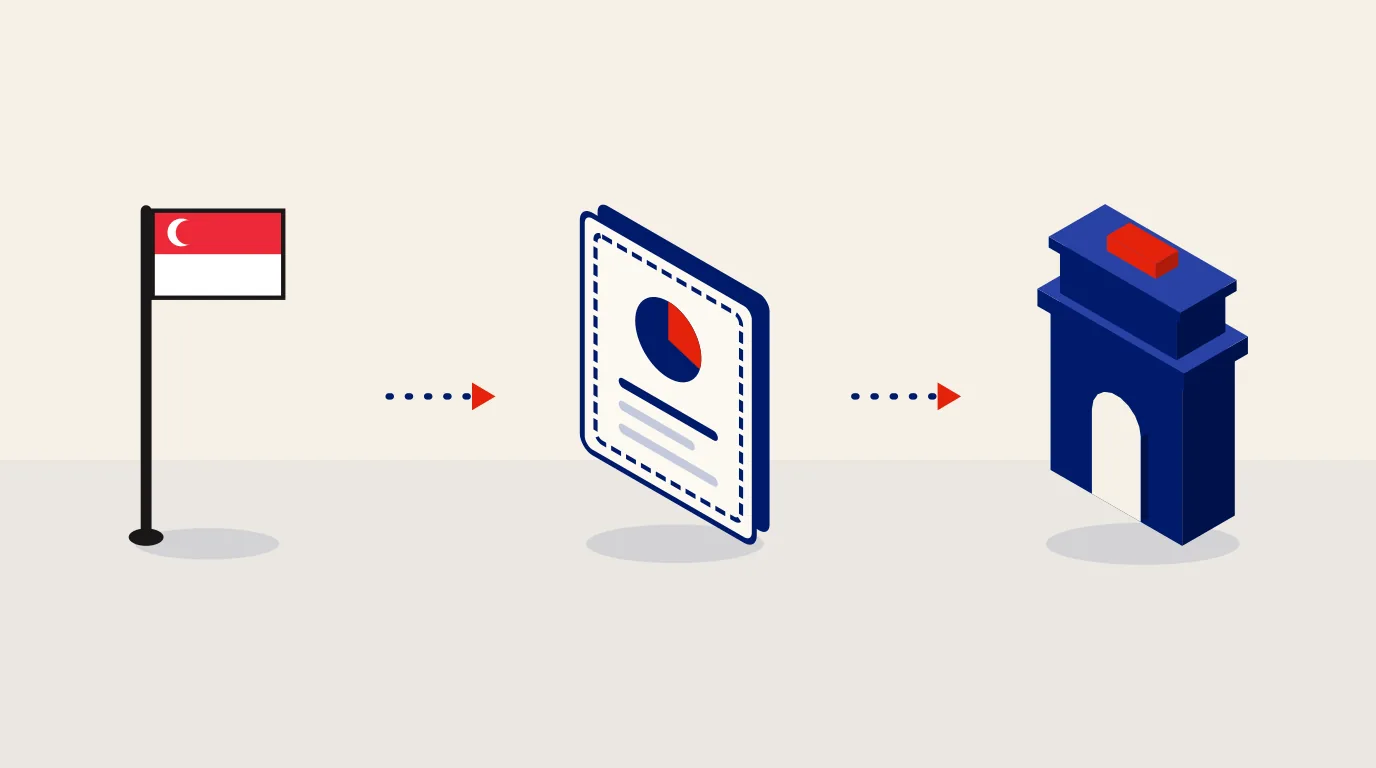
By 29 Nov 2024 India had AEO mutual recognition arrangements with seven partners, according to PIB. They are South Korea, Hong Kong, Taiwan, the USA, the UAE, Australia and Russia. The India Singapore arrangement became operational on 1 Sep 2025. Each partner treats the other's AEOs as trusted operators.
Partner
Status
Official source
South Korea
Signed
FTP 2023 para 1.22; PIB 2079189
Taiwan
Signed
FTP 2023 para 1.22; PIB 2079189
Hong Kong
Signed
FTP 2023 para 1.22; PIB 2079189
United States
Signed
FTP 2023 para 1.22; PIB 2079189
United Arab Emirates
Signed
PIB 2079189
Australia
Signed
PIB 2079189
Russia
Signed
PIB 2079189
Singapore
Operational from 1 Sep 2025
Singapore Customs Circular 07/2025
Uganda, East African Community, South Africa, Japan, Bahrain, New Zealand, UK, Belarus, BRICS, Brazil
Joint action plans towards an MRA
PIB 2079189
Singapore Customs Circular 07/2025 of 22 Aug 2025 shows how an MRA works in practice. Singapore STP Plus companies exporting to India get faster clearance. Indian AEOs get similar treatment on exports to Singapore. A Singapore importer quotes the Indian supplier's 17 character AEO code, starting "IN", in its declaration.
PIB's release of 16 Sep 2026 on the ten year event announced no new MRA. It listed expanded MRAs as an aim for the next decade. Check the MRA list on the AEO India portal for any later partner.
Two points often confuse foreign groups. First, a parent's certification at home does not make the Indian subsidiary an AEO in India. Second, the MRA helps the exporter's goods on arrival in the partner country. Ahmedabad Customs lists MRA benefits against AEO T2 and T3 on its AEO page.
The applicant files online on the AEO India portal with the annexures for its tier. CBIC aims to decide an AEO T1 application within 30 days of complete information, or 15 working days for an MSME. An AEO T2 or LO application can take up to 180 days because it includes a site visit.
Circular 26/2018-Customs of 10 Aug 2018 cut the AEO T1 form to two annexures. It also let customs zones decide T1 eligibility. Circular 51/2018-Customs of 7 Dec 2018 moved T1 filing online. An MSME files MSME Annexures 1 and 2 for T1, and adds MSME Annexure 3 on security for T2.
FAQ 57 sets these stages for AEO T2 and LO:
Customs acknowledges receipt within 30 days.
It assigns the application to an AEO team within 15 days.
The team visits the premises within 90 days. The applicant may follow up if no visit is planned within 45 days.
The team reports within 60 days of the visit.
Customs decides within 30 days of the recommendation, within 180 days overall.
For an MSME, the Mangaluru notice cuts the T2 timeline to three months from complete documents. An AEO T3 application from a T2 holder is assigned within 15 days and then follows the T2 timelines.
Before filing, gather these documents:
IEC, PAN, GST registrations and the Udyam certificate if the applicant is an MSME.
A list of bills of entry and shipping bills for the last financial year.
Audited financial statements and tax returns for the solvency years.
A solvency certificate from a chartered accountant.
Details of any show cause notices, demands and appeals for the compliance years.
For T2 and LO, the security procedures for premises, cargo, staff, IT and business partners.
How does validation work for AEO T2, T3 and LO?
Validation is a physical check of the applicant's customs related premises by a customs AEO team. It tests whether the controls the applicant described in its annexures work in practice. It is needed for T2, T3 and LO, and not for T1.
FAQ 58 to 60 describe the visit. The team checks all customs related premises. If several sites run the same way, it may visit one, on the applicant's undertaking. It looks at customs contraventions, accounting and logistics systems, internal controls, cargo flow, IT security and financial solvency.
The team can pause the validation by mutual consent in exceptional cases. The applicant must then report the corrections within 6 months. We tell clients to run a mock review first, because a pause adds months to a timeline that is already long.
A foreign owned subsidiary often relies on group systems. The team will want to see how the Indian entity controls them. Keep a short note on which ERP, warehouse and IT controls sit with the parent and how India accesses them.
How long is AEO status valid and how is it renewed?
AEO T2 is valid for three years. AEO T3 and LO are valid for five years. AEO T1 was valid for three years, but Circular 18/2021-Customs of 31 Jul 2021 moved it to continuous certification. A T1 holder now files a self declaration each year between 1 Oct and 31 Dec.
Under the old rule, a T1 holder applied for renewal 30 days before expiry. JNCH set out the new process in Public Notice 77/2021 of 4 Aug 2021. AEO T1 entities certified on or after 1 Apr 2019 moved to continuous certification from 1 Aug 2021.
The zone runs a comprehensive compliance review after at least two annual declarations. It must finish before 31 October, the due date of the third declaration. An entity certified during a calendar year need not file for that year.
Status can be lost. Customs and GST field formations, DGRI and DGGI must report any show cause notice or proceeding against an AEO. They report to the zone and the National AEO Programme Manager (Public Notice 77/2021, paragraph 11). A revoked AEO T1 returns only through a fresh application, and FAQ 72 lets T1 and T2 holders apply again one year after revocation.
How does AEO status link to the Foreign Trade Policy?
AEO status opens the Self Ratification Scheme for advance authorisation. Paragraph 4.06(iv) of the Foreign Trade Policy 2023 lets an exporter holding an AEO certificate use the scheme. Paragraph 4.06(v) admits a two star or higher status holder that has applied for AEO, if it gets AEO within 120 days.
The Self Ratification Scheme lets an exporter obtain an advance authorisation on its own declared input norms where no standard norm exists. Paragraph 4.06(v) covers only status holders that are manufacturers cum actual users, and it sets more conditions. These include no rejection, no infringement cases, positive net current assets and no insolvency proceedings (FTP 2023 Chapter 4).
If AEO status does not come within 120 days, DGFT withdraws the facility. The holder must then go to the Norms Committee. For an exporter that uses advance authorisation, this link alone can justify the AEO application.
Every AEO applicant needs an Importer Exporter Code first. Our IEC guide covers the DGFT side.
Should a foreign owned importer apply for AEO status?
Yes, once it qualifies and imports regularly. AEO T2 is the target for an importer that pays significant duty, because deferred payment is worth real money after 1 Mar 2026. A new subsidiary cannot qualify for two or three years. A manufacturer with two years of business can use the EMI route in its third year.
This is our view, based on the tests and benefits above. It depends on the subsidiary's volume and its readiness for an audit of its controls.
Subsidiary profile
Our view
Under two financial years old, few imports
Not eligible yet. Build clean customs records and file every bill of entry on time.
Manufacturer, two or more years, 25 or more documents, turnover above INR 5 crore
Apply as an Eligible Manufacturer Importer now. Plan AEO T2 before 31 Mar 2028.
Trader or service company, three or more years, 25 or more documents
Apply for AEO T1, then move to T2 if annual duty is large.
MSME on Udyam, two or more years, 10 or more documents
Use the MSME route for T1 or T2, with lower guarantees and faster decisions.
Exporter to an MRA country
Apply for T2. Partner customs recognise Indian AEOs only through the MRA.
Open demands above 10 percent of duty paid
Settle or document the disputes first, because the Programme Manager will examine them.
The costs are mostly internal. The subsidiary needs written procedures, a solvency certificate, a security review for T2 and an annual declaration for T1. It also needs discipline: show cause notices above the 10 percent ratio put the status in the Programme Manager's hands.
Other government agencies to use AEO status for preferential clearance
Budget speech 2026-27, paragraph 166 (proposal)
1 Feb 2026
Trusted importers went through the normal release process
Trusted importers' goods with no compliance requirement released on arrival
Budget speech 2026-27, paragraphs 167 and 168 (proposal)
1 Mar 2026
Deferred duty due on the 16th or the 1st, twice a month
Due by the 1st of the next month; March by 31 March
Notification 13/2026-Customs (N.T.) of 1 Feb 2026
1 Mar 2026
No deferral for non AEO manufacturers
EMI applications open on the AEO portal
Circular 08/2026-Customs of 28 Feb 2026; PIB release 2234116 of 1 Mar 2026
1 Apr 2026
Deferred payment only for AEO T2 and T3
Also for Eligible Manufacturer Importers until 31 Mar 2028
Notification 12/2026-Customs (N.T.) of 1 Feb 2026
A PIB background note of 5 Mar 2026 restates the AEO measures. It describes deferred payment as "a mechanism for delinking duty payment and Customs clearance".
What has happened since
This page first went up on 22 Mar 2026. These events came after that date.
The EMI deferred payment facility started on 1 Apr 2026. Mangaluru Customs repeated the conditions in Public Notice 11/2026 of 27 Mar 2026.
CBIC marked ten years of the 2016 programme at the AEO@10 event in New Delhi on 16 Sep 2026. PIB reported 5,967 certified entities across T1, T2, T3 and LO (PIB release 2310823, 16 Sep 2026).
Circular 39/2026-Customs of 3 Sep 2026 cut the EMI scheme upload from ten documents to three, from 15 Sep 2026 (same PIB release).
Worked example
Two calculations show what AEO status is worth to a subsidiary that imports steadily. The figures are illustrative.
Deferred payment. The subsidiary pays INR 1,20,00,000 of customs duty a month, including IGST. Bills are returned for payment evenly over a 30 day month. Its working capital costs 9 percent a year.
Without deferral, it pays on the day each bill is returned. The float is nil.
Under the twice monthly cycle to 28 Feb 2026, the average deferral was 8 days. Interest saved: INR 23,671 a month, or INR 2,84,055 a year.
Under the monthly cycle from 1 Mar 2026, the average deferral is 15.5 days. Interest saved: INR 45,863 a month, or INR 5,50,356 a year.
The monthly rule roughly doubles the value of deferral. The calculation is INR 1,20,00,000 × 15.5 ÷ 365 × 9 percent = INR 45,863 a month. March differs slightly, because all March duty falls due on 31 March and a bill returned on 31 March gets no deferral.
Bank guarantee. Customs asks a non AEO importer for a guarantee of INR 50,00,000 in a situation listed in Circular 38/2016-Customs. Assume the bank charges 1.5 percent a year.
Non AEO: guarantee INR 50,00,000, bank charge INR 75,000 a year.
AEO T1: guarantee INR 25,00,000, bank charge INR 37,500 a year.
AEO T2: guarantee INR 12,50,000, bank charge INR 18,750 a year.
AEO T3: no guarantee and no charge.
MSME AEO T1: guarantee INR 12,50,000, bank charge INR 18,750 a year.
MSME AEO T2: guarantee INR 5,00,000, bank charge INR 7,500 a year.
The guarantee also blocks bank limits. An AEO T2 frees INR 37,50,000 of limits in this case.
Common mistakes
Applying before the subsidiary has three financial years, or two as an MSME. Fix: diary the eligibility date and keep clean records until then.
Counting the parent's or the customs broker's documents. Fix: count only bills of entry and shipping bills filed under the subsidiary's own IEC.
Assuming AEO status gives direct port delivery. Fix: apply to the Chief Commissioner and register with the port authority.
Expecting lower guarantees in every case. Fix: check whether the case falls within Circular 38/2016-Customs.
Missing the AEO T1 annual self declaration. Fix: file it between 1 Oct and 31 Dec each year.
Planning cash on the old deferral cycle. Fix: plan for duty on the 1st of each month and the full March duty on 31 March.
Relying on the parent's home accreditation. Fix: apply in India for the Indian entity.
Leaving old show cause notices unexplained. Fix: prepare a note on each demand and its status before filing.
Treating EMI approval as permanent. Fix: plan the AEO T2 application well before 31 Mar 2028.
Checklist
Confirm the subsidiary has the business years and customs documents for the tier it wants.
Check the MSME status on Udyam, because MSME tests and guarantees are lighter.
List all show cause notices and demands for the compliance years, with their status.
Obtain the solvency certificate and audited financial statements for each year.
Write down the customs, accounting, inventory and IT controls the Indian entity runs.
Review security for premises, cargo, staff and business partners if applying for T2.
File the application and annexures on the AEO India portal.
Prepare the premises and staff for the validation visit.
Apply separately for direct port delivery once the status is granted.
Set up deferred payment and plan cash for the 1st of each month and 31 March.
Diary the T1 annual self declaration or the T2 and T3 renewal date.
Apply as an Eligible Manufacturer Importer meanwhile if the subsidiary is a manufacturer that qualifies.
We help subsidiaries prepare the AEO file alongside their IEC registration and customs set up.
Frequently Asked Questions
What is an authorised economic operator in India?+
It is a business that Indian customs has accredited as compliant and secure under CBIC Circular 33/2016-Customs of 22 Jul 2016. The programme follows the WCO SAFE Framework. Accredited importers, exporters and logistics operators get faster clearance, lower guarantees and, at higher tiers, deferred duty payment.
What are the AEO tiers in India?+
There are four. Importers and exporters hold AEO T1, T2 or T3, with T3 the highest. Logistics providers, custodians or terminal operators, customs brokers and warehouse operators hold AEO LO. T1 rests on documents. T2, T3 and LO need physical verification of premises.
Who can apply for AEO certification in India?+
A business established in India that takes part in the international supply chain can apply. It needs 25 bills of entry or shipping bills in the last financial year and three financial years of business. It also needs a clean compliance record and financial solvency. MSMEs need two years and 10 documents.
Can a foreign company get AEO status in India?+
Only through an Indian entity. The CBIC AEO FAQs require the applicant to be established in India. A foreign parent's accreditation in its home country does not make its Indian subsidiary an AEO. The subsidiary applies in its own name, using its own customs records.
How long does AEO T1 certification take?+
CBIC aims to grant AEO T1 within 30 days of receiving complete information, under FAQ 57 of the CBIC AEO FAQs. For an MSME, Mangaluru Customs Public Notice 03/2021 sets 15 working days. AEO T2 and LO take longer, up to 180 days, because they include a site visit.
How long is AEO certification valid?+
AEO T2 is valid for three years. AEO T3 and AEO LO are valid for five years, under FAQ 9 of the CBIC AEO FAQs. AEO T1 moved to continuous certification under Circular 18/2021-Customs of 31 Jul 2021. A T1 holder keeps its status through an annual self declaration.
Does AEO T1 need renewal?+
Not in the old sense. Since Circular 18/2021-Customs, AEO T1 holders certified from 1 Apr 2019 file a self declaration each year between 1 Oct and 31 Dec. The zone runs a compliance review after at least two declarations. It can approve continued status or revoke it.
What is deferred duty payment for AEOs?+
It lets an AEO T2 or T3 importer clear goods before paying customs duty. The basis is the proviso to section 47(1) of the Customs Act, 1962 and the Deferred Payment of Import Duty Rules, 2016. CBIC calls the principle clear first and pay later. Eligible Manufacturer Importers can use it until 31 Mar 2028.
When is deferred customs duty due from 1 Mar 2026?+
Duty is due by the 1st of the next month. That is rule 4 of the Deferred Payment of Import Duty Rules, 2016, as substituted by Notification 13/2026-Customs (N.T.). That applies to bills of entry returned for payment in any month except March. Duty on March bills is due by 31 March.
What is an Eligible Manufacturer Importer?+
It is a class of importer created by Notification 12/2026-Customs (N.T.) of 1 Feb 2026 that can defer duty without AEO status. Circular 08/2026-Customs requires manufacturer status, 25 customs documents a year, turnover above INR 5 crore and two years of business. The facility runs from 1 Apr 2026 to 31 Mar 2028.
Which countries have AEO mutual recognition with India?+
By 29 Nov 2024 India had MRAs with South Korea, Hong Kong, Taiwan, the USA, the UAE, Australia and Russia, according to PIB release 2079189. The India Singapore MRA became operational on 1 Sep 2025, under Singapore Customs Circular 07/2025. Joint action plans exist with several others, including Japan and the UK.
How much bank guarantee does an AEO furnish?+
An AEO T1 gives 50 percent of the normal guarantee, an AEO T2 gives 25 percent and an AEO T3 gives none. An MSME AEO T1 gives 25 percent and an MSME AEO T2 gives 10 percent. These cuts apply only in situations listed in Circular 38/2016-Customs.
What relaxations do MSMEs get under the AEO programme?+
Under CBIC's MSME package of 7 Jan 2021, as set out in Mangaluru Customs Public Notice 03/2021, an MSME needs two financial years of business, not three. It needs 10 customs documents, with at least 5 in each half year. Decisions come within 15 working days for T1 and three months for T2. Guarantees fall to 25 percent and 10 percent.
Does AEO status help with advance authorisation?+
Yes. Paragraph 4.06(iv) of the Foreign Trade Policy 2023 lets an exporter holding an AEO certificate use the Self Ratification Scheme for advance authorisation. Paragraph 4.06(v) also admits two star or higher status holders that have applied for AEO, if they obtain it within 120 days.
Is AEO certification mandatory for importers in India?+
No. FAQ 7 of the CBIC AEO FAQs says "the AEO scheme is purely an optional scheme". An importer without AEO status clears goods normally, but it pays duty before clearance and furnishes full guarantees. It also misses the priority treatment the programme gives.
Sources
CBIC, Frequently Asked Questions on the Authorised Economic Operator programme (hosted by JNCH), Aug 2019, https://www.jawaharcustoms.gov.in/pdf/Authorised%20Economic%20Operator%20(AEO)_FAQ_English.pdf
CBIC, Training presentation on the Authorised Economic Operator scheme (hosted by Bengaluru Customs), data as in Oct 2020, https://bangalorecustoms.gov.in/wp-content/uploads/2023/11/Authorised-Economic-Operator-Scheme-AEO.pdf
Ahmedabad Customs, AEO Programme page, accessed 23 Oct 2026, https://gujaratcustoms.gov.in/aeo-programme-2/
Jawaharlal Nehru Custom House, Public Notice 77/2021 on continuous certification of AEO T1 (Circular 18/2021-Customs), 4 Aug 2021, http://www.jawaharcustoms.gov.in/pdf/PN-2021/PN-77-2021.pdf
Mangaluru Customs, Public Notice 03/2021 on special measures for MSMEs under AEO T1 and T2, 8 Jan 2021, https://bangalorecustoms.gov.in/wp-content/uploads/2024/05/mcc_pn_03_2021.pdf
Press Information Bureau, CBIC introduces liberalised AEO package for MSMEs (release 1686826), 7 Jan 2021, https://www.pib.gov.in/PressReleasePage.aspx?PRID=1686826®=48&lang=2
Press Information Bureau, CBIC organises global India AEO programme with the World Bank (release 2079189), 29 Nov 2024, https://www.pib.gov.in/PressReleasePage.aspx?PRID=2079189
Press Information Bureau, CBIC commemorates 10 years of India's AEO Programme (release 2310823), 16 Sep 2026, https://www.pib.gov.in/PressReleasePage.aspx?PRID=2310823
Press Information Bureau, CBIC introduces deferred customs duty payment facility for Eligible Manufacturer Importers (release 2234116), 1 Mar 2026, https://www.pib.gov.in/PressReleasePage.aspx?PRID=2234116®=3&lang=1
Singapore Customs, Circular 07/2025 on implementation of the India Singapore Mutual Recognition Arrangement, 22 Aug 2025, https://www.customs.gov.sg/files/businesses/SLMB/Circular_07_2025_Ver1_.pdf
Directorate General of Foreign Trade, Foreign Trade Policy 2023, Chapter 1 (paragraph 1.22), https://content.dgft.gov.in/Website/dgftprod/6fa664dd-040d-4e1f-bd94-a0478856be5b/FTP2023_Chapter01.pdf
Directorate General of Foreign Trade, Foreign Trade Policy 2023, Chapter 4 (paragraph 4.06), https://content.dgft.gov.in/Website/dgftprod/a11b458e-0d61-460f-aef4-b201ed40a9aa/FTP2023_Chapter04.pdf
Ministry of Finance, Budget Speech 2026-27 (paragraphs 162 to 168), 1 Feb 2026, https://www.indiabudget.gov.in/doc/budget_speech.pdf
CBIC, Notification 13/2026-Customs (N.T.), Deferred Payment of Import Duty (Amendment) Rules, 2026, 1 Feb 2026, https://www.indiabudget.gov.in/doc/cen/cus1326.pdf
CBIC, Circular 08/2026-Customs on deferred payment for Eligible Manufacturer Importers, 28 Feb 2026, https://static.pib.gov.in/WriteReadData/specificdocs/documents/2026/mar/doc202631807301.pdf
Mangaluru Customs, Public Notice 11/2026 on deferred payment for Eligible Manufacturer Importers, 27 Mar 2026, https://bangalorecustoms.gov.in/wp-content/uploads/2026/04/mcc_pn_11_2026.pdf
Press Information Bureau, Policy reforms that transformed the business environment (background note), 5 Mar 2026, https://static.pib.gov.in/WriteReadData/specificdocs/documents/2026/mar/doc202635811201.pdf
CBIC, National Time Release Study 2025, Jun 2025, https://static.pib.gov.in/WriteReadData/specificdocs/documents/2025/jun/doc2025620574401.pdf
TALK TO AN ADVISOR
Facing this in your own entity?
Guides explain the rules. A conversation solves your specific case. Talk to a Krystal7 Consultants advisor about your India entry, FEMA or compliance position.
Nandini Hasija is a co-founder of Krystal7. She leads brand, business development and marketing, and works with founders to define their engagement. She is a Chartered Accountant and achieved All India Rank 49 in the CA examinations.
Six things you can check before you sign, and hold us to after.
A Chartered Accountant signs off
Filings go out through our Chartered Accountant practice, led by CA Nandini Hasija, All India Rank 49, ICAI.
A reply within 4 business hours
The team is online from 9:30 AM to 11:59 PM IST, which covers the working day in the UK and the UAE, the afternoon in Singapore and the morning in the US.
The fee is fixed before work starts
You see the professional fee in writing first. Government fees are passed on at cost.
Both sides of the border, one team
Company law, FEMA and RBI reporting, tax and transfer pricing sit with the same advisers.
Your due dates, tracked by us
We keep the compliance calendar for your entity and tell you what is due before it is due.
500+ clients across 5 continents
More than 50 advisers on the bench when a matter needs a specialist.
Working with the Kristal7 team has been an absolute pleasure. Their professionalism, attention to detail, pace they work at and commitment to delivering top-quality results stand out. They took the time to understand our needs and executed seamlessly. Highly recommend Kristal7 to anyone looking for a reliable partner to establish business in India.
We can't be happier after dealing with true professionals who really do things in India. Absolutely recommended, high-class professionals, Nihal knows his stuff better than anybody in India, trust me. Highly recommended if you ever need any type of business needs to be done properly and ON TIME in India! Thank you guys!!!
Krystal7 Consultants has an exemplary and professional attitude in their approach to services rendered by them. The team and it's leaders are thoroughly aggressive all throughout setting the processes timely and getting procedures done in a time bound and disciplined manner. Highly recommended Consultants to go-to.We wish them all the very best in all their future endeavours and growth story.
I had a great experience with this firm while filing my ITR! The team handled my ITR filing end-to-end, answered all my queries patiently, and made the entire process smooth and hassle-free. Nandini is highly professional, responsive, and took complete ownership throughout. Highly recommended for anyone looking for reliable tax filing assistance.
Very energetic and young professionals with best consultation and commitment of work completion on time in regionable fees. Mr. Nihal is very punctual & committed .
Very happy with my experience with them. They have thoroughly guided me through the processes and executed them as planned, for all my registrations. Definitely would recommend using their services.
Recap
Crystal Seven Consultants, especially Nandini Hassija and Nihal Srivastava, have redefined my experience with compliance management. From professionalism to problem-solving, they delivered trust, accuracy, and peace of mind—qualities rare in this industry.
Detailed Review
When Nandini first called me from Crystal Seven Consultants, I’ll admit I was hesitant. In the compliance and consultancy space, it’s common to see aggressive sales tactics with little to no delivery. But Nandini immediately broke that stereotype with her professionalism, clear communication, and genuine approach. She personally assisted me with something as important as a resignation process, ensuring it was handled responsibly and without stress.
Later, Nihal stepped in and impressed me with his technical expertise and eye for detail. He uncovered a serious compliance error (a mug-up) created by my previous consultant—something that could have been risky and damaging for my company. The way Nihal managed this issue with care, accuracy, and professionalism gave me full confidence that my compliance matters were finally in safe hands.
Today, I rest assured knowing that Daxy’s compliances are being managed with integrity, precision, and accountability. Both Nandini and Nihal have shown me that this industry can, in fact, be built on trust, transparency, and delivery.
I genuinely recommend Crystal Seven Consultants to any business owner who wants their legal, financial, and compliance matters handled not just properly—but with care, reliability, and genuine expertise.
We use Google Analytics to see how the site is used and Google Ads cookies to measure enquiries that come from our ads. You choose what we use, and you can change it at any time. Cookie policy