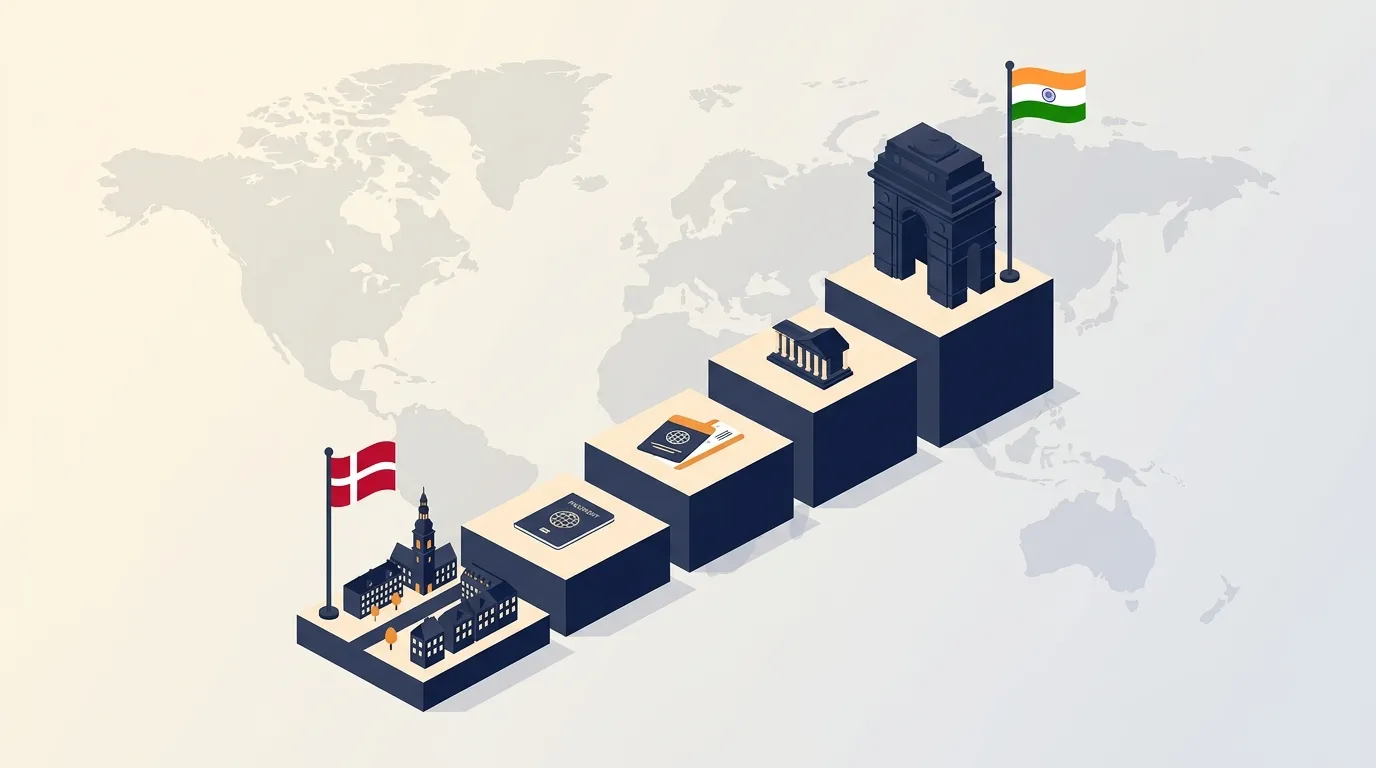
Company registration in India runs on the same statutory rail whoever the parent is, but the Denmark corridor carries its own FEMA reporting, treaty and banking wrinkles. Here is the process, cost and timeline that actually holds in 2026.
## The Denmark to India Corridor in 2026
Danish companies have been active in India for long enough that the corridor now has a clear operating pattern. For promoters in green energy, shipping, industrial systems and water technology, India is usually not a speculative market. It is a market that often requires a local subsidiary to contract properly, recruit talent, service customers and anchor regional operations.
The corridor has visible templates. Maersk, Vestas, Grundfos and Danfoss all sit inside the Danish playbook for India, and many newer Danish businesses enter with a similar logic: set up a clean operating subsidiary instead of trying to do long term business through a thin representative model. The practical question is therefore direct: how do you register a company in India from Denmark, and get it to a usable, revenue ready state without avoidable detours.
From the Indian side, the answer is not mysterious, but it is sequence dependent. Entity choice, apostille, resident director support, bank account opening, FEMA reporting, treaty planning and the compliance calendar all need to fit together. This guide lays out that process for a Danish parent in 2026.
## Entity Choice: ApS or A/S Parent, Indian Private Limited Wholly Owned Subsidiary
For most Danish groups, the preferred structure is to keep the parent as a Danish ApS or A/S and set up an Indian private limited company as a wholly owned subsidiary. This is the structure Indian company law and Indian banks are used to dealing with, and it allows the Danish parent to own and control the Indian vehicle fully.
That makes practical sense. A wholly owned subsidiary can hire, invoice, lease premises, contract with customers and vendors, and receive capital in a straightforward way. It is also the format that aligns best with ongoing tax compliance, group reporting and later profit repatriation.
Branch offices and liaison offices still exist as legal concepts in India, but they are not usually the right answer for a Danish business that wants real commercial activity. The structure we use in our [foreign subsidiary setup service](/services/foreign-subsidiary.html) is the Indian private limited wholly owned subsidiary because it is the route that best fits long term operating plans.
## Step by Step Incorporation: DSC, Name Reservation, SPICe+, MoA
Once the structure is chosen, the legal formation follows a standard sequence.
- Digital Signature Certificate, DSC: each proposed director needs an Indian DSC before the incorporation forms can be submitted.
- Name reservation: the proposed company name is checked and reserved through the approved filing route, with backup options normally prepared.
- SPICe+ filing: the integrated incorporation process captures the company formation details and linked registrations such as PAN and TAN.
- Memorandum of Association and Articles of Association: these constitutional documents are drafted and submitted as part of the formation package.
- Certificate of Incorporation: once approved by the Registrar of Companies, the Indian company is formally incorporated.
The process is routine if the document trail is clean. Delays usually come from preparation issues rather than from complexity in Indian law. In cross border cases, apostille timing, signatory consistency and correct parent company details matter a lot.
## Documents and the Apostille Chain in Denmark
Denmark is a Hague Apostille member, so the legalisation path is easier than in a non Hague jurisdiction. For Danish incorporation documents intended for use in India, the usual route is notarisation where required and apostille from the Ministry of Foreign Affairs in Copenhagen. No additional Indian consular legalisation is normally required after a proper apostille.
The typical document package includes the Danish parent's registration and constitutional documents, a board resolution approving the Indian subsidiary and its authorised signatory, plus identity and address proofs for directors and beneficial owners. The exact forms can vary, but the consistency requirement does not.
The practical issue is not whether apostille exists. It is whether the document package has been built carefully enough to survive the Indian filing review without queries. A mismatch in names, a weak board resolution or an incorrectly prepared proof can cost more time than the apostille itself.
## The Resident Director Rule
Every Indian private limited company must have at least one resident director under Indian company law. A Danish parent generally does not have an India based director ready for that role at the start.
The usual answer is a nominee resident director arrangement. This satisfies the statutory rule while leaving ownership and practical control with the Danish parent and its appointed board. It is a routine part of foreign subsidiary structuring, not an unusual workaround.
The key is to document the role properly and fit it into the governance design from the start. That way the Danish parent gets compliance coverage without diluting ownership or strategic control.
## Banking and Capital Remittance
After the company is incorporated, the next operational step is bank account activation and receipt of capital from Denmark. This is where incorporation and exchange control compliance intersect.
The normal funding route is a SWIFT remittance from the Danish parent to the Indian subsidiary's account. The Indian bank issues the FIRC to evidence the foreign capital inflow, and the company then allots shares to the Danish parent against the funds received.
After allotment, Form FC-GPR must be filed within 30 days. This filing is a core part of early stage [FEMA compliance](/services/fema-compliances.html). If the filing is missed or prepared inaccurately, the subsidiary moves out of routine compliance and into a correction path that wastes time and attention.
This is why the funding workflow needs to be handled as one chain. Bank documentation, board approvals, allotment records and FC-GPR filing all need to line up from the first remittance onward.
## Corridor Taxes: What a Danish Parent Needs to Watch
An Indian subsidiary of a Danish parent generally pays Indian corporate tax at 25 percent under the regular domestic regime, or 22 percent if it opts into the concessional new regime and meets the relevant conditions. GST commonly applies at 18 percent on services, with goods following their own classification rates.
The India Denmark treaty needs more careful attention than some other European corridors. Dividend withholding can be 15 percent where the required 25 percent or greater shareholding threshold is met under the treaty structure, and otherwise 25 percent. Royalty withholding is 20 percent, which means the treaty often gives limited practical relief on royalties compared with what some foreign parents expect.
That is why royalty and intercompany charging flows should be planned carefully from the start. A Danish parent licensing technology, know how or group intellectual property into India needs to consider not just the withholding cost but also characterisation risk and transfer pricing support. This is exactly where structured [transfer pricing advisory](/services/transfer-pricing-advisory.html) becomes important.
For broader profit extraction planning, including dividends and non royalty routes, our guide on [repatriation of profits from India](/insights/repatriation-of-profits-from-india-to-a-foreign-parent-the-2026-strategic-guide) gives the practical framework Danish groups usually need before moving cash out of India.
## Ongoing Compliance Calendar
Once incorporated, the Indian subsidiary enters a recurring compliance cycle that the Danish parent needs to treat as part of operations, not a back office afterthought.
- The annual FLA return is due by 15 July each year where the company has foreign investment or relevant foreign liabilities or assets.
- Registrar of Companies annual filings have to be completed each year on time.
- GST returns apply on the normal filing cycle where the company is registered and making taxable supplies.
- TDS obligations apply monthly on salaries, vendors and other taxable payments.
Missed compliance affects more than penalty amounts. It can damage reporting discipline, create audit noise and complicate future transactions. For that reason, many Danish groups prefer to build a structured [virtual CFO service](/services/ecfo.html) layer over the Indian statutory calendar from the beginning.
## Danish Reporting to Indian Books and Group Consolidation
A Danish parent's reporting framework and internal controls will not always line up naturally with Indian statutory bookkeeping. The Indian company needs local books that work for tax, GST and company law, while the Danish group often needs a reporting package suitable for consolidation and management review.
That means the Indian chart of accounts, reporting tags and intercompany structure should be designed with group reporting in mind. Revenue treatment, fixed assets, employee costs and cost centre logic should not be left to improvisation if the parent wants clean consolidation later.
This is one of those areas where early design saves a lot of avoidable rework at the first year end.
## Timeline and Fees
With clean apostilled documents, a Danish parent can usually complete incorporation in 30 to 45 days. If the bank account, inward remittance, FIRC and FC-GPR process move on time, the subsidiary is often revenue ready within around 45 days from the start of the engagement.
Time zone coordination is manageable. In summer, IST is 3.5 hours ahead of Denmark, which normally allows same day review windows between Copenhagen and India when the process is run tightly.
Fees should be quoted before signing on a fixed basis. The Danish parent should know whether resident director support, banking coordination, post incorporation registrations and first stage FEMA filings are included before the mandate begins.
## Why Danish Companies Pick Krystal7
Danish companies entering India usually want a team that is technical, direct and commercially useful, not one that buries execution inside vague advisory language. That is how we work. We bring over 10 years of cross border practice, more than 10,000 startups and founders advised across India and five continents, and an operating style built around getting foreign parents to a compliant Indian setup quickly.
The work is handled by Chartered Accountants. That matters because incorporation is only the beginning. Tax, FEMA, reporting and compliance rhythm all follow immediately after. We aim to respond within 4 business hours on first contact and quote every engagement on a fixed fee basis, so the Danish promoter knows the scope and cost upfront.
For the structure most foreign parents choose, read the [wholly owned subsidiary in India guide](/insights/wholly-owned-subsidiary-in-india), or go straight to the [foreign subsidiary registration service](/services/foreign-subsidiary.html) for the fixed fee scope.
## Frequently Asked Questions
### Can a Danish company own 100 percent of an Indian subsidiary
Yes. A Danish ApS or A/S can generally own 100 percent of an Indian private limited subsidiary in sectors where foreign direct investment is permitted under the automatic route, subject to sector specific conditions.
### How long does it take to register an Indian company from Denmark
With properly prepared and apostilled documents, incorporation usually takes 30 to 45 days. If banking and FEMA steps are handled promptly, the company is often revenue ready within around 45 days from the start.
### Which documents need apostille in Denmark
The Danish parent's registration and constitutional documents, the board resolution authorising the Indian subsidiary, and the supporting identity and address proofs used in the filing typically need the apostille process in Denmark.
### What is the dividend withholding rate under the India Denmark treaty
Under the treaty structure, dividend withholding can be 15 percent where the required shareholding threshold is met, and otherwise 25 percent. The exact treatment should be checked before repatriation.
### Do I need to travel to India to incorporate
No. In most cases the incorporation can be completed remotely through digital signatures, apostilled documents and local authorised filings in India.
### What does it cost to set up an Indian subsidiary from Denmark
The cost depends on the scope, especially whether resident director support, banking support and early FEMA work are included. A proper fixed fee should be quoted before the engagement starts.
Frequently Asked Questions
Can a Danish company own 100 percent of an Indian subsidiary
How long does it take to register an Indian company from Denmark
Which documents need apostille in Denmark
What is the dividend withholding rate under the India Denmark treaty
Do I need to travel to India to incorporate
What does it cost to set up an Indian subsidiary from Denmark
Facing this in your own entity?
Guides explain the rules. A conversation solves your specific case. Talk to a Krystal7 advisor about your India entry, FEMA, or compliance position.
Book a Discovery Call