JAPAN TO INDIA
How to Register a Company in India from Japan: Cost & Timeline (2026)
An Indian subsidiary of a Japanese company needs a clear ownership and signing plan. Start with the Japanese parent's current records and the proposed Indian business activity.
Country Guides

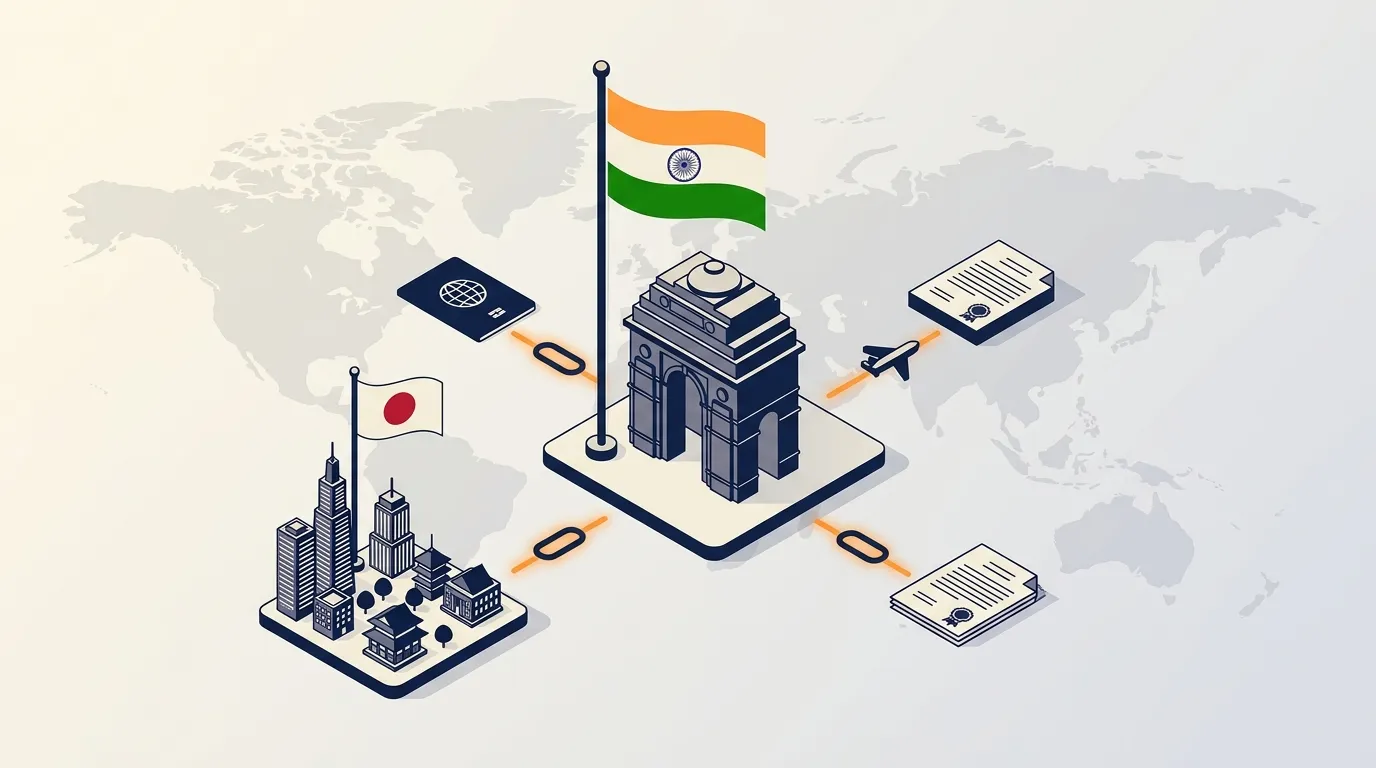
An Indian subsidiary of a Japanese company needs a clear ownership and signing plan. Start with the Japanese parent's current records and the proposed Indian business activity.
Confirm who approves the investment, who signs the incorporation documents and which records need translation or certification. Use this guide to connect those decisions with the Indian subsidiary registration process.
Why Japanese companies are building in India now
What usually triggers the move
In practice, Japanese companies tend to set up in India for a handful of recurring reasons. Some are following an existing Japanese customer or supply chain partner who has already localised in India. Others are responding to rising costs or capacity constraints in their existing manufacturing base and are diversifying production. A growing number are simply targeting the Indian domestic market directly, given its scale and growth trajectory. Whatever the trigger, the structuring and registration questions that follow are broadly the same.
Choosing the structure from Japan
Wholly owned subsidiary as the default
For most Japanese parents, the default and generally preferred structure is a wholly owned subsidiary incorporated as an Indian Private Limited company, with the KK or GK holding all or substantially all of the shares. This structure gives the Indian entity its own legal personality, allows it to contract, hire, hold assets and open bank accounts in its own name, and is the structure most Indian customers, vendors and banks expect to deal with. Under current regulations, most sectors permit full foreign ownership of an Indian subsidiary through the automatic route, meaning no prior government approval is required, though certain sectors carry conditions or caps that should always be verified for the specific business activity before incorporation.
Branch and liaison office compared
A branch office or liaison office is sometimes considered by Japanese companies that want a presence in India without setting up a separate legal entity, typically for market research, representing the parent, or coordinating with Indian buyers and suppliers. These structures are approved and regulated separately under FEMA rules and generally come with restrictions on the commercial activities they can undertake in India, since a liaison office in particular is not meant to carry out revenue generating activity. For most Japanese companies planning actual operations, sales, or manufacturing in India, a wholly owned subsidiary tends to be the more workable long term structure, with a liaison office reserved for an initial scouting phase if one is needed at all.
Personal shareholding versus corporate parent
Personal investment and investment through a corporate parent produce different ownership records and document requirements. Choose the investor based on the operating plan, governance and future funding. An individual does not automatically lose all treaty relief because the investment is held personally. Eligibility depends on the treaty, residence, payment and applicable conditions.
How to register a company in India from Japan, step by step
At a glance, the sequence looks like this:
- Choose the structure, for most Japanese parents a wholly owned Private Limited subsidiary
- Draft and pass the KK or GK board resolution authorising the investment and naming signatories
- Notarise the corporate documents in Japan and obtain the MOFA apostille, with certified English translations
- Obtain digital signatures (DSC) and apply for DINs for the proposed directors
- Reserve the company name and file SPICe plus with the MCA
- Receive the certificate of incorporation with PAN and TAN, then open the Indian bank account
- Remit the share capital from Japan and file FC GPR within 30 days of share allotment
- Register for GST where required and set up the monthly compliance calendar
The sections below unpack the steps that behave differently when the shareholder is a Japanese company.
SPICe plus with a foreign parent
Indian company incorporation runs through an integrated online form generally referred to as SPICe plus, filed with the Ministry of Corporate Affairs. This single filing typically covers name reservation, incorporation, allotment of a Permanent Account Number and Tax Deduction Account Number, and often registrations such as GST, provident fund and employee state insurance where applicable. When the shareholder is a Japanese company rather than an individual, the filing additionally requires corporate documents from the KK or GK, such as its certificate of incorporation, board resolution authorising the investment, and details of its authorised signatories, all of which need to be properly legalised before submission.
Documents and legalisation
Japanese documents go through the MOFA apostille route. The steps for each document type are set out under Apostille in Japan and translation requirements below.
DIN for foreign directors
Any individual proposed as a director of the Indian subsidiary, including Japanese nationals who will not relocate to India, needs a Director Identification Number, generally referred to as a DIN. Obtaining this requires identity and address proof from the director, which for a Japan based individual usually means a notarised and apostilled passport copy along with a similarly certified proof of residential address. This is one of the steps that most often causes delay in the timeline if it is not started early, since arranging notarisation and apostille from Japan takes coordination and cannot be rushed at the last stage of the filing.
Resident director and registered office
At least one director must have stayed in India for at least 182 days during the financial year. For a newly incorporated company, the requirement applies proportionately at the end of its first financial year. Nationality does not replace this residence test. A resident director has statutory duties even when the overseas parent retains ownership. See section 149 of the Companies Act.
Prepare the Indian registered office address, authority to use it and supporting evidence. Ownership of the office is not the same question as company ownership.
From Board Resolution in Tokyo to a Live Indian Subsidiary
| Timing | What happens |
|---|---|
| Depends on your documents and the Japanese authorities | KK or GK board resolution, notarisation in Japan, MOFA apostille, certified English translations |
| 2 to 3 working days | DSCs issued for the directors, DIN applications, company name reserved through SPICe+ Part A |
| 2 working days to file once the apostilled documents arrive, then 2 to 3 working days | SPICe+ Part B filed with MoA, AoA and AGILE PRO S, registrar queries answered, certificate of incorporation issued with PAN and TAN |
| 2 to 3 weeks after incorporation | Indian bank account opened with KYC on the Japanese parent, GST registration where needed, share capital remitted, shares allotted |
| After allotment | FC-GPR filed within 30 days of allotment, the compliance calendar goes live |
Japan specifics that change the playbook
KK and GK parents, board resolutions the MCA accepts
A KK and a GK can have different approval and representation arrangements. Confirm who has authority under the parent’s governing documents and Japanese law. The Indian filing needs evidence of the investment decision and the authorised signatory; one generic board resolution is not appropriate for every company.
Apostille in Japan and translation requirements
Japan’s Ministry of Foreign Affairs distinguishes eligible public documents from private documents. A certificate of registered matters and a company resolution do not automatically follow the same sequence. Private documents may require notarial and legal affairs bureau certification. Confirm the originals, copies and English translations with the Indian receiving office. See the MOFA document guidance and authentication FAQ. Use the official Japan authority directory to identify the competent office.
The working set can include the investor’s registration and governing documents, investment approval, signatory authority and director identity evidence. Agree the required forms and any translations before paying for certification.
Treaty Eligibility for the Proposed Payment
Check the treaty provisions and current domestic law for the proposed payment before remitting funds. Dividend, interest, royalty and service payments can have different treatment. Residence evidence alone does not establish every treaty condition. Review beneficial ownership, substance and any relevant limitation or anti abuse rule. Under the India Japan DTAA, dividends, interest and royalties or fees for technical services each carry a 10 percent ceiling on Indian withholding. The ceiling applies only when the recipient meets these conditions. File Form 10F and the parent company tax residency certificate before the first payout so the treaty rate applies at source.
Money in, money out: repatriating profits from India to Japan
Capital remittance and FC GPR
Agree the investment route, valuation and bank evidence before sending capital. Record the receipt and issue dates separately. A remittance certificate evidences funds received; it does not itself classify the money as equity or a loan. For a reportable FDI equity issue, FC-GPR is due within 30 days of issue under the RBI reporting direction. Assign the reporting work before funding and retain the filed acknowledgement.
JETRO support and the Japanese industrial townships
Japanese companies setting up in India can generally draw on support from JETRO's India offices, which assist with market information, matchmaking and some administrative guidance for Japanese investors. India has also developed dedicated Japanese industrial parks and townships in states such as Gujarat, Rajasthan and Tamil Nadu, aimed specifically at Japanese manufacturers wanting a cluster with familiar infrastructure and, in some cases, other Japanese companies nearby. These are worth exploring early if the business involves manufacturing, since site selection interacts with state level incentives and logistics planning.
The expat heavy operating model Japanese subsidiaries prefer
Compared to some other foreign investor groups, Japanese subsidiaries in India more often start with a relatively expat heavy leadership model, with one or more Japanese nationals seconded from the parent to manage the Indian operation directly in its early years, alongside locally hired staff. This has implications for employment visas, secondment agreements, and how salary and social security contributions are structured between the Japanese and Indian entities, all of which should be planned alongside the incorporation rather than treated as a separate, later exercise.
The compliance calendar after day one
FC GPR, FLA and the FEMA rhythm
Track each investment report from its own triggering event. Check whether the annual Foreign Liabilities and Assets return applies and verify the deadline for that year, including notified extensions. Keep the bank acknowledgements, share records and filed reports together.
ROC, GST and payroll basics
On the domestic side, the Indian subsidiary generally needs to file annual returns and financial statements with the Registrar of Companies, maintain statutory registers, and hold board and shareholder meetings within prescribed intervals. If the business is registered under GST, periodic GST returns are required based on its turnover and registration category. Once the subsidiary hires staff in India, payroll compliance including tax deduction at source, provident fund and, where applicable, employee state insurance contributions becomes a recurring monthly obligation.
On cross border payments to the Japanese parent, such as royalty, technical service fees, or repayment of any loan, the Indian subsidiary generally needs to file the prescribed remittance certification forms before any qualifying outward payment. The exact form numbers and procedure should be confirmed with your Chartered Accountant at the time of remittance, since the underlying certification framework has recently undergone legislative change and the current requirements should be verified rather than assumed from older guidance.
What a monthly retainer should cover
Most Japanese subsidiaries in India engage a compliance provider on a monthly retainer covering bookkeeping, GST return filing, TDS compliance, payroll processing, and support for board meetings and ROC event based filings such as director changes or share transfers. It is worth confirming upfront whether the retainer includes FEMA filings like the annual FLA return, since these are sometimes billed separately, and whether the provider has direct experience with Japanese parent documentation, since the apostille and translation nuances described above are easy to miss for a firm that has not handled this corridor before.
What it costs to register a company in India from Japan
A realistic all in budget
The ranges below give a realistic planning bracket at recent exchange rates; government fees and professional rates both move, so confirm them against a formal, itemised quote from your chosen provider. A realistic all in budget for setting up an Indian subsidiary from Japan should account for government incorporation fees, professional fees for the incorporation itself, the cost of notarisation, apostille and certified translation of Japanese documents, and the cost of an ongoing monthly compliance retainer once the entity is operational. Ask any prospective advisor to break these out separately rather than quoting a single bundled number, so you can see exactly what is a one time setup cost and what recurs annually.
| Cost component | Where paid | Typical range |
|---|---|---|
| Notarisation, apostille and certified translation of parent documents | Japan | ¥40,000 to ¥120,000 depending on document count |
| Government incorporation and stamp fees | India | ₹5,000 to ₹15,000 (about ¥8,500 to ¥26,000) |
| DSC for two directors | India | ₹4,000 to ₹6,000 (about ¥7,000 to ¥10,000) |
| Krystal7 Consultants' professional fee, foreign parent incorporation | India | USD 1,200 to 1,700 (about ₹1,15,000 to ₹1,63,000) |
| Registered office, serviced, per month | India | ₹5,000 to ₹15,000 (about ¥8,500 to ¥26,000) |
| Krystal7 Consultants' compliance retainer, per month once live | India | From USD 300 (about ₹29,000) |
Yen figures are approximations at recent exchange rates near ₹1 = ¥1.7 and move with the currency; treat the ranges as planning brackets and verify against an itemised quote before they go into a budget.
Planning the Completion Date
Ask for a schedule that separates overseas document preparation, any investment approval, incorporation and bank onboarding. Filing queries and bank checks can change the completion date. Do not treat incorporation as confirmation that the company is ready for every transaction.
Frequently Asked Questions
Can a Japanese company own 100 percent of an Indian subsidiary?
Under current regulations, most sectors permit full foreign ownership of an Indian subsidiary through the automatic route, meaning a Japanese KK or GK can generally hold all the shares without needing prior government approval. Certain sectors carry conditions, caps, or require prior approval, so the specific business activity should always be checked against current sector rules before assuming full ownership is available.
How long does it take to register an Indian company from Japan?
Plan on about 8 to 10 working days from the start to the certificate of incorporation, plus the time to notarise, apostille and translate the documents in Japan. The bank account and GST registration take another 2 to 3 weeks, so allow about four to five weeks in all, plus the apostille time. The document legalisation chain from Japan is usually the slowest part of the process, not the Indian filing itself.
Do I need to travel to India to incorporate?
Much of the incorporation work can be coordinated remotely. Confirm the document execution, digital signature verification and bank KYC requirements for the actual people and documents. Some steps may need original documents or personal attendance. Agree those requirements before deciding whether travel is necessary.
What does it cost to set up and run an Indian subsidiary?
Costs generally fall into two buckets: a one time setup cost covering government fees, professional fees, and document legalisation from Japan, and an ongoing annual cost covering ROC filings, GST compliance, payroll and a monthly compliance retainer. The cost table above gives planning brackets for each item. Confirm them against a current, itemised quote from your chosen service provider.
Can foreigners register a company in India?
Yes. Foreign individuals and foreign companies, including Japanese nationals and Japanese KK or GK entities, can generally register and own an Indian company, most commonly as a Private Limited company, subject to sector specific foreign investment conditions that should be verified for the exact business activity involved.
How much will it cost to register a company in India?
The cost depends on the structure chosen, the professional fees of the firm engaged, and, for a foreign parent, the additional cost of document notarisation, apostille and translation. The cost table above gives planning brackets. Government fees and professional charges change, so confirm them against a current, itemised quote from your compliance provider.
Can I register a company myself in India?
Technically, the incorporation filing can be done without a professional, but in practice, most foreign parents, including Japanese companies, engage a Chartered Accountant or company secretary in India to handle the filing, since the process involves technical steps such as digital signature issuance, DIN application, and document formatting that are easy to get wrong without local experience, and errors can delay incorporation significantly.
For the corridor neutral mechanics that apply from any country, see the complete guide to foreign subsidiary registration in India.
NEXT STEP
Plan your India registration from Japan
Review our incorporation scope and discuss the ownership structure, documents and support your Indian entity needs.
WRITTEN BY
CA Nandini
Co-founder · All India Rank 49, ICAINandini Hasija is a co-founder of Krystal7. She leads brand, business development and marketing, and works with founders to define their engagement. She is a Chartered Accountant and achieved All India Rank 49 in the CA examinations.
Filed under Country Guides · All corridors