UNITED STATES TO INDIA
Delaware C Corp India Subsidiary: The 2026 Playbook
The Delaware-specific route to an Indian subsidiary: structure, investor questions, the FC-GPR clock, twin compliance calendars and the Wyoming LLC question.
Cross-Border

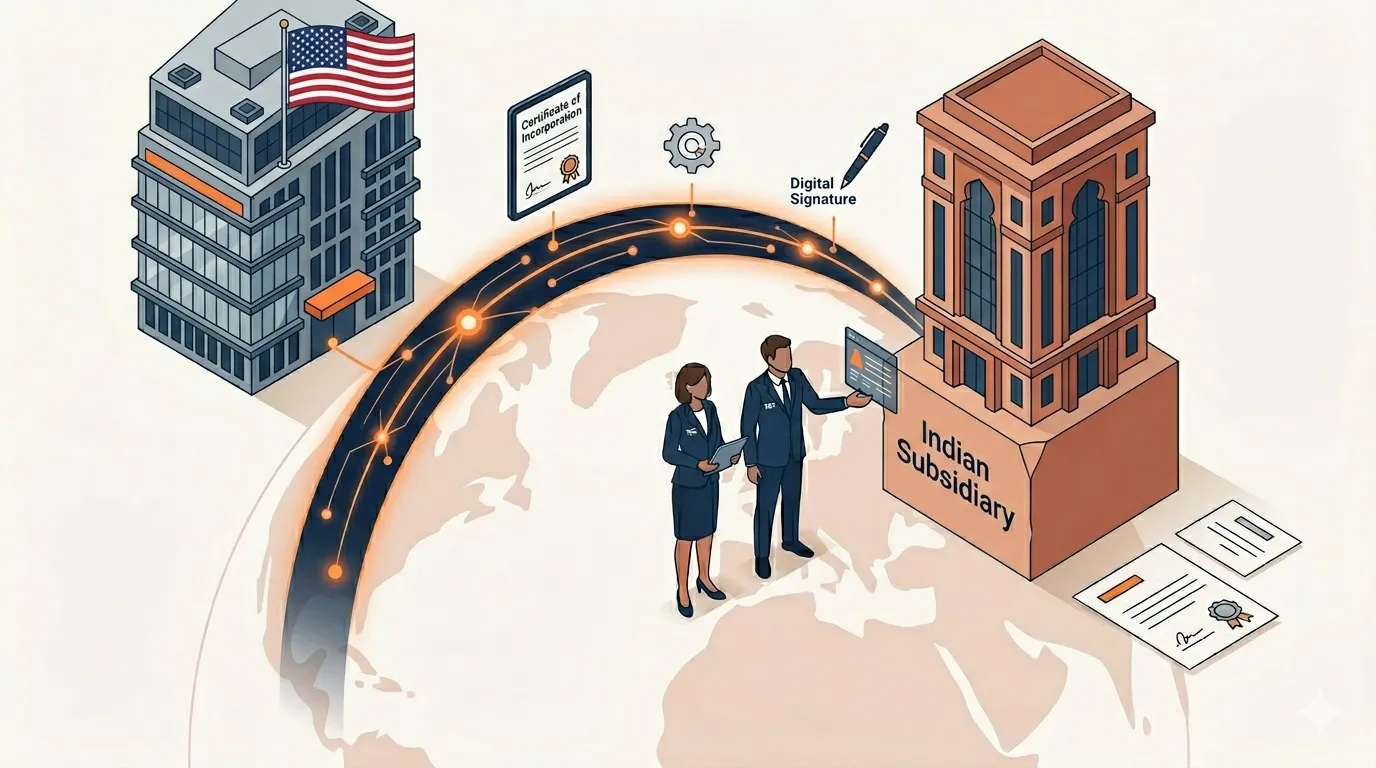
This is the Delaware C corp India subsidiary playbook for 2026: what a funded US parent actually signs, files and budgets to own an Indian Private Limited company.
Most guides that mention Delaware and India in the same breath are written for Indian founders incorporating in the United States. This one runs the other way.
Who this guide is for: a Delaware C corp, or its founders, planning a wholly owned Indian entity. For the corridor neutral walkthrough that applies to any US parent, use the US parent subsidiary guide; this page stays Delaware specific.
You have a Delaware C corporation, probably with investors on the cap table, and you need a wholly owned subsidiary in India for engineering, operations or sales. This playbook covers what is specific to a Delaware parent: how the structure fits, what your investors will ask, how the two compliance calendars run side by side, and what changes if your parent is actually a Wyoming LLC. For the full incorporation walkthrough that applies to any US parent, the US parent guide to setting up a subsidiary in India is the reference; this page assumes you have read it or will.
Why the Delaware C Corp Is the Standard Parent
Delaware is the default home of venture-backed US companies for reasons that have nothing to do with India: predictable corporate law, a specialist court, and investor documents that assume it. What matters for your India plan is that Indian law does not care which state your parent lives in. The Reserve Bank of India and the Ministry of Corporate Affairs see a foreign body corporate; Delaware, Wyoming or Texas makes no difference to eligibility. Where the Delaware choice does help is paperwork fluency: your certificate of incorporation, good standing certificate and board resolutions follow formats that Indian banks and professional firms process every week, which keeps your KYC and apostille chain boring. Boring is what you want.
The Structure: Delaware Parent, Indian Private Limited
The standard shape is a wholly owned subsidiary: an Indian private limited company with the Delaware C corp holding effectively all shares and a nominee holding one share to satisfy the two-shareholder minimum. Foreign direct investment into most sectors, including software, SaaS, services and most manufacturing, comes in under the automatic route, meaning no prior government approval, only reporting after the money moves. The land border approval rule does not apply to a US parent unless owners from a land border country hold more than 10 percent of it or control it (Press Note 2 (2026 Series), in force through S.O. 2174(E) of 1 May 2026). Ask your adviser to check this once and record it.
Two design decisions deserve board time before filing anything. First, authorised capital: size it for the first eighteen months of funding needs, because increasing it later is a filing, not a crisis, but under-capitalising invites repeated remittance rounds and repeated reporting. Second, directors: the Indian company needs at least one director resident in India. Your Delaware officers can hold the other seats. A professional resident director is a normal, compliant solution while your India lead earns that seat.
What Your Investors Will Ask
VCs with portfolio companies in India ask three questions. Who controls the subsidiary: answer, the parent board, through shareholding and reserved matters in the subsidiary's articles. Is the IP safe: answer, employment contracts and invention assignment sit in the Indian company, and an intercompany agreement assigns or licenses work product to the parent, priced at arm's length. What does it cost to unwind: answer, an orderly strike-off or sale is available, and nothing about the structure traps capital beyond the normal repatriation rules covered below. Have these answers written before the money moves and your next board meeting is ten minutes shorter.
Money In: the FC-GPR Filing Deadline
Capital comes in as an inward remittance to the subsidiary's Indian bank account, shares must be allotted against it within sixty days, and Form FC-GPR must be filed with the RBI within 30 days of allotment, supported by a valuation certificate and the bank's FIRC trail. This is the single most missed deadline in the corridor, and missing it means a Late Submission Fee, or compounding if the delay runs past three years. Put the FC-GPR date in the same calendar entry as the wire.
Transfer Pricing From Day One
If the subsidiary bills the parent for development or services, that invoice is a related-party transaction priced at arm's length from the first rupee. For a development centre the standard answer is a cost plus model, documented, consistent, and reviewed annually. India's safe harbour rules for transfer pricing can take the argument off the table for eligible IT and ITeS services at prescribed margins. The accountant's TP report is an annual fixture once related party transactions exist: Form 48 (formerly Form 3CEB) from tax year 2026-27, due by 31 October in most TP cases. Master file obligations arrive with scale. Price founder and cross-entity time properly from the start; retrofitting a transfer pricing position two years in costs more than doing it right in month one.
Two Calendars, One Company
| Obligation | Where | When |
|---|---|---|
| Franchise tax and annual report | Delaware | 1 March (corporations) |
| Registered agent renewal | Delaware | Annually |
| FC-GPR | India, RBI | Within 30 days of each allotment |
| FLA return | India, RBI | By 15 July every year |
| Statutory audit and AOC-4, MGT-7 | India, MCA | AGM by 30 September; AOC-4 within 30 days and MGT-7 within 60 days of the conclusion of the AGM |
| Income tax return and Form 48 (Form 3CEB for FY 2025-26) | India | TP report by 31 October, return by 30 November |
| GST, TDS, payroll filings | India | Monthly and quarterly |
The failure mode is not either calendar alone, it is the founder who assumes the US accountant watches India. Nobody watches India unless you appoint someone to.
Money Out: Repatriation Routes
Model the Indian withholding for each route with the India repatriation planner, then have the numbers verified before committing to a mix.
Dividends flow under the India-US tax treaty with withholding at 15% for a corporate parent holding at least ten percent of the subsidiary, 25% otherwise. Buyback rules changed again on 1 April 2026: proceeds are now taxed as capital gains in the shareholder's hands, with the cost of the shares deductible. A US parent holding over 10 percent is typically a promoter and pays additional tax, for an effective rate of 30 percent. Intercompany service fees and royalties are legitimate routes when they reflect real services at arm's length prices. And if the subsidiary exports services to the parent, GST zero-rating with a Letter of Undertaking keeps the invoice chain clean. Model repatriation before you need it; the worst time to design the route is the quarter you need the cash.
What If the Parent Is a Wyoming LLC Instead of a Delaware C Corp
Plenty of bootstrapped companies hold everything in a Wyoming LLC for the privacy and the trivial annual fees. India will still let that LLC own the subsidiary; the friction is everywhere else. A default LLC is a pass-through, so the subsidiary's dividends land directly on the members' personal US returns, and treaty benefits get messier to claim. Indian bank KYC and beneficial-ownership declarations trace through the LLC to its members, which unwinds the privacy that made Wyoming attractive. And no institutional investor prices a round into an LLC, so a conversion to a Delaware C corp is in your future anyway if venture funding is.
Practical rules of thumb. If you will raise priced venture rounds, convert to a Delaware C corp before the India entity exists, not after; one apostille chain instead of two. If you will stay private and profitable, the LLC can work: consider a check-the-box election on Form 8832 to be taxed as a corporation if treaty clarity matters more to you than pass-through treatment, and accept the KYC disclosure. Cost-wise Wyoming stays cheaper year to year, Delaware's franchise tax buys you the standard rails. This is a one-hour decision with your US tax advisor, and it is much cheaper taken before incorporation in India than after.
Delaware Parent to Indian Subsidiary in 8 Steps
- Board approval and an India budget signed off at the parent
- Apostille the Delaware charter documents and director IDs
- Reserve the Indian name and file SPICe+ with the parent as subscriber
- Certificate of Incorporation, PAN and TAN issued
- Open the Indian bank account and remit the share capital
- Allot shares within 60 days of the money landing
- File FC-GPR on FIRMS within 30 days of allotment
- Start the compliance calendar: auditor, first board meeting, statutory registers
| Filing | Deadline |
|---|---|
| Share allotment | 60 days from receipt of funds |
| FC-GPR on FIRMS | 30 days from allotment |
| First board meeting | 30 days from incorporation |
| Auditor appointment | 30 days from incorporation |
| FLA return | 15 July every year |
Run your own dates through the FC-GPR deadline calculator before the bank credit lands, and hand the filings to the FEMA compliance team if the calendar is already tight.
Common Mistakes With a Delaware Parent
The most common mistake is using content or templates built for the opposite journey, Indian founders flipping into Delaware; the documents look similar and do the wrong thing. The second is treating the FC-GPR clock as an accounting detail rather than a legal deadline. The third is paying US expenses from the Indian account, which creates FEMA questions no one needs. The fourth is ignoring transfer pricing until the first audit letter, by which point the clean options have expired.
Ready to move? Start with the full US parent guide, then talk to the US desk and we will map your Delaware stack onto an Indian subsidiary with a fixed fee and a dated calendar.
Frequently Asked Questions
Can a Wyoming LLC own an Indian subsidiary?
It can, but pass through taxation at the parent usually makes the Indian dividend and compliance position messy, so most advisors reroute ownership through a C corp before incorporating in India. The Wyoming section above covers the workarounds.
What is the FC-GPR filing deadline?
Form FC-GPR is due within 30 days of share allotment on the RBI FIRMS portal, and the allotment itself must happen within 60 days of the capital hitting the Indian account.
Can a foreign company have a subsidiary in India?
Yes. A foreign company, including a Delaware C corporation, can own up to 100% of an Indian private limited company in most sectors under the automatic route, with reporting to the RBI after investment rather than approval before it.
Does the Delaware parent need an Indian resident director?
The parent does not, but the Indian subsidiary must have at least one director who is resident in India. Founders commonly appoint a professional resident director at incorporation and replace that seat with their India country head later.
Can a Delaware LLC own the Indian subsidiary instead?
Legally yes, practically the same trade-offs as Wyoming: pass-through taxation complicates treaty relief, KYC traces to members, and investors will want a C corp eventually. If venture funding is the plan, convert first.
What does the first year cost all in?
Government fees are modest; the real budget lines are incorporation professional fees, the apostille chain in the US, the FEMA filings around your capital, and a monthly compliance retainer covering payroll, GST, TDS and the annual close. Serious firms quote a fixed fee for your specific case with government charges at cost; see pricing for how we structure it.
NEXT STEP
Put this step into your India entry plan
Continue with the United States guide for the full registration journey, from ownership and documents to banking and ongoing compliance.
WRITTEN BY
Nihal Srivastava
Co-FounderNihal Srivastava is a co-founder of Krystal7. He leads client delivery and operations, working with foreign founders on India entry, business structuring and cross border compliance.
Filed under Cross-Border · All corridors