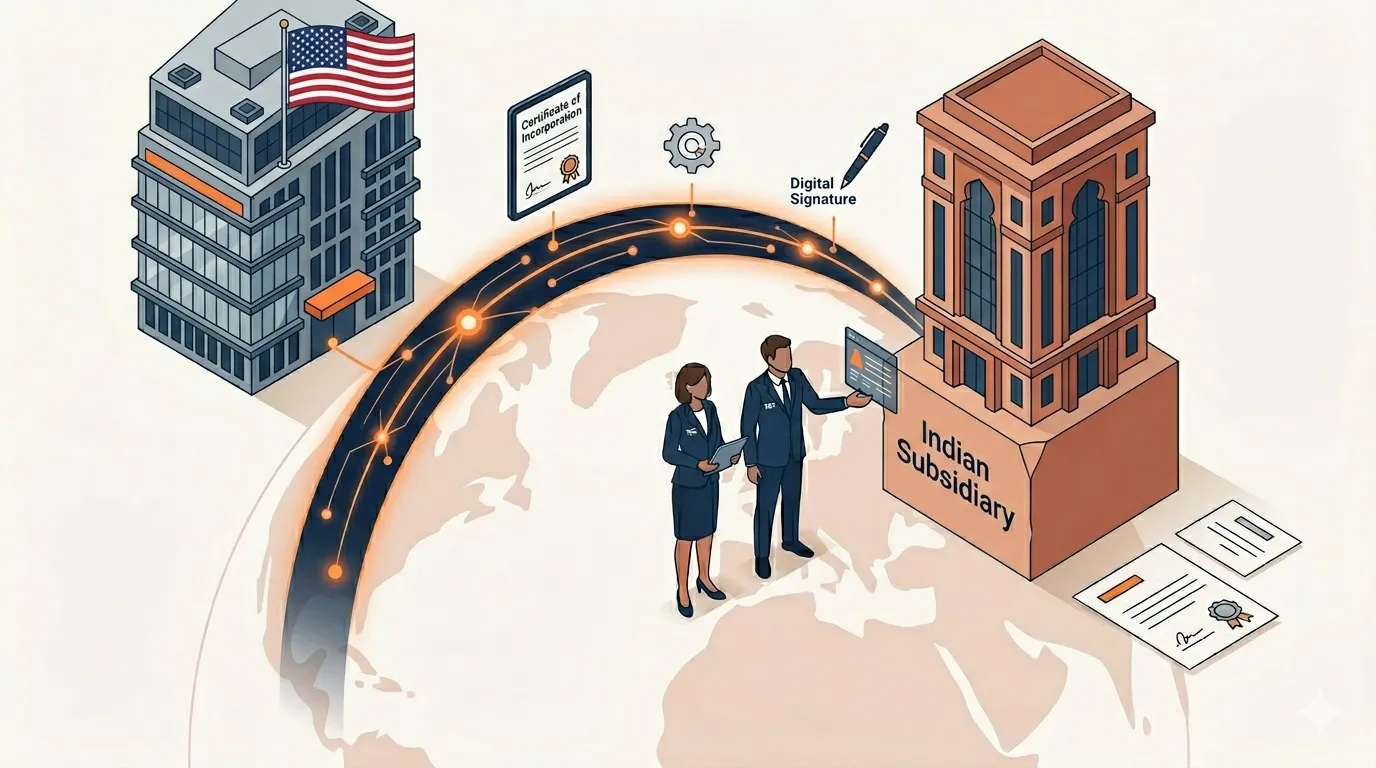
You raised, you have eighteen months of runway, and the hiring plan says India. The constraint is not ambition, it is founder attention: every week you spend learning Indian company law is a week not spent on the product. This guide is the speed run for YC and YC-adjacent founders, built around the stack you already have, the Delaware C corp, the SAFEs, the standard docs, and tuned for one outcome: engineers on payroll in Bengaluru or Pune while you stay focused on the batch cadence of building and shipping.
## Your YC Stack, and What India Adds
Nothing about your existing stack changes. The Delaware C corp stays the parent, your SAFEs and priced rounds live at the parent, and your India entity is a wholly owned subsidiary underneath: an Indian private limited company the parent owns completely, with one nominee share for the two-shareholder minimum. SAFEs do not complicate the India side, because India only sees one thing: the parent company subscribing to the subsidiary's shares. Investment into an Indian software or product subsidiary comes in under the automatic route, no prior approval, reporting after the money moves. The Delaware-specific detail, franchise tax, the parallel calendars, the Wyoming LLC question if you have not converted yet, lives in the [Delaware C corp playbook](/insights/setting-up-a-us-company-india-subsidiary-the-comprehensive-2026-guide).
## The Fast Path, With Real Dates
| Step | Owner | Typical time |
|---|---|---|
| US document notarisation and apostille | You + our checklist | 1 to 2 weeks |
| Name approval, incorporation filing, certificate | Krystal7 | 1 to 2 weeks |
| PAN, TAN, GST, first registrations | Krystal7 | Runs alongside |
| Bank account, capital remittance, share allotment | You + bank + Krystal7 | 2 to 4 weeks |
| FC-GPR filing with the RBI | Krystal7 | Within 30 days of allotment |
End to end, six to eight weeks is the honest range, with the apostille chain and bank KYC as the variance. The two dates that are law rather than logistics: shares must be allotted within sixty days of the capital landing, and Form FC-GPR must reach the RBI within 30 days of allotment. Both go into the calendar the day the wire is planned.
## Hiring Before the Entity Exists
You do not have to wait for the certificate to make offers. The standard bridge is an employer of record: your first hires start on an EOR's payroll this month, then flip onto your subsidiary's payroll the month it goes live, with continuity of tenure written into their letters. Contractors during the batch are simpler still, paid from the parent against invoices, with GST on their side handled by their registration status. The rule that keeps this clean: sign the IP assignment and confidentiality terms with each person from day one, in favour of the entity chain, so nothing needs re-papering at the flip.
## ESOPs Your Indian Team Will Actually Value
Two workable patterns. Grant parent-level options to Indian employees under your existing plan, which keeps one cap table and is what most YC companies do early; the tax event for the employee lands at exercise, so design exercise windows with that in mind. Or, at scale, mirror a scheme at the Indian company. Start with parent options, document the India grants properly, and revisit when the India team passes the size where local practice matters for retention.
## Investor Reporting Without the Scramble
Your investors will ask two India questions at the next board meeting: is the subsidiary compliant, and what did it cost. The artifacts that answer them are the certificate of incorporation, the FC-GPR acknowledgment, the FIRC trail for capital, and a one-page compliance calendar showing payroll, GST, TDS, the audit and the annual FLA return each have an owner and a date. We hand you that pack as a deliverable, because a ten-minute board answer is part of what you are buying.
## Compliance on Autopilot
After go-live the rhythm is fixed: monthly payroll with TDS, monthly or quarterly GST, quarterly TDS returns, the statutory audit cycle, MCA annual filings, the FLA return by 15 July every year, and transfer pricing documentation for the parent-subsidiary service flow, priced cost plus and certified annually. If the subsidiary bills the parent for development, zero-rate the export invoices under a Letter of Undertaking. None of this needs founder attention beyond a monthly summary email, which is the point.
## Why YC Founders Pick Krystal7 First
Fixed fees agreed before we start, quoted for your case, with government charges at cost, because surprise invoices are a batch-speed killer. A corridor playbook that has run the US-parent flip repeatedly, so your apostille chain, bank KYC and FC-GPR clock are checklist items, not discoveries. One team across incorporation, FEMA, transfer pricing, payroll and virtual CFO, which means one thread to follow and no vendor gaps. Async-first communication built for US hours. And documents drafted at engineer speed: checklists, dates and owners, not fifty-page memos.
## The Batch to Bangalore Checklist
Convert to a Delaware C corp if you are still an LLC. Approve the India plan at parent board level. Run the apostille chain from our country checklist. Reserve the company name. Appoint the resident director solution. Incorporate and collect PAN, TAN, GST. Open the bank account and wire the first capital. Allot shares inside sixty days, file FC-GPR inside 30. Flip EOR hires onto the subsidiary. Put the compliance calendar on autopilot and get back to shipping.
If the hiring plan says India this quarter, [talk to the US desk](/contact.html). Fixed fee, dated calendar, and your first India payroll run lands while the batch is still fresh.
## Frequently Asked Questions
### Can we sign an India office lease before incorporation?
Practically, use the interim tools: coworking under a founder or EOR arrangement, then move the lease onto the subsidiary once the certificate exists. Long leases signed personally by founders are a re-papering headache later.
### Do SAFEs complicate FDI reporting in India?
No. SAFEs are instruments of the Delaware parent. India's reporting concerns the parent's equity investment into the subsidiary, FC-GPR and the annual FLA return, regardless of how the parent financed itself.
### How do we pay Indian contractors during the batch, before the entity exists?
From the parent, against invoices, with clear IP assignment in each contract. Once the subsidiary is live, move ongoing contractors and employees onto it so costs sit where the work happens, which also keeps your transfer pricing story clean.
Frequently Asked Questions
Can we sign an India office lease before incorporation?
Do SAFEs complicate FDI reporting in India?
How do we pay Indian contractors during the batch, before the entity exists?
Facing this in your own entity?
Guides explain the rules. A conversation solves your specific case. Talk to a Krystal7 advisor about your India entry, FEMA, or compliance position.
Book a Discovery Call