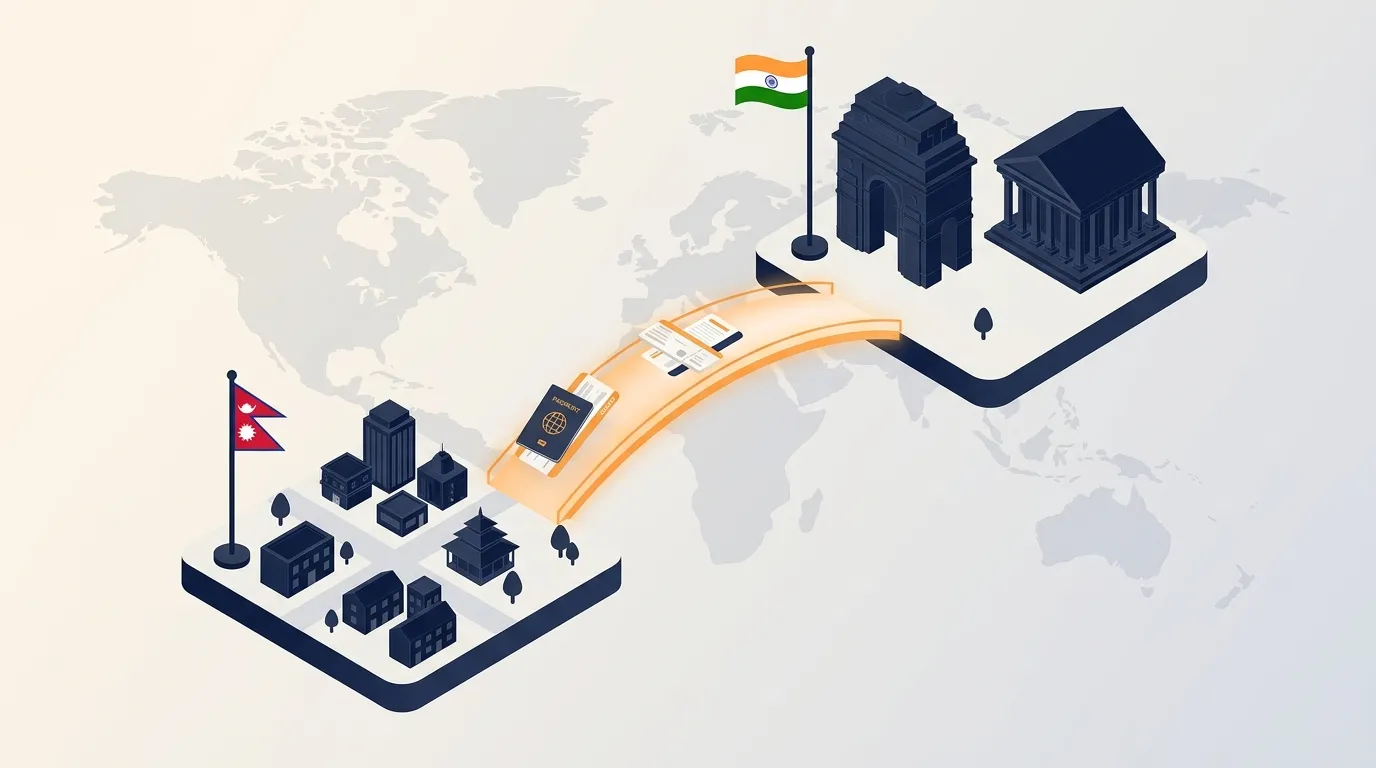
Company registration in India runs on the same statutory rail whoever the parent is, but the Nepal corridor carries its own FEMA reporting, treaty and banking wrinkles. Here is the process, cost and timeline that actually holds in 2026.
## The Open Border Does Not Open the FDI Gate
Few corridors feel as close as Nepal to India. The two countries share an open border, deep treaty ties and decades of everyday commerce. That closeness leads many founders to assume that investing in an Indian company is a light touch affair. It is not, and the reason is Press Note 3. India requires prior Government of India approval for foreign direct investment from every country that shares a land border with it, and Nepal is on that list.
So the open border is a fact about people and goods, not about capital. It does not exempt Nepali investment from India's land border FDI screening, and we say so plainly at the start of every engagement rather than letting a client discover it after committing to a plan. The company law mechanics of incorporation in India are genuinely straightforward, but they sit behind an approval gate that has to be cleared first, and no shares can be allotted to a Nepali parent until the government consents. Press Note 3 shapes this guide from beginning to end.
We write from the Indian advisory side and describe how these matters really proceed. The Nepal India relationship is warm, but foreign direct investment approval is not something the open border relaxes. Our [foreign subsidiary setup service](/services/foreign-subsidiary.html) is organised so the approval is settled before any incorporation step is taken.
## Press Note 3: The Rule That Shapes This Corridor
In April 2020, India revised its foreign direct investment framework through the notification known as Press Note 3. Under it, any investment from an entity of a land bordering country, or one whose beneficial owner sits in such a country, needs prior approval from the Government of India. Nepal shares that border, so the rule reaches Nepali investors directly, regardless of how friendly the wider bilateral relationship is.
The policy is anchored to beneficial ownership. The government does not stop at the immediate shareholder; it follows control to the ultimate owner. Placing a holding company from a non border country over Nepali capital does not remove the requirement. Approval is mandatory across every sector, it overrides the automatic route that would otherwise apply, and silence from the authorities is never treated as consent, because there is no deemed approval on this route.
The filing is made on the Foreign Investment Facilitation Portal, the FIFP, which sends the proposal to the administrative ministry for the sector concerned, with Ministry of Home Affairs clearance forming part of the assessment. Decisions come case by case and generally take months. Officials probe ownership, funding and the purpose of the investment. Our task at the outset is to set expectations honestly: the pace is the government's to set, and no commercial urgency changes it.
## The Approval Application, What It Takes
At the heart of the application is a full ownership chart running to the ultimate beneficial owner, showing each intermediate entity, the shareholding at every level and any rights that confer control. For many Nepali businesses the ownership is refreshingly simple, which helps, but it still has to be documented precisely rather than assumed from familiarity.
The rest of the file gives the proposal substance: a business plan for the Indian entity, a clear account of the source of funds, and identity records for the beneficial owners. The narrative has to reflect what the Indian company will really do, whether trading, services or distribution across the border the two economies already share.
Founders should plan for a multi month timeline on the approval alone and treat it as the main event of the project. These approvals are selective and quiet, with no public queue and no paid fast lane. The value we add is in the preparation: a complete, consistent file that answers the obvious questions before they are asked, so that a government query can be resolved quickly instead of reopening the review.
## Phase Two: Incorporation After Approval
The incorporation steps start only once approval exists, because the Nepali parent cannot be allotted shares any earlier. With the approval granted, the company formation runs through its familiar order:
- Digital Signature Certificates for the proposed directors, arranged remotely by video verification.
- Name reservation via SPICe plus Part A at the Ministry of Corporate Affairs.
- The SPICe plus filing that incorporates the company and obtains its PAN and TAN.
- Memorandum of Association and Articles of Association reflecting the approved ownership.
- The Certificate of Incorporation, at which point the Indian subsidiary exists in law.
On documents, Nepal uses the consular legalisation route rather than the apostille. The parent's corporate records, board resolution and director identity proofs are notarised, authenticated in Nepal and then legalised through the Indian mission before they are accepted in India. Despite the open border, this legalisation chain still applies, and the legalised documents must match the ownership disclosed in the approval file exactly, or the Registrar and the reviewers will both raise questions.
## The Resident Director Rule
Indian company law requires at least one director who has been resident in India for the qualifying period in the preceding year. A Nepali parent without an existing Indian presence meets this through a nominee resident director appointed solely to satisfy the statutory test. The nominee holds no shares, plays no part in strategy and is bound by an agreement that keeps the role purely formal, while the Nepali parent keeps complete control through its own board appointees and its shareholding. On this corridor the residency requirement is simple housekeeping and never the sticking point; the approval that must precede any allotment is.
## Banking, Capital and FC-GPR
After incorporation, the Nepali parent remits share capital by SWIFT into the subsidiary's Indian current account. The receiving bank issues a Foreign Inward Remittance Certificate, the FIRC, confirming the funds arrived as investment. Shares are allotted only after the Press Note 3 approval is in hand, and Form FC-GPR is then filed with the Reserve Bank within 30 days of the allotment. The sequence does not bend: approval first, then remittance and allotment, then reporting.
Banks apply heightened KYC to land border corridors, so a Nepali parent should expect detailed questions on beneficial ownership, source of funds and the approval before an account opens or a wire settles, whatever the ease of movement in daily life. Our [FEMA compliance](/services/fema-compliances.html) desk runs the FIRC, valuation and FC-GPR sequence so the filings stay aligned with the approval record.
## Taxes on the Nepal Corridor
Once the subsidiary is trading, its tax position is unremarkable. Indian corporate tax applies at 25 percent under the standard regime, or 22 percent under the concessional regime where the conditions are met, and GST applies at 18 percent on most services. Under the India Nepal Double Taxation Avoidance Agreement, dividends to the parent are withheld at 5 percent where the parent is a company holding at least 10 percent of the capital, and at 10 percent otherwise, provided the tax residency certificate, Form 10F and beneficial ownership are in order before the distribution.
Intercompany charges between the parent and the Indian company, for services, licensing or shared costs, come under transfer pricing rules with Form 3CEB disclosure, and that is where our [transfer pricing advisory](/services/transfer-pricing-advisory.html) work engages. For returning profits to Nepal, the available routes and their tax effects are set out in our guide to [repatriation of profits from India](/insights/repatriation-of-profits-from-india-to-a-foreign-parent-the-2026-strategic-guide). The ongoing monthly and annual compliance, the FLA return included, is what our [virtual CFO service](/services/ecfo.html) exists to run.
## Structures That Do Not Work
We regularly decline requests to engineer a way around the approval. Channelling the investment through Singapore, Mauritius, the UAE or any other third country does not defeat Press Note 3, because the screening follows beneficial ownership rather than the final address on the paperwork. If the owner is Nepali, the approval requirement stays with the money along every step of the route.
Nominee disguises, where a person outside the border list holds shares for the true Nepali owner, are a FEMA violation from the first remittance onward. They unravel as soon as a bank, an auditor or a future investor examines the structure, and they carry penalties far heavier than the wait they were intended to avoid. We do not build these arrangements and we counsel strongly against them. The approval application, prepared properly, is the slower path but the only one that holds up.
## Timeline and Fees
Honestly stated, the approval phase is the timeline. It runs for months, its pace belongs to the government, and it is the part a Nepali founder should plan the entire project around. After approval, incorporation is comparatively quick, usually 30 to 45 days from clean documents to the Certificate of Incorporation, with banking and the first FEMA filings close behind.
We quote a fixed fee before signing for the incorporation, the nominee director, banking support and the initial FEMA reporting. The Press Note 3 approval phase is scoped and priced separately, because the effort depends on the ownership chain and the sector, and rolling it into one loose figure would obscure where the risk actually lies. There is no hourly billing and no later charge for a filing that was always going to be needed.
## Why Nepali Companies Pick Krystal7
Nepali companies moving into India want advisors who raise the approval question first and then see it through. We bring over 10 years of cross border practice, more than 10,000 startups and founders advised across India and five continents. Our work is led by Chartered Accountants, we answer first inquiries within 4 business hours, and we quote fixed fees before any engagement begins. On the Nepal corridor the most valuable early deliverable is a straight judgment on whether approval is realistic, how long it may take, and which ownership facts will drive the outcome.
For the structure most foreign parents choose, read the [wholly owned subsidiary in India guide](/insights/wholly-owned-subsidiary-in-india), or go straight to the [foreign subsidiary registration service](/services/foreign-subsidiary.html) for the fixed fee scope.
## Frequently Asked Questions
### Does a Nepali investor need government approval to invest in India
Yes. Nepal shares a land border with India, so Press Note 3 applies and prior Government of India approval is required before any shares are allotted to a Nepali parent. The open border does not change this, and it holds across all sectors regardless of the automatic route.
### How long does Press Note 3 approval take
Plan for several months. The proposal is decided case by case through the FIFP portal, the relevant administrative ministry and Ministry of Home Affairs clearance, with no published timeline and no deemed approval. Incorporation only begins once the approval is granted.
### Does routing through a third country avoid the approval
No. The screening is based on beneficial ownership, not the immediate shareholder's location. If the ultimate owner is Nepali, the approval requirement survives a route through Singapore, Mauritius or the UAE. Nominee disguises also breach FEMA, and we decline that work.
### Can a Nepali company own 100 percent of the Indian subsidiary once approved
Generally yes. In sectors that permit full foreign ownership, a Nepali parent can hold 100 percent of the Indian company once the Press Note 3 approval is in place. The approval is about consent to invest, not a limit on the eventual shareholding.
### What is the dividend withholding rate under the India Nepal treaty
Dividends are withheld at 5 percent where the Nepali parent is a company holding at least 10 percent of the capital, and at 10 percent otherwise, under the India Nepal Double Taxation Avoidance Agreement, subject to the tax residency certificate, Form 10F and beneficial ownership conditions.
### Do we need to travel to India to incorporate
No. Once approval is granted, incorporation runs remotely despite the open border. Digital signatures are issued by video verification, legalised documents move by courier, and every filing is electronic, so the Nepali team can complete the process from home.
Frequently Asked Questions
Does a Nepali investor need government approval to invest in India
How long does Press Note 3 approval take
Does routing through a third country avoid the approval
Can a Nepali company own 100 percent of the Indian subsidiary once approved
What is the dividend withholding rate under the India Nepal treaty
Do we need to travel to India to incorporate
Facing this in your own entity?
Guides explain the rules. A conversation solves your specific case. Talk to a Krystal7 advisor about your India entry, FEMA, or compliance position.
Book a Discovery Call