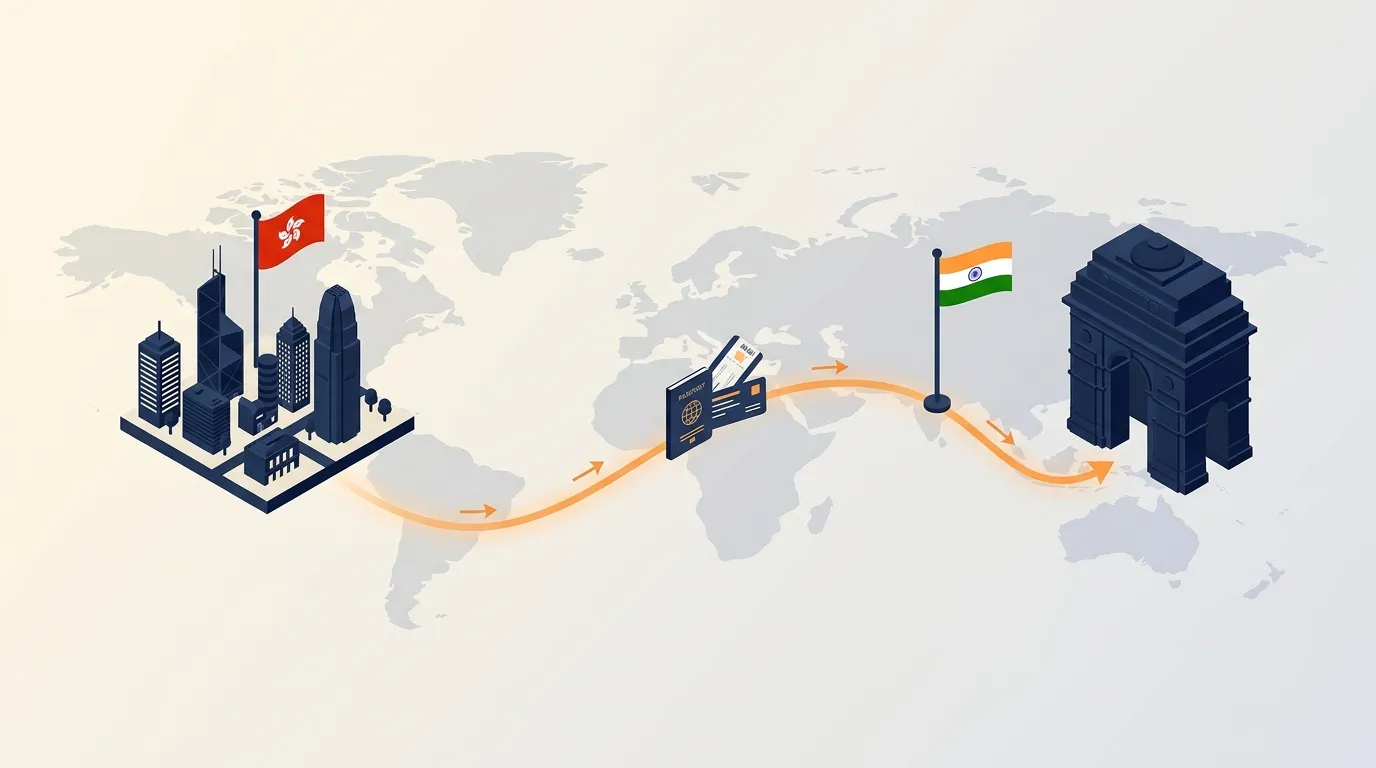
Company registration in India runs on the same statutory rail whoever the parent is, but the Hong Kong corridor carries its own FEMA reporting, treaty and banking wrinkles. Here is the process, cost and timeline that actually holds in 2026.
## The Hong Kong to India Corridor in 2026 Starts With a Screening Rule, Not an Incorporation Form
India screens investments whose beneficial ownership traces to mainland China, and Hong Kong entities fall under this screening. That is the central fact that shapes this corridor in 2026. If a Hong Kong parent wants to register a company in India, the first question is not how fast the SPICe+ filing can be submitted. The first question is whether the investment needs prior Government of India approval under Press Note 3, and in practice that answer is usually yes where the beneficial ownership chain traces to mainland China.
This makes the Hong Kong corridor fundamentally different from France, Belgium, Israel or most of Europe. The usual foreign subsidiary playbook, choose the entity, collect apostilles, reserve the name, file SPICe+, open the bank account, does not apply in that order. Approval risk sits in front of incorporation mechanics, and any honest guide has to start there.
That does not mean Hong Kong investment into India is blocked. It means it is screened, fact specific and slower. Hong Kong trading companies and family offices have used Indian subsidiaries as their subcontinent base since before the tax treaty signed in 2018, and that still happens. HSBC and Standard Chartered both run full Indian banking operations, which does help on account opening once a structure is approved. But no serious advisor should treat Hong Kong as just another fast treaty jurisdiction if beneficial ownership ultimately links back to mainland China. We map the ownership chain first, then the approval path, and only then move to incorporation.
## Press Note 3: The Rule That Shapes This Corridor
In April 2020, India changed its foreign direct investment policy through what is commonly referred to as Press Note 3. The rule requires prior Government of India approval for any investment, direct or indirect, from an entity situated in a country sharing a land border with India, or where the beneficial ownership of the investment traces to such a country. In practice, Hong Kong structures with beneficial ownership connected to mainland China are treated within this screening framework.
The effect is blunt. No share allotment should happen before approval. No founder should assume that being incorporated in Hong Kong by itself avoids the test. The Indian government looks through the immediate parent to the beneficial ownership chain. If beneficial ownership traces to mainland China, the transaction is screened on that basis.
The approval is not automatic and it is not a rubber stamp. Decisions are taken case by case, often over months rather than weeks. The application is made through the Foreign Investment Facilitation Portal, commonly called the FIFP portal. The administrative ministry for the relevant sector reviews the proposal, and home ministry clearance is part of the process. Questions on the ownership chain, business activity, funding source and downstream rights are common. This is why we tell clients plainly: do not build commercial timelines on the assumption that approval is quick.
Just as important, routing through a third country does not escape the beneficial ownership test. If the ultimate beneficial ownership still traces to mainland China, the screening issue remains. We advise against disguise structures. They increase risk, they usually fail diligence later, and they can create a much larger compliance problem than the one they were meant to avoid.
## Entity Choice: Hong Kong Limited Parent, Indian Private Limited Subsidiary
Once approval strategy is understood, the entity structure itself is still familiar. The Hong Kong parent is usually a Limited company, and the Indian operating vehicle is typically a private limited company set up as a wholly owned subsidiary. This remains the cleanest vehicle for operating in India: it can hire staff, sign contracts, invoice locally, hold licences and maintain its own compliance footprint.
The difference from most other corridors is not the entity type. It is the order in which you can implement it. For a standard European parent, the question is whether the sector is under the automatic route. For a Hong Kong parent with beneficial ownership concerns, the question is whether the proposal can move at all before government approval. Only after that answer is settled does the incorporation path become a normal company law exercise.
For approved cases, our [foreign subsidiary setup service](/services/foreign-subsidiary.html) covers the company incorporation, the first year setup and the coordination between the approval logic, the corporate filings and the banking sequence.
## Two Phase Incorporation: Approval First, Company Formation Second
The practical incorporation path for a Hong Kong parent should be treated as a two phase process.
**Phase One: Approval Before Any Share Allotment**
Before any shares are subscribed or allotted, the ownership chain is mapped in full, including immediate parent, intermediate holding entities, beneficial owners and any shareholder rights that create control. If Press Note 3 is engaged, the application is filed on the FIFP portal with the sectoral details, business plan, funding structure and ownership disclosures. The proposal then moves through the administrative ministry and home ministry clearance process. This is the stage that drives the real timeline.
**Phase Two: DSC, Name Reservation, SPICe+, MoA After Approval**
Only after approval is in hand should the normal company incorporation steps begin:
- Digital Signature Certificate for the proposed directors
- Name reservation through the MCA process
- SPICe+ filing for incorporation, PAN and TAN allotment and related registrations
- Memorandum and Articles of Association reflecting the approved ownership structure
- Certificate of Incorporation and bank account opening
This sequencing matters because approval is not a box you tick after the company exists. It sits before the investment step itself.
## Documents and the Apostille Chain in Hong Kong
Hong Kong documents for Indian use generally need to be notarised and then apostilled through the High Court of Hong Kong, since Hong Kong operates within the Hague Apostille system for this purpose. That means no consular legalisation at an Indian mission is typically required once the apostille is affixed.
The usual document set includes the Hong Kong parent company's certificate of incorporation, business registration documents, board resolutions authorising the Indian subsidiary, constitutional documents, and identity and address proof for directors and beneficial owners. These need to align exactly with what is disclosed in the approval application where Press Note 3 is engaged. If the ownership narrative in the apostilled documents and the approval file does not match, delays follow fast.
The practical lesson is simple: document preparation for this corridor is not just an incorporation exercise. It is part of the screening record.
## Resident Director Requirement
Indian company law still requires at least one director on the board who has been resident in India for the statutory period in the preceding year. Hong Kong promoters normally satisfy this through a nominee resident director, appointed solely for the legal requirement while control stays with the foreign parent and its nominated board representatives.
That resident director requirement is routine. It is not the hard part of this corridor. The hard part is approval before allotment. Once approval exists, the resident director step is handled the same way as in any other foreign subsidiary structure.
## Banking and Capital Remittance
After approval and incorporation, the capital remittance follows the standard foreign investment route. The Hong Kong parent sends funds by SWIFT transfer into the Indian subsidiary's bank account. Because HSBC and Standard Chartered both maintain full Indian banking operations, account opening and cross border coordination can be smoother than in some other corridors, though the beneficial ownership and approval history will still shape KYC depth.
The receiving Indian bank issues a Foreign Inward Remittance Certificate, or FIRC, confirming the receipt of investment funds. Once shares are allotted, the company files Form FC-GPR within 30 days of allotment through the RBI reporting system. This reporting chain sits under [FEMA compliance](/services/fema-compliances.html), and in the Hong Kong corridor it needs to match the prior approval record exactly, not just the bank receipt.
## Corridor Taxes: India Hong Kong DTAA, Withholding and Profit Repatriation
Once the subsidiary is operational, the tax position becomes more conventional. The India Hong Kong tax treaty provides a 5 percent dividend withholding rate where the beneficial owner is a company holding at least 10 percent of the capital, and 10 percent otherwise. Royalties are generally taxed at 10 percent under the treaty. These are attractive rates, but they only matter after the investment structure itself has crossed the approval gate cleanly.
Indian corporate tax applies at 25 percent under the standard regime or 22 percent under the newer concessional regime where the conditions are met, and GST at 18 percent applies to most services. If the Hong Kong parent licenses IP, charges management services or runs procurement flows through the Indian company, those intercompany transactions need to be priced and documented carefully. That is where our [transfer pricing advisory](/services/transfer-pricing-advisory.html) work becomes important.
Once profits start building in India, the choice between dividend, royalty or service fee extraction should be planned with treaty access, substance and pricing in mind. Our guide on [repatriation of profits from India](/insights/repatriation-of-profits-from-india-to-a-foreign-parent-the-2026-strategic-guide) walks through those mechanics in detail.
## Ongoing Compliance Calendar
After incorporation, the recurring compliance calendar looks like that of any other foreign owned Indian subsidiary.
- Annual FLA return by 15 July each year
- ROC annual filings, including financial statements and annual return
- Monthly GST compliance where applicable
- Monthly TDS compliance and related quarterly filings
- Ongoing board, audit and tax return compliance under Indian law
The key difference is that in the Hong Kong corridor, the company should maintain a clean internal file linking its ongoing structure and reporting back to the approval path, because beneficial ownership questions can reappear later during remittances, banking reviews or future capital raises. Our [virtual CFO service](/services/ecfo.html) is often useful here because it keeps the compliance calendar and management reporting aligned with the ownership record that justified approval in the first place.
## Timeline and Fees
For a Hong Kong structure that triggers Press Note 3 screening, the timeline is measured in months, not 30 to 45 days. The approval stage drives the process, and the incorporation mechanics only begin after approval. That means the headline timeline depends on the sector, the ownership chain, the completeness of the filing and the pace of inter ministry review.
Once approval is granted, the company formation steps themselves can move on a normal timeline. But that is not the number founders should budget around. The honest way to plan this corridor is to assume months driven by approval, then add the normal company incorporation and banking sequence afterward.
Fees should be quoted in fixed stages: approval analysis and application support first, then incorporation, then the banking and post incorporation reporting stack. Bundling all of it into one vague quote hides where the real work is, and in this corridor the real work is the approval strategy.
## Why Hong Kong Investors Pick Krystal7
Hong Kong investors dealing with India under this corridor need advisors who will say the difficult part out loud at the start, not bury it after the engagement begins. We bring over 10 years of cross border practice, more than 10,000 startups and founders advised across India and five continents. Our work is led by Chartered Accountants, we respond to first inquiries within 4 business hours, and we quote fixed fees before the engagement begins. That matters when the first deliverable is not a company incorporation form but an honest view on whether Press Note 3 approval is likely, how long it may take, and what ownership facts will control the answer.
For the structure most foreign parents choose, read the [wholly owned subsidiary in India guide](/insights/wholly-owned-subsidiary-in-india), or go straight to the [foreign subsidiary registration service](/services/foreign-subsidiary.html) for the fixed fee scope.
## Frequently Asked Questions
### Can a Hong Kong company own 100 percent of an Indian subsidiary
Yes, a Hong Kong Limited company can in principle own 100 percent of an Indian private limited subsidiary. The real question is whether the investment triggers Press Note 3 screening because beneficial ownership traces to mainland China. If it does, prior government approval is needed before the investment proceeds.
### Does a Hong Kong investor need government approval to invest in India
If the beneficial ownership of the investment traces to mainland China, yes. India screens such investments under Press Note 3, and prior Government of India approval is required before any share allotment regardless of sector. The analysis is ownership based, not just based on the country of the immediate parent.
### How long does it take to register an Indian company from Hong Kong
If Press Note 3 screening applies, the timeline is measured in months because approval comes first and drives the process. Only after approval do the normal incorporation steps begin. The company law filing itself can still move quickly afterward, but that is not the controlling timeline.
### Which documents need apostille in Hong Kong
The Hong Kong parent company's certificate of incorporation, business registration records, board resolutions, constitutional documents and director and beneficial owner identity records usually need to be notarised and apostilled through the High Court of Hong Kong for Indian use.
### What is the dividend withholding rate under the India Hong Kong treaty
The India Hong Kong treaty provides a 5 percent dividend withholding rate where the beneficial owner is a company holding at least 10 percent of the capital, and 10 percent otherwise. Royalties are generally taxed at 10 percent under the treaty.
### Can routing through a third country avoid Press Note 3 screening
No. Routing through a third country does not escape the beneficial ownership test. If beneficial ownership still traces to mainland China, the screening issue remains. We advise against disguise structures because they increase legal and regulatory risk without solving the underlying approval question.
Frequently Asked Questions
Can a Hong Kong company own 100 percent of an Indian subsidiary
Does a Hong Kong investor need government approval to invest in India
How long does it take to register an Indian company from Hong Kong
Which documents need apostille in Hong Kong
What is the dividend withholding rate under the India Hong Kong treaty
Can routing through a third country avoid Press Note 3 screening
Facing this in your own entity?
Guides explain the rules. A conversation solves your specific case. Talk to a Krystal7 advisor about your India entry, FEMA, or compliance position.
Book a Discovery Call