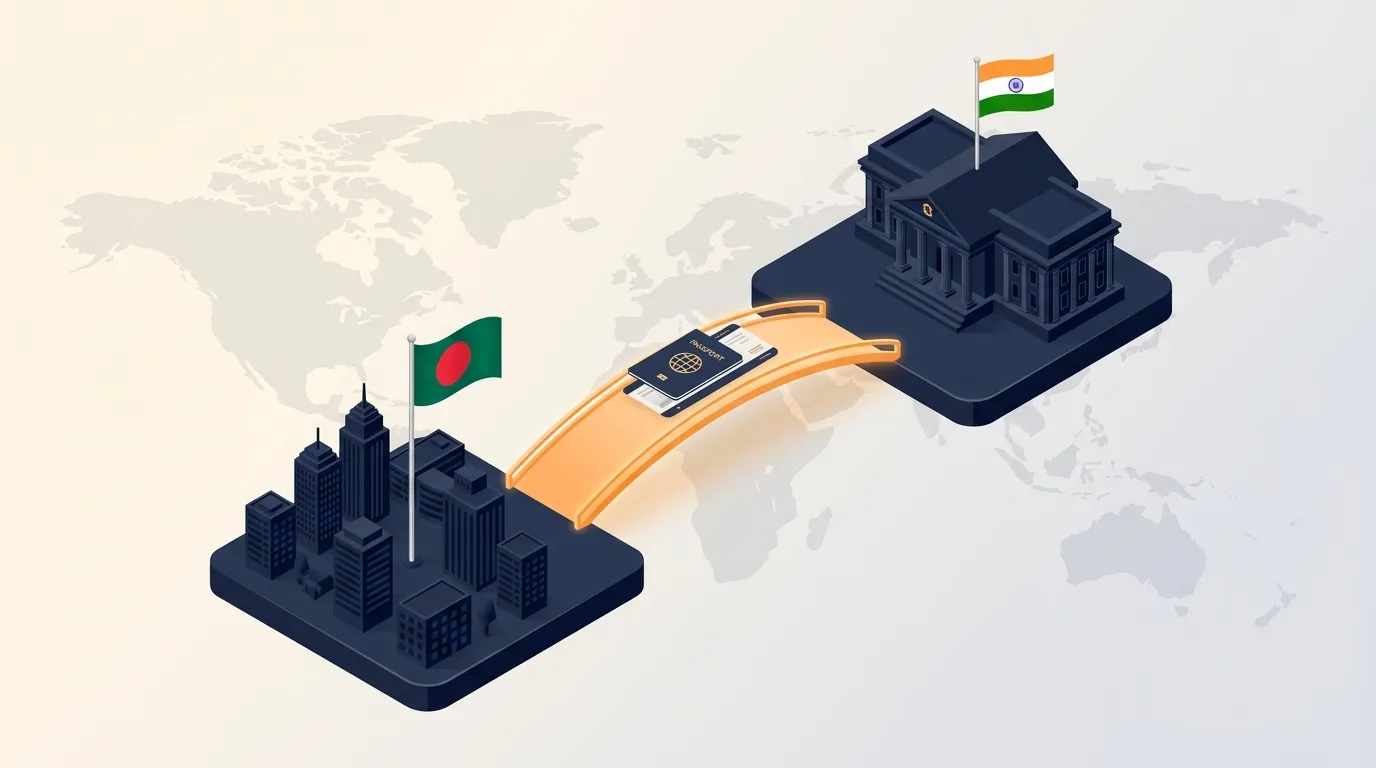
Company registration in India runs on the same statutory rail whoever the parent is, but the Bangladesh corridor carries its own FEMA reporting, treaty and banking wrinkles. Here is the process, cost and timeline that actually holds in 2026.
## Why the Bangladesh to India Corridor Starts With Policy, Not Paperwork
A Bangladeshi company looking at India in 2026 has an obvious commercial case. Dhaka's garment giants have the manufacturing depth to serve Indian brands directly, and Bangladeshi pharma firms, among the most capable in South Asia, see a large neighbouring market next door. What stops most founders in their tracks is not the commercial logic but a single Indian rule: Press Note 3. Because Bangladesh shares a long land border with India, any foreign direct investment from a Bangladeshi owner needs prior approval from the Government of India before it can proceed.
That places Bangladesh in the same policy category as every other land bordering country, and it changes the order of work. The usual sequence of pick an entity, gather documents, file and fund cannot run here, because no shares may be allotted to a Bangladeshi parent until the government has approved the investment. We plan for that land border screening from day one of the engagement rather than discovering it midway. Press Note 3 is the frame around this entire corridor, and this guide is written in that order.
We approach this from the Indian side of the table, describing how these files actually move. The commercial story of garments and pharma expanding into India is real, but it has to be built on top of an approval, not in front of one. Our [foreign subsidiary setup service](/services/foreign-subsidiary.html) treats the approval as the first milestone and the incorporation as the second.
## Press Note 3: The Rule That Shapes This Corridor
India rewrote its foreign direct investment policy in April 2020 through the measure known as Press Note 3. It requires that any investment from an entity of a country sharing a land border with India, or beneficially owned by someone in such a country, receive prior Government of India approval. Bangladesh is one of those countries, so the requirement applies to Bangladeshi investors as a matter of policy, not case selection.
The rule is written around beneficial ownership. It is not enough to look at the immediate shareholder; the government traces control up to the ultimate owner. A structure that puts a non border holding company on top of Bangladeshi money does not change the answer. Approval is needed whatever the sector, and whatever the activity would have been under the automatic route, and there is no deemed approval if the authorities stay silent.
The application goes through the Foreign Investment Facilitation Portal, known as the FIFP, which passes it to the administrative ministry that owns the relevant sector, with Ministry of Home Affairs clearance built into the process. These decisions are made case by case and typically take months. The reviewers ask about ownership, funding and intent. Our first job is to set an honest expectation: the timeline belongs to the government, and no commercial deadline can compress it.
## The Approval Application, What It Takes
The spine of the application is an ownership chart drawn all the way to the ultimate beneficial owner. Every layer between the proposed Indian company and that owner has to be shown, with shareholdings and any special control rights spelled out. For a Bangladeshi group with family or cross holding structures, getting this chart clean and consistent is often the most demanding part of the preparation.
Alongside it sits a genuine business plan describing the Indian operation, a documented source of funds, and identity records for the beneficial owners. A garments manufacturer explaining a sourcing entity, or a pharma company describing a regulatory arm, needs the narrative in the file to match the commercial reality.
Founders should budget a multi month timeline for this phase and treat it as the project. Approvals on this route are selective and deliberately quiet: there is no ticket number to track and no fee that speeds a decision. What we can control is quality, a file that is complete and internally consistent, so that a government query can be answered and closed rather than reopening the review.
## Phase Two: Incorporation After Approval
Incorporation begins only after the approval is granted, because the Bangladeshi parent cannot receive an allotment of shares before then. With the approval secured, the standard company law steps proceed in sequence:
- Digital Signature Certificates for the proposed directors, obtained remotely by video verification.
- Name reservation through SPICe plus Part A at the Ministry of Corporate Affairs.
- The SPICe plus incorporation form, which also secures the company's PAN and TAN.
- Memorandum of Association and Articles of Association reflecting the approved shareholding.
- The Certificate of Incorporation, which brings the Indian subsidiary into legal existence.
On legalisation, Bangladesh has historically used the consular route, where the parent's documents are notarised, authenticated and then legalised through the Indian mission. Bangladesh acceded to the Hague Apostille Convention in 2025, so the active chain should be confirmed at engagement: depending on timing and document type, the file may run through apostille or through consular legalisation. Either way, the legalised documents must line up exactly with the ownership already disclosed in the approval application.
## The Resident Director Rule
Every Indian private limited company must have at least one director who satisfies the residency test for the preceding year. A Bangladeshi parent without existing Indian operations covers this with a nominee resident director, engaged only to meet the statutory requirement. That nominee holds no shares, takes no commercial decisions and works under an agreement that keeps the role strictly formal. The Bangladeshi parent retains full control through its own directors and its ownership of the company. The residency appointment is standard practice and never the difficult part of this corridor; the approval that precedes any allotment is.
## Banking, Capital and FC-GPR
With the company incorporated, the Bangladeshi parent sends share capital by SWIFT into the subsidiary's Indian bank account. The bank issues a Foreign Inward Remittance Certificate, the FIRC, as proof the funds came in as investment. Only after the Press Note 3 approval is in place are shares allotted, and Form FC-GPR is then filed with the Reserve Bank within 30 days of that allotment. The order is fixed and it is not negotiable: approval first, then the money and the allotment, then the reporting.
Banks apply heightened KYC to land border corridors like this one, so expect close scrutiny of beneficial ownership, the source of funds and the approval documentation before an account is live. Our [FEMA compliance](/services/fema-compliances.html) team manages the FIRC, valuation and FC-GPR steps so the filings track the approval instead of contradicting it.
## Taxes on the Bangladesh Corridor
When the subsidiary is operating, its tax profile is ordinary. Indian corporate tax is charged at 25 percent under the standard regime, or 22 percent under the concessional regime where the conditions are met, and GST applies at 18 percent on most services. Under the India Bangladesh Double Taxation Avoidance Agreement, dividends to the parent are withheld at 10 percent where the parent is a company holding at least 10 percent of the capital, and at 15 percent otherwise, subject to the usual tax residency certificate, Form 10F and beneficial ownership conditions.
Cross charges between the parent and the Indian company, whether for services, licensing or shared costs, fall under transfer pricing rules with Form 3CEB reporting, which is where our [transfer pricing advisory](/services/transfer-pricing-advisory.html) work sits. For moving profits back to Dhaka, the routes and their tax treatment are laid out in our guide to [repatriation of profits from India](/insights/repatriation-of-profits-from-india-to-a-foreign-parent-the-2026-strategic-guide). The recurring monthly and annual compliance, including the FLA return, is the work our [virtual CFO service](/services/ecfo.html) is designed to carry.
## Structures That Do Not Work
We are often asked to help route around the approval, and we say no. Passing the investment through Singapore, Mauritius, the UAE or any third country does not defeat Press Note 3, because the screening follows beneficial ownership rather than the last entity on the paperwork. If the owner is Bangladeshi, the approval requirement stays attached to the money wherever it travels.
Nominee disguises, where someone from outside the border list fronts for the real Bangladeshi owner, are a direct FEMA violation from the first remittance. They fail the moment a bank, an auditor or a future investor looks closely, and the penalties dwarf the delay they were meant to sidestep. We will not construct these arrangements and we advise clients firmly against them. A properly prepared approval application is the only route that survives scrutiny.
## Timeline and Fees
The truthful position is that the approval phase is the timeline. It runs for months, the government sets its pace, and it is what a Bangladeshi founder should plan the whole project around. Once approval is granted, incorporation is comparatively fast, usually 30 to 45 days from clean documents to the Certificate of Incorporation, with banking and the first FEMA filings following.
We quote a fixed fee before signing for incorporation, the nominee director, banking support and the initial FEMA reporting. The Press Note 3 approval work is scoped and priced separately, because its effort depends on the ownership structure and the sector, and folding it into a single vague number would hide the part that carries the risk. There is no hourly billing and no surprise charge for a filing that was always required.
## Why Bangladeshi Companies Pick Krystal7
Bangladeshi companies expanding into India want advisors who name the approval problem at the start and then handle it end to end. We bring over 10 years of cross border practice, more than 10,000 startups and founders advised across India and five continents. Our work is led by Chartered Accountants, we reply to first inquiries within 4 business hours, and we quote fixed fees before any engagement starts. On the Bangladesh corridor the first thing worth paying for is a clear judgment on whether approval is achievable, how long it may run, and what the ownership facts will require.
Most parents land on the wholly owned route; the [wholly owned subsidiary in India guide](/insights/wholly-owned-subsidiary-in-india) explains why, and the [fixed fee registration service](/services/foreign-subsidiary.html) covers scope and pricing.
## Frequently Asked Questions
### Does a Bangladeshi investor need government approval to invest in India
Yes. Bangladesh shares a land border with India, so Press Note 3 applies and prior Government of India approval is required before any shares are allotted to a Bangladeshi parent. This holds across every sector and overrides the automatic route.
### How long does Press Note 3 approval take
Expect several months. The proposal is reviewed case by case through the FIFP portal, the relevant administrative ministry and Ministry of Home Affairs clearance, with no published timeline and no deemed approval. Incorporation waits until approval is granted.
### Does routing through a third country avoid the approval
No. The test is beneficial ownership, not the location of the immediate shareholder. If the ultimate owner is Bangladeshi, the approval requirement remains even if the money passes through Singapore, Mauritius or the UAE. Nominee disguises also breach FEMA, and we decline such work.
### Can a Bangladeshi company own 100 percent of the Indian subsidiary once approved
Generally yes. In sectors that allow full foreign ownership, a Bangladeshi parent can hold 100 percent of the Indian company after the Press Note 3 approval is in place. The approval governs consent to invest, not the size of the permitted stake.
### What is the dividend withholding rate under the India Bangladesh treaty
Dividends are withheld at 10 percent where the Bangladeshi parent is a company holding at least 10 percent of the capital, and at 15 percent otherwise, under the India Bangladesh Double Taxation Avoidance Agreement, subject to the tax residency certificate, Form 10F and beneficial ownership conditions.
### Do we need to travel to India to incorporate
No. After approval, the incorporation is fully remote. Digital signatures are issued through video verification, legalised documents travel by courier, and all filings are electronic, so the Bangladeshi team can complete everything from Dhaka.
Frequently Asked Questions
Does a Bangladeshi investor need government approval to invest in India
How long does Press Note 3 approval take
Does routing through a third country avoid the approval
Can a Bangladeshi company own 100 percent of the Indian subsidiary once approved
What is the dividend withholding rate under the India Bangladesh treaty
Do we need to travel to India to incorporate
Facing this in your own entity?
Guides explain the rules. A conversation solves your specific case. Talk to a Krystal7 advisor about your India entry, FEMA, or compliance position.
Book a Discovery Call