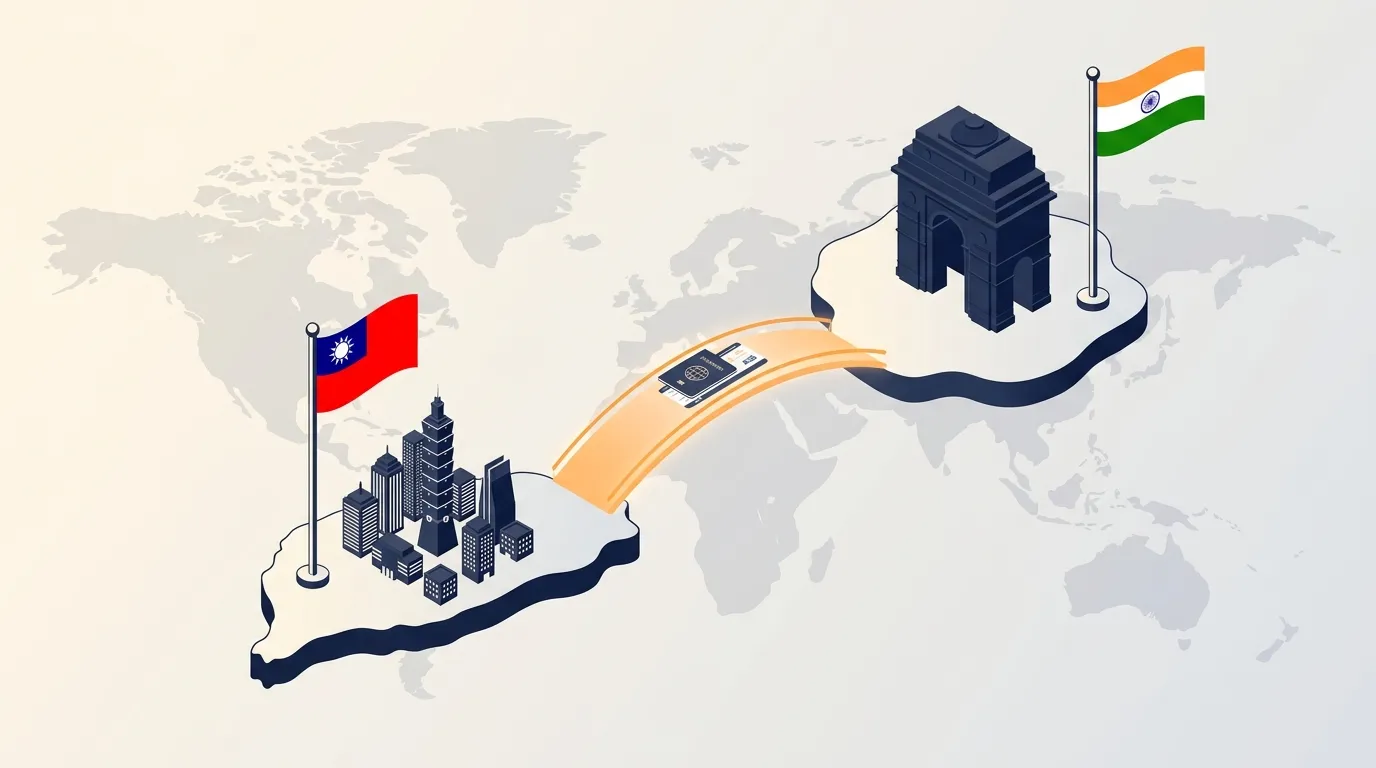
Company registration in India runs on the same statutory rail whoever the parent is, but the Taiwan corridor carries its own FEMA reporting, treaty and banking wrinkles. Here is the process, cost and timeline that actually holds in 2026.
## The Taiwan to India Corridor in 2026
Taiwanese electronics manufacturers are moving assembly and components to India at speed, and Foxconn's expansion made this corridor mainstream rather than niche. What used to be an occasional strategic move for a large contract manufacturer is now a regular board discussion for Taiwanese component makers, industrial electronics groups and consumer hardware companies that want an India presence for manufacturing, sourcing or domestic sales.
India's attraction is not hard to understand. It offers a large domestic market, a manufacturing policy environment that increasingly rewards local production, and a chance to diversify supply chains away from single geography dependence. For a Taiwanese parent looking at India in 2026, the commercial case may be obvious. The procedural case is where most delays happen, because Taiwan sits outside the Hague Apostille Convention for India purposes and the document chain is different from what European founders are used to.
This guide explains how a Taiwanese parent company can register a company in India from Taiwan: the preferred entity structure, the incorporation mechanics, the consular legalisation chain, banking and SWIFT remittance, the treaty position on dividends and royalties, and the compliance calendar once the entity is live. It is written for founders, CFOs and operations teams who need a working plan rather than a conceptual overview.
One practical point worth remembering from the start: Taiwan runs two and a half hours ahead of India, which makes cross border execution easier than many European corridors. Your Taiwan afternoon overlaps neatly with the Indian workday, and that helps when coordinating bank KYC, legalisation steps and company law filings.
## Entity Choice: Taiwanese Parent Co., Ltd., Indian Private Limited Subsidiary
For almost every Taiwanese group entering India, the clean structure is a wholly owned Indian private limited company with the Taiwanese parent company, typically a Co., Ltd., holding 100 percent of the shares. This gives the Indian operation its own legal personality, allows it to hire employees directly, open bank accounts, lease premises and sign contracts in India, while leaving strategic ownership and control with the Taiwan parent.
Alternative structures, such as a liaison office or branch office, are rarely right for a Taiwanese company that actually wants to manufacture, trade or build a long term operating presence. They are more restrictive and less flexible on both the regulatory and tax sides. A private limited subsidiary is the structure Indian counterparties and banks understand, and it is the one our [foreign subsidiary setup service](/services/foreign-subsidiary.html) is designed around.
## Step by Step Incorporation: DSC, Name Reservation, SPICe+, MoA
The Indian company formation steps themselves are familiar and mostly digital once the cross border documents are ready.
- Digital Signature Certificate for the proposed directors, issued for use on the MCA filing portal
- Name reservation through the MCA process
- SPICe+ filing for incorporation, PAN, TAN and related registrations
- Memorandum of Association and Articles of Association drafted to reflect the Taiwanese parent as sole subscriber
- Certificate of Incorporation issued by the Registrar of Companies
- Bank account opening and post incorporation registrations
The part that makes this corridor slower is not the Indian filing itself. It is the Taiwan document authentication chain that has to be completed before the incorporation pack is submission ready.
## Documents and the Legalisation Chain in Taiwan
Taiwan is outside the Hague Apostille Convention for India purposes, so apostille is not available here. Instead, the document chain runs through local notarisation, authentication at the Bureau of Consular Affairs, and then legalisation through the India Taipei Association.
That sequence matters. The relevant documents, typically the Taiwan parent's incorporation certificate, board resolutions authorising the Indian subsidiary, constitutional documents, and identity and address records for directors and authorised signatories, are first notarised locally in Taiwan. They are then authenticated at the Bureau of Consular Affairs. After that, they are legalised through the India Taipei Association so that Indian authorities will accept them in the incorporation file.
This is slower than an apostille corridor, but it works in practice and is a well understood path if the document set is built correctly from the start. The mistake we see most often is founders preparing Taiwan corporate documents in a form that is valid locally but not aligned with what the Indian registrar and bank actually need. The cure is simple: build the Taiwan document set to the India checklist, not the other way round.
## Resident Director Requirement
Indian company law requires every private limited company to have at least one director who has been resident in India for the statutory period in the preceding year. A Taiwanese parent with no existing India footprint typically satisfies this by appointing a nominee resident director.
The nominee resident director does not become the operating head of the business. The role exists to satisfy the legal requirement while the Taiwanese parent retains control through board appointments, shareholder rights and internal governance documents. This is a normal foreign subsidiary arrangement, not an exotic exception.
## Banking and Capital Remittance
Once the company is incorporated, capital is remitted from Taiwan to India by SWIFT transfer into the Indian subsidiary's bank account. In practice, routing through Singapore correspondent banks is standard in this corridor, and Indian banks are used to seeing that flow.
The receiving Indian bank issues a Foreign Inward Remittance Certificate, or FIRC, confirming the capital remittance. After shares are allotted to the Taiwanese parent, the subsidiary must file Form FC-GPR within 30 days of allotment under India's foreign exchange rules. That reporting chain is part of [FEMA compliance](/services/fema-compliances.html), and it needs to line up cleanly with the remittance, valuation and share allotment record from day one.
## Corridor Taxes: Treaty Position and Operating Taxes
The India Taiwan arrangement on direct taxes works through specified representative associations rather than a classic state to state treaty, but it functions in practice and is relied on by businesses operating in the corridor. Under this framework, dividend withholding is generally 12.5 percent and royalties are taxed at 10 percent, subject to the usual documentation and beneficial ownership requirements.
At the Indian operating company level, corporate tax applies at 25 percent under the standard regime or 22 percent under the newer concessional regime where conditions are satisfied. GST at 18 percent applies to most services and many operating transactions, and manufacturing businesses need to map their indirect tax position carefully from the first invoice.
Intercompany pricing matters early in this corridor because many Taiwanese parents supply designs, tooling, process know how or procurement support into the Indian entity. Those flows need to be benchmarked and documented properly, which is where our [transfer pricing advisory](/services/transfer-pricing-advisory.html) work comes in. And when the Indian business starts generating distributable profit, our guide on [repatriation of profits from India](/insights/repatriation-of-profits-from-india-to-a-foreign-parent-the-2026-strategic-guide) is the practical starting point for deciding whether dividend, royalty or service fee extraction makes the most sense.
## Ongoing Compliance Calendar
The recurring compliance calendar for a Taiwanese owned Indian subsidiary is the same basic one that applies to other foreign owned Indian companies.
- Annual FLA return by 15 July each year
- Registrar of Companies annual filings
- Monthly GST returns where applicable
- Monthly TDS compliance and related quarterly filings
- Statutory audit and annual income tax filing
This is the point where many founders underestimate the workload. Incorporation creates the company, but staying compliant keeps the corridor usable for future remittances, contract work and audits. Our [virtual CFO service](/services/ecfo.html) is usually the right support layer for Taiwanese parents that want regular reporting and a managed calendar without building a full local finance back office immediately.
## Local Reporting and Group Consolidation
The Indian subsidiary will keep local statutory books under Indian accounting standards and Indian company law requirements. The Taiwanese parent will typically want monthly or quarterly management reporting in a format aligned to group reporting, manufacturing controls and board level review.
If the parent runs multi jurisdiction operations, the Indian numbers need to map cleanly into the group chart of accounts, and any cross charges for procurement, engineering support or technology use need consistent treatment across local books and group reporting. This is easier to build from the start than to retrofit after the first audit cycle.
## Timeline and Fees
A realistic timeline for this corridor is usually a little slower than a Hague apostille market because the legalisation chain in Taiwan is longer. Once the Taiwan side documents are properly notarised, authenticated and legalised, the Indian incorporation itself can move quickly. In practical terms, many Taiwanese parents should budget around 30 to 45 days for the company formation process after the cross border document pack is ready, with extra time in the front end for the Taiwan legalisation sequence.
The company is usually revenue ready shortly after incorporation once the bank account is active, the share capital has arrived and the first foreign investment filings are completed. Fees should be quoted as a fixed scope before signing, covering incorporation, the first [FEMA compliance](/services/fema-compliances.html) cycle and the post incorporation setup rather than being left open ended.
## Why Taiwanese Companies Pick Krystal7
Taiwanese companies entering India need execution support that is practical, bilingual in business logic if not always in language, and honest about where the delay risk sits. We bring over 10 years of cross border practice, more than 10,000 startups and founders advised across India and five continents. Our work is led by Chartered Accountants, we reply to first inquiries within 4 business hours, and we quote fixed fees before the engagement begins. That combination matters when the corridor depends on getting both the Taiwan legalisation chain and the Indian foreign investment filing sequence right the first time.
The [wholly owned subsidiary in India guide](/insights/wholly-owned-subsidiary-in-india) covers the structure most parents pick, and the [registration service page](/services/foreign-subsidiary.html) shows the fixed fee.
## Frequently Asked Questions
### Can a Taiwanese company own 100 percent of an Indian subsidiary
Yes. A Taiwanese parent company can generally own 100 percent of an Indian private limited subsidiary in sectors that fall under India's automatic route, subject to the usual sector specific restrictions.
### How long does it take to register an Indian company from Taiwan
The Indian incorporation step can move on a normal timeline, but the full process is often slower than a Hague apostille corridor because the Taiwan document chain requires notarisation, Bureau of Consular Affairs authentication and legalisation through the India Taipei Association before filing.
### Which documents need legalisation in Taiwan
The Taiwan parent's incorporation certificate, board resolutions, constitutional documents and director and authorised signatory identity records typically need local notarisation, authentication at the Bureau of Consular Affairs and legalisation through the India Taipei Association for use in India.
### What is the dividend withholding rate on payments from India to Taiwan
Under the applicable India Taiwan tax arrangement, dividends are generally subject to 12.5 percent withholding and royalties to 10 percent, subject to the relevant documentation and beneficial ownership requirements.
### Do I need to travel to India to incorporate
No. The process can usually be handled remotely if the Taiwan documents are correctly notarised, authenticated and legalised, and the Indian resident director requirement is covered through the structure.
### What does it cost to set up an Indian subsidiary from Taiwan
Costs depend on the legalisation workload, sector and post incorporation scope, but the right approach is a fixed fee agreed before signing, covering incorporation, first stage FEMA reporting and the immediate compliance setup.
Frequently Asked Questions
Can a Taiwanese company own 100 percent of an Indian subsidiary
How long does it take to register an Indian company from Taiwan
Which documents need legalisation in Taiwan
What is the dividend withholding rate on payments from India to Taiwan
Do I need to travel to India to incorporate
What does it cost to set up an Indian subsidiary from Taiwan
Facing this in your own entity?
Guides explain the rules. A conversation solves your specific case. Talk to a Krystal7 advisor about your India entry, FEMA, or compliance position.
Book a Discovery Call