SOUTH KOREA TO INDIA
Company Registration in India from South Korea: Process, Cost and Timeline (2026)
Planning an Indian company from South Korea? Decide whether the Korean business or an individual founder will own the shares. Prepare the parent records and proposed Indian activity before arranging the incorporation documents.
Country Guides

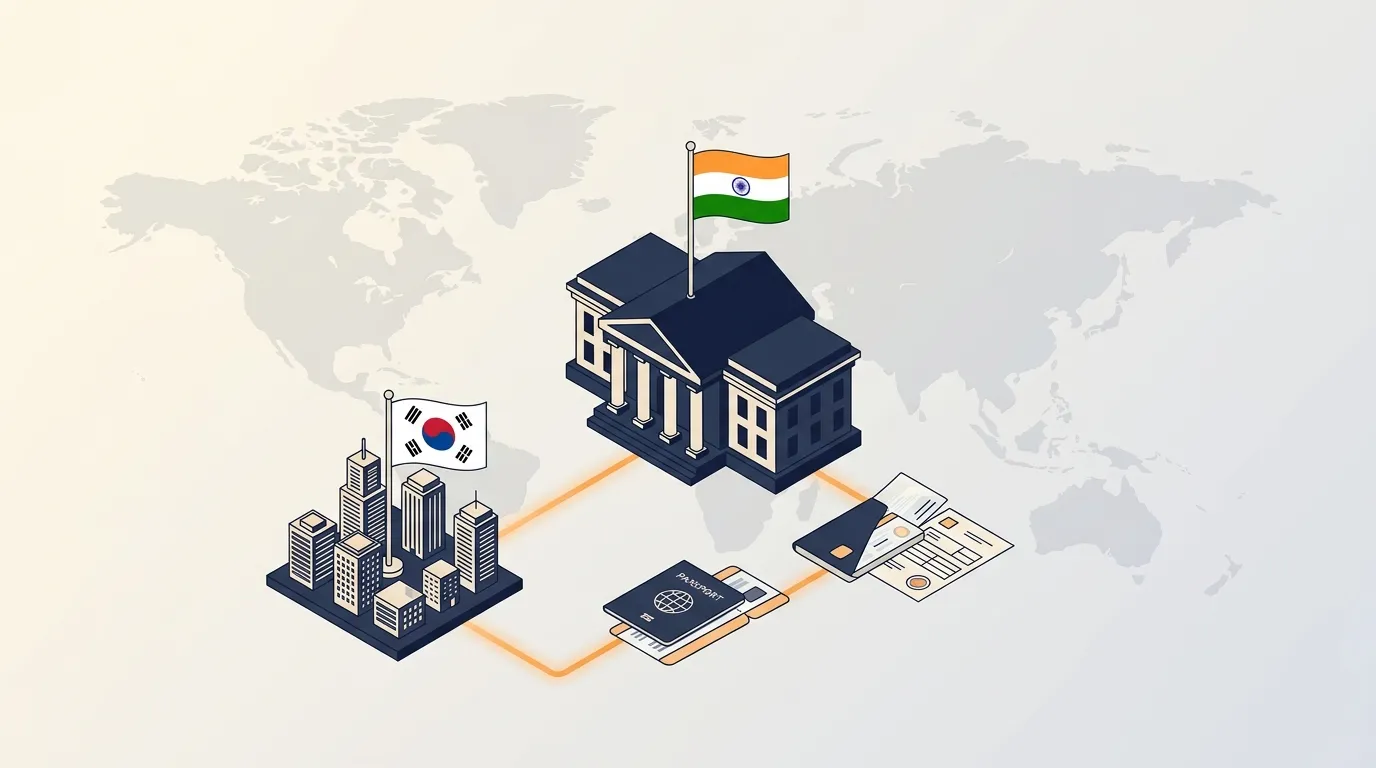
Planning an Indian company from South Korea? Decide whether the Korean business or an individual founder will own the shares. Prepare the parent records and proposed Indian activity before arranging the incorporation documents.
For a Korean parent, confirm the signatory's authority and the required translations before certification. Use the document, process and funding sections below to prepare your subsidiary registration enquiry.
Can You Register a Company in India from South Korea?
Yes. A South Korean parent can generally hold up to 100 percent of an Indian subsidiary through the automatic route in most sectors, including manufacturing, IT services and trading, without prior government approval. A small number of sectors carry sectoral caps or approval requirements, so it is worth checking the current FDI policy against your specific business activity before filing.
This is the same automatic route used by Japanese, German and Singaporean parents setting up in India, and it is the reason a Private Limited Company is the default structure for a Korean company subsidiary in India rather than a branch or liaison office.
Why South Korea Companies Are Building in India Now
What Usually Triggers the Move
Korean companies usually enter India with a specific commercial trigger. The trigger is usually one of three things: a global OEM customer, often in electronics or automotive, asking for local Indian production; production linked incentive schemes making Indian manufacturing commercially attractive; or a broader supply chain diversification strategy that reduces dependence on a single manufacturing base. Once one of these triggers exists, the question stops being whether to enter India and becomes how quickly a compliant entity can be stood up.
Choosing the Right Structure
Wholly Owned Subsidiary as the Default
For almost every Korean manufacturing or services entrant, a wholly owned subsidiary incorporated as a Private Limited Company is the right starting structure. It gives you a separate Indian legal person, limited liability for the Korean parent, the ability to hold Indian IP and contracts directly, and access to the automatic FDI route in most sectors. Setting up a foreign subsidiary in India this way also keeps GST registration, hiring and banking straightforward, since the entity is treated as a domestic Indian company for most operational purposes despite full Korean ownership.
Branch and Liaison Office Compared
A smaller number of Korean entrants use a branch or liaison office instead, usually because they want a toehold before committing capital to a subsidiary.
| Structure | FDI route | Typical approval | Best suited for |
|---|---|---|---|
| Private Limited subsidiary | Automatic route in most sectors | Registrar of Companies incorporation only | Manufacturing, trading, IT services, holding Indian IP |
| Branch office | Not FDI; FEMA branch office rules | Authorised dealer bank approval; RBI or government only in specified cases | Established Korean parent doing specific permitted activities |
| Liaison office | Not FDI; FEMA liaison office rules | Authorised dealer bank approval; RBI or government only in specified cases | Market research and representation, no revenue generation |
Under current regulations, a liaison office cannot invoice Indian customers or generate revenue, and a branch office is restricted to specific approved activities. Neither is a substitute for a subsidiary if the plan is genuine manufacturing or sales in India.
Personal Shareholding versus Corporate Parent
Personal investment and investment through a corporate parent produce different ownership records and document requirements. Choose the investor based on the operating plan, governance and future funding. An individual does not automatically lose all treaty relief because the investment is held personally. Eligibility depends on the treaty, residence, payment and applicable conditions.
Costs and Timeline for a Korean Parent
| Item | Where paid | Typical range |
|---|---|---|
| Notarisation, apostille and translations | South Korea | Corridor dependent, budget generously |
| Government incorporation and stamp fees | India | 5,000 to 15,000 rupees |
| Digital signatures for two directors | India | 4,000 to 6,000 rupees |
| Krystal7 Consultants' professional fee, foreign parent incorporation | India | USD 1,200 to USD 1,700 (about 1,15,000 to 1,63,000 rupees) |
| All in setup, most Korean parents | Both | USD 1,200 to USD 1,700 plus government fees, digital signatures and Korean legalisation |
| Timeline | Both | About 8 to 10 working days to incorporation, about four to five weeks to bank account and GST, plus apostille time |
How to Register a Company in India from South Korea
At a high level, the registration sequence runs as follows.
- Have the Korean parent's documents notarised in Korea and apostilled, along with identity and address proof for any Korean national directors.
- Obtain a digital signature certificate for each proposed director, generally including an India resident director.
- Reserve the proposed company name through the integrated incorporation service on the Ministry of Corporate Affairs portal.
- File the main incorporation form with the Korean parent's board resolution, subscriber details and identity documents attached. The same form allots a Director Identification Number to up to three directors.
- Secure a registered office address in India and use the linked forms to apply for GST, provident fund and employee insurance registration alongside incorporation.
- Receive the Certificate of Incorporation together with the company's PAN and TAN from the Registrar of Companies.
- Open a corporate bank account, remit the share capital from Korea, and file the RBI report for the share allotment.
SPICe+ With a Foreign Parent
SPICe+, the Simplified Proforma for Incorporating Company Electronically, is the single integrated form the Ministry of Corporate Affairs uses to cover name reservation, incorporation, PAN, TAN and statutory registrations together. When the subscriber is a Korean parent company rather than an individual, the filing needs the parent's board resolution authorising the subscription, an apostilled copy of the parent's certificate of incorporation, and identity documents for the individuals who will sign on the parent's behalf.
Documents and Legalisation
The Korean parent's documents need notarisation and an apostille before the Indian filing. The section on Korean parent documents below lists the competent authorities and the working set.
DIN for Foreign Directors
Every director of an Indian company needs a Director Identification Number. For a Korean national director, the application generally needs a passport copy, apostilled proof of address, and a photograph, all notarised or apostilled as current Ministry of Corporate Affairs rules require. Travel to India is not required for this step in most cases, since the process runs on documentary verification rather than in person appearance.
Resident Director and Registered Office
At least one director must have stayed in India for at least 182 days during the financial year. For a newly incorporated company, the requirement applies proportionately at the end of its first financial year. Nationality does not replace this residence test. A resident director has statutory duties even when the overseas parent retains ownership. See section 149 of the Companies Act.
Prepare the Indian registered office address, authority to use it and supporting evidence. Ownership of the office is not the same question as company ownership.
South Korea Specifics That Change the Playbook
The Manufacturing Wave: Electronics and Auto Components
A large share of recent Korea India manufacturing setup activity sits in electronics assembly and auto component supply, often following an existing Korean OEM customer that has already committed to Indian production. If your business fits this pattern, factor in not just company registration but also factory land, environmental clearances and customs registrations, since these run on separate timelines from the ROC filing.
Korean Parent Documents and the Apostille Chain
South Korea assigns apostille responsibility to different authorities by document category, including foreign affairs, justice and court administration. A public corporate record and a notarial act may follow different routes. Do not assume a chamber of commerce attestation replaces the required authentication for every document. Use the official South Korea authority directory to identify the competent office.
The working set can include the investor’s registration and governing documents, investment approval, signatory authority and director identity evidence. Agree the required forms and any translations before paying for certification.
Treaty Eligibility for the Proposed Payment
Check the treaty provisions and current domestic law for the proposed payment before remitting funds. Dividend, interest, royalty and service payments can have different treatment. Residence evidence alone does not establish every treaty condition. Review beneficial ownership, substance and any relevant limitation or anti abuse rule. Obtain a calculation for the actual recipient and payment rather than assuming a single corridor rate.
Money In, Money Out
Capital Remittance and FCGPR
Agree the investment route, valuation and bank evidence before sending capital. Record the receipt and issue dates separately. A remittance certificate evidences funds received; it does not itself classify the money as equity or a loan. For a reportable FDI equity issue, FC-GPR is due within 30 days of issue under the RBI reporting direction. Assign the reporting work before funding and retain the filed acknowledgement.
Korean Promoter Structures in FDI Filings
Korean parents most often hold the Indian company directly, with no intermediate holding company. Some groups do route through a Singapore or Hong Kong holding entity for broader group tax or commercial reasons unrelated to India specifically. Whichever structure you use, any charges between the Korean parent and the Indian subsidiary for management fees, royalties or shared services need supporting transfer pricing documentation, since these are related party transactions under current Indian tax rules.
Expats, Visas and the Korean Operating Model
Korean parents frequently start Indian operations with a rotating secondee from headquarters before hiring a full local leadership team. Short business trips generally run on a business visa, while anyone taking up an actual role in the Indian entity, drawing an Indian salary or working from an Indian office on an ongoing basis generally needs an employment visa and subsequent FRRO registration. Build this into your Indian HR plan early, since visa processing timelines run in parallel with, not faster than, company incorporation.
The Compliance Calendar After Day One
FCGPR, FLA and the FEMA Rhythm
Track each investment report from its own triggering event. Check whether the annual Foreign Liabilities and Assets return applies and verify the deadline for that year, including notified extensions. Keep the bank acknowledgements, share records and filed reports together.
ROC, GST and Payroll Basics
Beyond FEMA, the subsidiary carries the standard Indian compliance load: annual financial statements and returns filed with the Registrar of Companies, statutory audit, board meetings at prescribed intervals, GST registration and periodic GST returns once the business is trading, and monthly payroll compliance covering tax deduction at source, provident fund and employee insurance contributions for Indian staff.
What a Monthly Retainer Should Cover
A sensible monthly compliance retainer for a Korean subsidiary generally bundles bookkeeping, GST filing, payroll processing and TDS compliance, FEMA filing coordination, and board minute preparation into one predictable fee rather than a series of ad hoc invoices. When comparing quotes, check whether FEMA filings and transfer pricing documentation sit inside the retainer or bill separately, since those two lines are where cheap quotes claw back their discount.
Most parents land on the wholly owned route; the wholly owned subsidiary in India guide explains why, and the fixed fee registration service covers scope and pricing.
Frequently Asked Questions
Can a South Korean company own 100 percent of an Indian subsidiary?
Yes, in most sectors through the automatic route with no prior approval, including manufacturing, IT services and trading. The parent holds every share except one nominee share, and sector caps apply only in a minority of industries.
Can a Korean company open an Indian subsidiary without visiting India?
Much of the incorporation work can be coordinated remotely. Confirm the document execution, digital signature verification and bank KYC requirements for the actual people and documents. Some steps may need original documents or personal attendance. Agree those requirements before deciding whether travel is necessary.
Do Korean documents need an apostille for Indian incorporation?
Yes. South Korea is a party to the Apostille Convention, so public documents for an Indian filing are apostilled. Different Korean authorities issue apostilles by document category. Use the official South Korea authority directory to identify the competent office.
How long does it take to register an Indian company from South Korea?
Plan on about four to five weeks to a company with a bank account and GST, plus the time the Korean apostille chain takes. The Korean notarisation, apostille and translation chain is the pacing item; the Indian filing itself completes in days once documents are ready.
Are treaty benefits available on payments back to Korea?
Generally yes. The India Korea DTAA reduces withholding on dividends, royalties and technical service fees, conditional on beneficial ownership and a Korean tax residency certificate, and CEPA reduces tariffs on qualifying goods. Confirm the rate for each specific payment type before relying on it.
For the corridor neutral mechanics, structures and the full FEMA calendar, see the complete guide to foreign subsidiary registration in India.
NEXT STEP
Plan your India registration from South Korea
Review our incorporation scope and discuss the ownership structure, documents and support your Indian entity needs.
WRITTEN BY
Nihal Srivastava
Co-FounderNihal Srivastava is a co-founder of Krystal7. He leads client delivery and operations, working with foreign founders on India entry, business structuring and cross border compliance.
Filed under Country Guides · All corridors