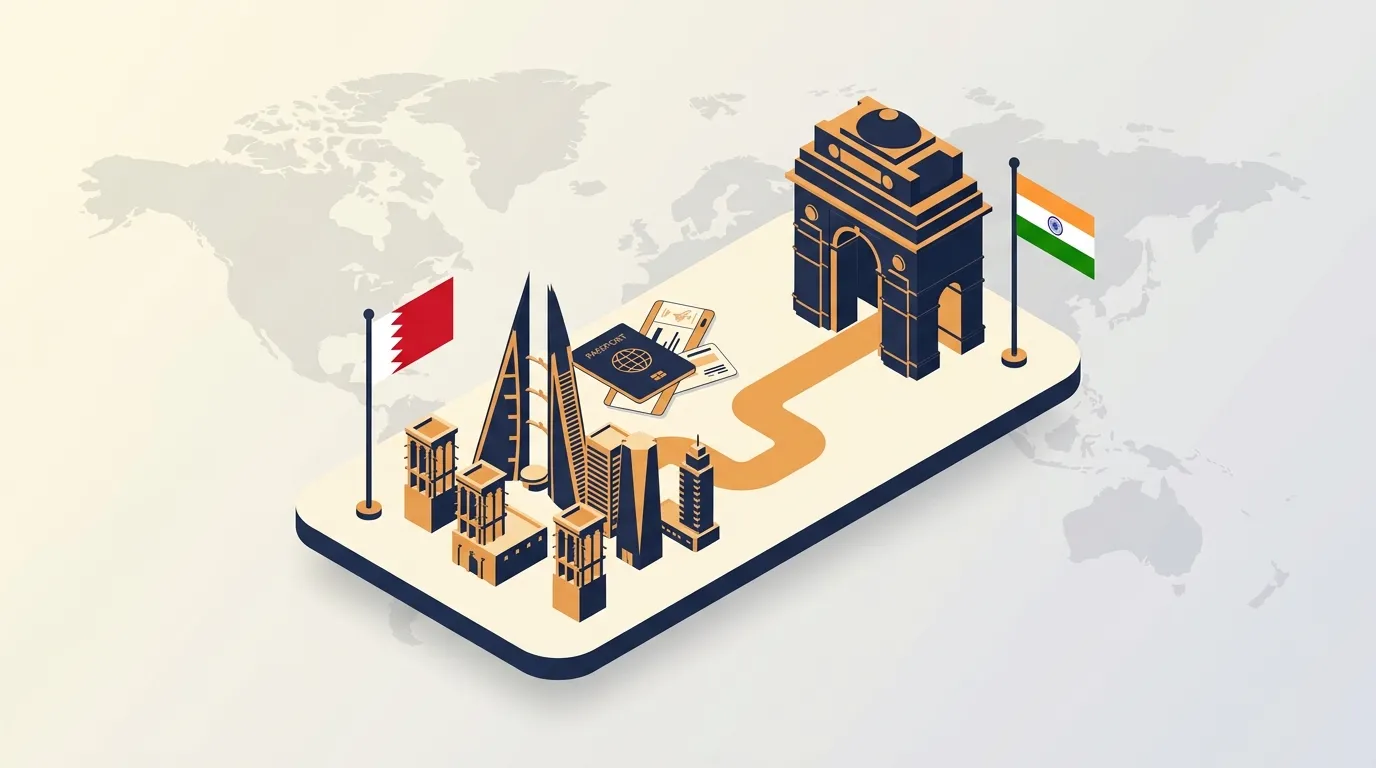
Company registration in India runs on the same statutory rail whoever the parent is, but the Bahrain corridor carries its own FEMA reporting, treaty and banking wrinkles. Here is the process, cost and timeline that actually holds in 2026.
## The Bahrain to India Corridor in 2026
Bahrain's fintech and banking hub status makes it the GCC base many funds use, and that has pulled more India entry conversations into Manama boardrooms than before. For some Bahrain based investors, India is a direct operating market. For others, it is the underlying commercial engine behind a broader Gulf investment thesis in technology, financial services, healthcare or consumer platforms.
This corridor, however, needs to be approached differently from a treaty first market. The most important point is not the incorporation form. It is the holding structure. Bahrain does not have a comprehensive double taxation avoidance agreement with India. That means the domestic Indian withholding regime, broadly 20 percent plus surcharge and cess, applies to dividends and royalties. If you leave structure as an afterthought, you can build an Indian subsidiary that is legally incorporated but tax inefficient from day one.
That is why, for many Bahrain based investors, the first conversation is not about company name reservation or the SPICe+ filing. It is about whether the parent should invest directly from Bahrain at all, or whether a UAE or Mauritius holding company with real commercial substance makes more sense before any Indian entity is formed. We model both before incorporation because the wrong choice at the top of the structure is much harder to undo once money is in.
This guide explains the India entry route for a Bahrain based parent in 2026: the subsidiary structure, the Bahrain legalisation chain, capital remittance and FIRC handling, the domestic withholding exposure, and the ongoing compliance calendar if you do proceed with a direct Bahrain to India structure.
## Entity Choice: Bahraini Parent WLL or BSC, Indian Private Limited Subsidiary
If a Bahrain based investor proceeds directly, the Indian operating vehicle is usually a private limited company with the Bahraini parent, whether a WLL or a BSC, holding the shares. The private limited company is the most familiar operating form under Indian company law and works for hiring, contracts, domestic revenue and local licensing.
The issue is not whether the Indian vehicle works. It does. The issue is whether the Bahraini parent is the right owner of that vehicle given the tax cost on future dividends and royalties. This is why the ownership discussion sits ahead of the incorporation discussion in this corridor. For direct setups that are still commercially justified, our [foreign subsidiary setup service](/services/foreign-subsidiary.html) can handle the India side cleanly. But we do not treat the direct Bahrain route as the default answer.
## Step by Step Incorporation: DSC, Name Reservation, SPICe+, MoA
Where the direct structure is approved after modelling, the Indian incorporation sequence itself is straightforward.
- Digital Signature Certificate for the proposed directors
- Name reservation through the MCA platform
- SPICe+ filing for incorporation, PAN, TAN and related registrations
- Memorandum of Association and Articles of Association showing the Bahraini parent as shareholder
- Certificate of Incorporation and post incorporation registrations
- Bank account opening, capital remittance and foreign investment reporting
The technical filing route is not the difficult part here. The structuring decision before the filing is the part that determines whether the result is worth keeping.
## Documents and the Legalisation Chain in Bahrain
Bahrain is not an apostille route for this process. The documents need to be notarised, authenticated at the Bahraini Ministry of Foreign Affairs, and then legalised at the Indian Embassy in Manama before they can be relied on in the Indian incorporation file.
That usually includes the parent company's registration and constitutional records, the authorising board or shareholder resolutions, and identity and address documents for directors, authorised signatories and beneficial owners. Those records also need to line up with whatever holding structure analysis has been done if the investor is considering a UAE or Mauritius parent above the India investment.
The practical point is simple: in this corridor, the Bahrain documentation exercise is not just for company law. It is part of the broader ownership and tax planning file.
## Resident Director Requirement
Indian company law requires every private limited company to have at least one director who has been resident in India for the statutory period in the preceding year. A Bahrain based parent with no Indian operating presence usually satisfies this through a nominee resident director.
This is routine and solvable. It is not the strategic issue. The strategic issue is whether the direct Bahrain parent structure makes sense at all given the absence of treaty relief on dividends and royalties.
## Banking, SWIFT Remittance and FIRC
Once the company is incorporated, and assuming the direct structure is still the chosen path, the Bahraini parent remits capital into India by SWIFT transfer. In practice, major Bahraini banks such as ABC and NBB route through correspondent channels for this corridor. Indian banks will want a clear ownership and source of funds file before processing the investment smoothly.
When the remittance lands, the Indian bank issues a Foreign Inward Remittance Certificate, or FIRC. After shares are allotted, the company must file Form FC-GPR within 30 days of allotment under the Indian foreign investment reporting rules. This is part of [FEMA compliance](/services/fema-compliances.html), and in this corridor it needs to be coordinated with the ownership model chosen at the structuring stage.
## No Comprehensive India Bahrain DTAA: Why Structure Comes First
This is the point that changes the entire corridor. There is no comprehensive India Bahrain double taxation avoidance agreement that gives you treaty relief on dividends and royalties in the way many other corridors do. As a result, domestic Indian withholding broadly applies, which means 20 percent plus surcharge and cess can apply to dividends and royalties paid from India to Bahrain.
That is expensive enough that many Bahrain based investors do not proceed directly once the numbers are modelled. Instead, they examine whether a UAE or Mauritius holding company with real substance, commercial rationale and defendable governance is a better route before the Indian investment is made. We model both before incorporation because this is not something to improvise after the Indian company exists.
The warning here needs to be plain. A Bahrain direct hold can still be commercially justified in some cases, especially where dividend extraction is not the primary objective or where the commercial simplicity outweighs the tax cost. But for many investors, the absence of treaty relief makes holding structure the first conversation, not the cleanup conversation. If there are management fees, licence charges or service arrangements across the group, they also need to be benchmarked and defended, which is where our [transfer pricing advisory](/services/transfer-pricing-advisory.html) support comes in. And if the investment proceeds, our guide on [repatriation of profits from India](/insights/repatriation-of-profits-from-india-to-a-foreign-parent-the-2026-strategic-guide) becomes essential reading before any cash is extracted.
## Ongoing Compliance Calendar
If the Bahrain route proceeds and the Indian company is incorporated, the recurring compliance calendar looks like that of any other foreign owned Indian subsidiary.
- Annual FLA return by 15 July each year
- Registrar of Companies annual filings
- Monthly GST compliance where applicable
- Monthly TDS compliance and related quarterly filings
- Statutory audit and annual income tax return
The difference is that the compliance file should stay aligned with the ownership and tax logic that justified the structure in the first place. That is especially true if the Bahrain parent is part of a wider Gulf holding stack. Our [virtual CFO service](/services/ecfo.html) is often the right support layer here because it keeps reporting, calendar control and remittance planning tied together rather than handled in isolation.
## Local Reporting and Group Oversight
The Indian subsidiary will keep its local books under Indian accounting and tax rules, while the Bahrain parent or its wider holding group will typically want management reporting aligned to investment committee reviews, treasury planning and any cross border service arrangements.
Where the structure includes a potential UAE or Mauritius holdco above the investment, the reporting discipline needs to reflect that reality from the start. It is far easier to build clean monthly reporting around the actual ownership plan than to reconstruct it later once distributions or intercompany flows begin.
## Timeline and Fees
If the direct Bahrain route is chosen, the Indian incorporation itself can move within a normal 30 to 45 day window once the legalised documents are ready. But that is not the timeline founders should focus on first. The real front end work is the ownership analysis: direct Bahrain, UAE holdco, Mauritius holdco, or a different route entirely. That is what determines whether the structure is commercially sensible.
Once that decision is made, the legalisation and Indian incorporation process becomes more mechanical. Fees should therefore be quoted in stages: structuring and modelling first, then incorporation, then remittance reporting and post incorporation compliance. A single blended number often hides the fact that the main value in this corridor is the structure decision, not just the filing work.
## Why Bahrain Based Investors Pick Krystal7
Bahrain based investors usually need an advisor who is willing to say that the direct route may not be the right one before incorporation starts. We bring over 10 years of cross border practice, more than 10,000 startups and founders advised across India and five continents. Our work is led by Chartered Accountants, we reply to first inquiries within 4 business hours, and we quote fixed fees before the engagement begins. That matters in a corridor where the most valuable advice is often the decision on holding structure before any Indian company is formed at all.
Most parents land on the wholly owned route; the [wholly owned subsidiary in India guide](/insights/wholly-owned-subsidiary-in-india) explains why, and the [fixed fee registration service](/services/foreign-subsidiary.html) covers scope and pricing.
## Frequently Asked Questions
### Can a Bahrain company own 100 percent of an Indian subsidiary
Yes. A Bahraini WLL or BSC can own 100 percent of an Indian private limited subsidiary in many sectors under India's automatic route. The real issue is whether Bahrain is the right holding jurisdiction for that ownership given the lack of treaty relief.
### How long does it take to register an Indian company from Bahrain
If the direct structure is chosen and the documents are legalised properly, the Indian incorporation itself can usually move within 30 to 45 days. The more important timing question is the front end structuring analysis, which should happen before incorporation.
### Which documents need legalisation in Bahrain
The parent company's registration and constitutional documents, authorising board or shareholder resolutions, and the identity records of directors, signatories and beneficial owners usually need notarisation in Bahrain, authentication at the Bahraini Ministry of Foreign Affairs, and legalisation at the Indian Embassy in Manama.
### What is the withholding tax position on dividends and royalties from India to Bahrain
Because there is no comprehensive India Bahrain treaty providing relief here, domestic Indian withholding broadly applies, which means 20 percent plus surcharge and cess can apply to dividends and royalties. That is why structure is the first conversation in this corridor.
### Do I need to travel to India to incorporate
No. The process can usually be handled remotely if the Bahrain documents are legalised correctly and the Indian resident director requirement is handled within the structure.
### What does it cost to set up an Indian subsidiary from Bahrain
Costs depend heavily on whether the investor proceeds directly from Bahrain or uses a different holding structure. The right fee model is staged and fixed, covering structuring first, then incorporation, then the first FEMA compliance cycle and immediate setup.
Frequently Asked Questions
Can a Bahrain company own 100 percent of an Indian subsidiary
How long does it take to register an Indian company from Bahrain
Which documents need legalisation in Bahrain
What is the withholding tax position on dividends and royalties from India to Bahrain
Do I need to travel to India to incorporate
What does it cost to set up an Indian subsidiary from Bahrain
Facing this in your own entity?
Guides explain the rules. A conversation solves your specific case. Talk to a Krystal7 advisor about your India entry, FEMA, or compliance position.
Book a Discovery Call