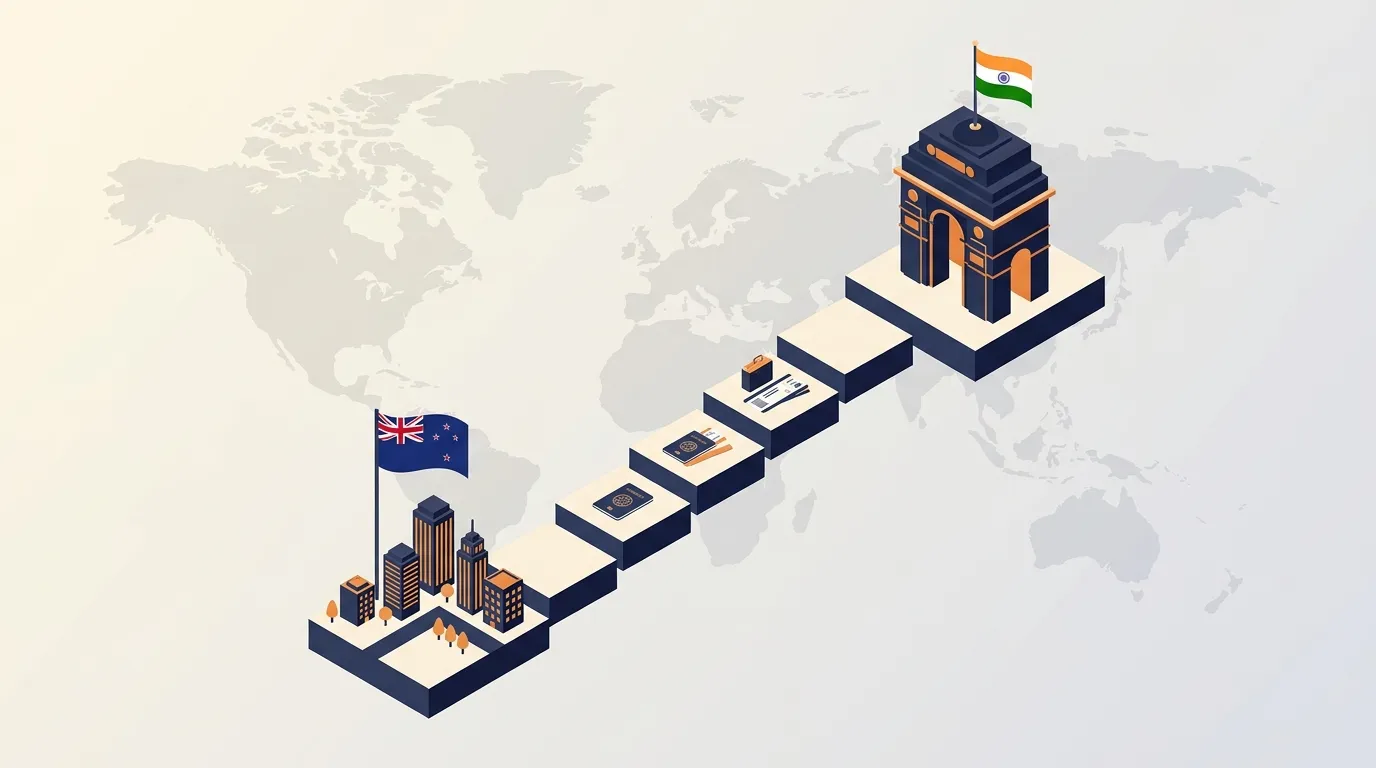
Company registration in India runs on the same statutory rail whoever the parent is, but the New Zealand corridor carries its own FEMA reporting, treaty and banking wrinkles. Here is the process, cost and timeline that actually holds in 2026.
## The New Zealand to India Corridor in 2026
New Zealand agritech, dairy tech and SaaS firms increasingly use India for both market access and engineering scale, and the time zone actually helps because your morning is India's midday. That single operational advantage matters more than many founders expect. A New Zealand management team can begin its day with live India decisions already moving, rather than waiting for the other side of the world to wake up.
The commercial logic is broader than time zones, of course. India offers a large domestic market for technology and services, a deep technical labour pool, and a manufacturing and operations base that many New Zealand companies can plug into without building an oversized local structure. For agritech and dairy adjacent businesses, India is both a customer market and a field testing ground. For SaaS founders, it is often the first serious engineering centre outside New Zealand.
This guide walks through what it actually takes in 2026 to register a company in India from New Zealand: the preferred entity structure, the incorporation steps, the e-apostille chain in New Zealand, banking and capital remittance, the India New Zealand tax treaty position, and the recurring compliance calendar that begins once the Indian entity is live.
One practical detail is worth stating early. New Zealand sits six and a half hours ahead of India in the New Zealand winter and seven and a half hours ahead in the New Zealand summer. That means your morning is India's midday, and your afternoon is often still usable for legal, finance and banking work in India. For founders used to dealing with Europe or the United States, this corridor often feels easier to execute.
## Entity Choice: New Zealand Limited Parent, Indian Private Limited Subsidiary
For most New Zealand companies, the standard structure is a wholly owned Indian private limited company with the New Zealand parent Limited company holding 100 percent of the shares. This gives the Indian operation its own legal identity, lets it hire, contract, invoice and hold assets in India, and preserves limited liability and governance clarity for the parent.
Alternative forms such as liaison offices or branch offices are available under Indian law, but they are usually not the best fit for a New Zealand company planning to operate commercially. A private limited subsidiary is the structure Indian customers, vendors, banks and regulators recognise immediately, and it is the one our [foreign subsidiary setup service](/services/foreign-subsidiary.html) is designed to implement efficiently.
The parent company form in New Zealand is rarely the issue. What matters is the quality of the authorising resolutions, the identity and address record for signatories and directors, and a clean ownership file that Indian regulators and banks can verify without repeated queries.
## Step by Step Incorporation: DSC, Name Reservation, SPICe+, MoA
Once the New Zealand side documents are ready, the Indian incorporation path is relatively straightforward.
- Digital Signature Certificate for the proposed directors
- Name reservation through the MCA process
- SPICe+ filing for incorporation, PAN, TAN and related registrations
- Memorandum of Association and Articles of Association reflecting the New Zealand parent as shareholder
- Certificate of Incorporation from the Registrar of Companies
- Bank account opening and post incorporation registrations
The Indian system has become much more integrated than it was a decade ago. Most timing slippage now comes from document preparation or banking, not from the company law filing portal itself.
## Documents and the E-Apostille Chain in New Zealand
New Zealand is a Hague Apostille corridor, and it has the further advantage of a modern e-apostille process through the Department of Internal Affairs. That makes the document authentication chain much cleaner than in markets that still require embassy legalisation.
The usual document set includes the New Zealand parent company's certificate of incorporation or company extract, board resolutions approving the Indian subsidiary, constitutional documents where needed, and identity and address records for directors and authorised signatories. Those documents are prepared and then e-apostilled through the Department of Internal Affairs so that Indian authorities can rely on them without any consular legalisation step.
The simplification is real, but it does not mean the document set can be casual. Indian banks and registrars still expect the resolutions and identity records to be drafted for Indian use, not simply copied from a domestic governance file in Auckland or Wellington. Getting the wording right at the start is faster than explaining a mismatch later.
## Resident Director Requirement
Indian company law requires every private limited company to have at least one director who has been resident in India for the statutory period in the preceding year. A New Zealand company entering India for the first time will usually satisfy this through a nominee resident director.
This is a routine feature of foreign subsidiary structures. The nominee director fulfils the legal requirement while the New Zealand parent retains ownership and strategic control through the board and shareholder rights. The presence of a nominee resident director does not change the economic ownership of the company.
## Banking, SWIFT Remittance and FIRC
Once the Indian company is incorporated and the bank account is open, the New Zealand parent remits capital to India by SWIFT transfer. In practice, ANZ and BNZ commonly route through correspondent banks for these transactions, and Indian banks are familiar with that corridor.
When the funds arrive, the Indian bank issues a Foreign Inward Remittance Certificate, or FIRC, confirming the receipt and purpose of the remittance. After the shares are allotted to the New Zealand parent, the company must file Form FC-GPR within 30 days of allotment. This reporting obligation sits within [FEMA compliance](/services/fema-compliances.html), and a clean first filing matters because every future remittance and capital event tends to lean on that original record.
## Corridor Taxes: Corporate Tax, GST and the India New Zealand Treaty
At the Indian operating level, the subsidiary is taxed as a domestic Indian company. Corporate tax generally applies at 25 percent under the standard regime or 22 percent under the concessional regime where the eligibility conditions are met. GST at 18 percent applies to most services and many operating supplies in India.
For remittances back to New Zealand, the India New Zealand treaty sets a 15 percent dividend withholding rate and a 10 percent royalty rate, subject to the usual treaty conditions and documentation. Those are workable rates, but they still require planning, especially if the parent expects to charge technology fees, management services or shared support functions into the Indian subsidiary.
That is where our [transfer pricing advisory](/services/transfer-pricing-advisory.html) support becomes relevant. If the Indian company is paying for technology, central support or group services, the pricing must be defendable. And if the parent expects to move cash back efficiently once the Indian company is profitable, our guide on [repatriation of profits from India](/insights/repatriation-of-profits-from-india-to-a-foreign-parent-the-2026-strategic-guide) is the practical starting point for choosing between dividend, royalty and other channels.
## Ongoing Compliance Calendar
Once the company exists, the recurring compliance calendar starts immediately and continues whether the entity is busy or quiet.
- Annual FLA return by 15 July each year
- Registrar of Companies annual filings
- Monthly GST compliance where applicable
- Monthly TDS compliance and related quarterly filings
- Statutory audit and annual income tax return
Most problems here are caused by underestimating how quickly deadlines begin to stack up. An Indian subsidiary is not difficult to keep compliant, but it does need an active owner of the calendar. Our [virtual CFO service](/services/ecfo.html) is often the right layer for New Zealand parents that want visibility, monthly reporting and calendar control without building a full local finance team immediately.
## Local Reporting and Group Consolidation
The Indian subsidiary will keep its statutory books under Indian accounting and tax rules, on the Indian financial year. The New Zealand parent will usually want regular management reporting aligned to group oversight, investor reporting or board review. The time zone advantage helps here because monthly close follow ups can often be dealt with within the same workday.
If the Indian entity carries engineering cost centres, shared support functions or intercompany service arrangements, those numbers need to tie back not just to local books but to group level reporting logic and any transfer pricing support. Building the reporting bridge from the first month is simpler than reconstructing it later.
## Timeline and Fees
Once the New Zealand documents are correctly prepared and e-apostilled, the Indian incorporation path can usually move within a normal 30 to 45 day window. The Indian entity is often revenue ready shortly after that, once the bank account is active, the capital remittance has landed and the first foreign investment reporting cycle has been completed.
The most common delays are not on the company law side. They come from incomplete document packs, slow banking responses or uncertainty over the first remittance and share allotment sequence. Planning those pieces in parallel keeps the timeline tight.
Fees should be quoted on a fixed basis before signing, covering incorporation, the first [FEMA compliance](/services/fema-compliances.html) cycle and the immediate post incorporation setup. That gives the New Zealand parent a clear entry budget rather than a rolling estimate.
## Why New Zealand Companies Pick Krystal7
New Zealand companies expanding into India usually want an advisor who can make the corridor feel operationally manageable rather than opaque. We bring over 10 years of cross border practice, more than 10,000 startups and founders advised across India and five continents. Our work is led by Chartered Accountants, we reply to first inquiries within 4 business hours, and we quote fixed fees before the engagement begins. That matters when the parent wants one team to coordinate the e-apostille chain, the Indian incorporation and the first year reporting setup without unnecessary friction.
For the structure most foreign parents choose, read the [wholly owned subsidiary in India guide](/insights/wholly-owned-subsidiary-in-india), or go straight to the [foreign subsidiary registration service](/services/foreign-subsidiary.html) for the fixed fee scope.
## Frequently Asked Questions
### Can a New Zealand company own 100 percent of an Indian subsidiary
Yes. In most sectors under India's automatic route, a New Zealand Limited company can own 100 percent of an Indian private limited subsidiary without a local shareholder.
### How long does it take to register an Indian company from New Zealand
Once the New Zealand documents are properly prepared and e-apostilled, the Indian incorporation process usually fits within a 30 to 45 day planning window, with additional time for banking and the first capital remittance sequence.
### Which documents need apostille in New Zealand
The New Zealand parent company's incorporation extract, board resolutions, constitutional documents where relevant, and director or signatory identity records typically need to be prepared for Indian use and e-apostilled through the Department of Internal Affairs.
### What is the dividend withholding rate under the India New Zealand treaty
Under the India New Zealand treaty, dividends are generally subject to 15 percent withholding and royalties are generally taxed at 10 percent, subject to treaty documentation and beneficial ownership requirements.
### Do I need to travel to India to incorporate
No. The process can usually be handled remotely if the New Zealand documents are prepared correctly and the Indian resident director requirement is dealt with inside the structure.
### What does it cost to set up an Indian subsidiary from New Zealand
Costs vary with scope and banking complexity, but the right structure is a fixed fee agreed before signing, covering incorporation, initial FEMA compliance work and the immediate setup after incorporation.
Frequently Asked Questions
Can a New Zealand company own 100 percent of an Indian subsidiary
How long does it take to register an Indian company from New Zealand
Which documents need apostille in New Zealand
What is the dividend withholding rate under the India New Zealand treaty
Do I need to travel to India to incorporate
What does it cost to set up an Indian subsidiary from New Zealand
Facing this in your own entity?
Guides explain the rules. A conversation solves your specific case. Talk to a Krystal7 advisor about your India entry, FEMA, or compliance position.
Book a Discovery Call